
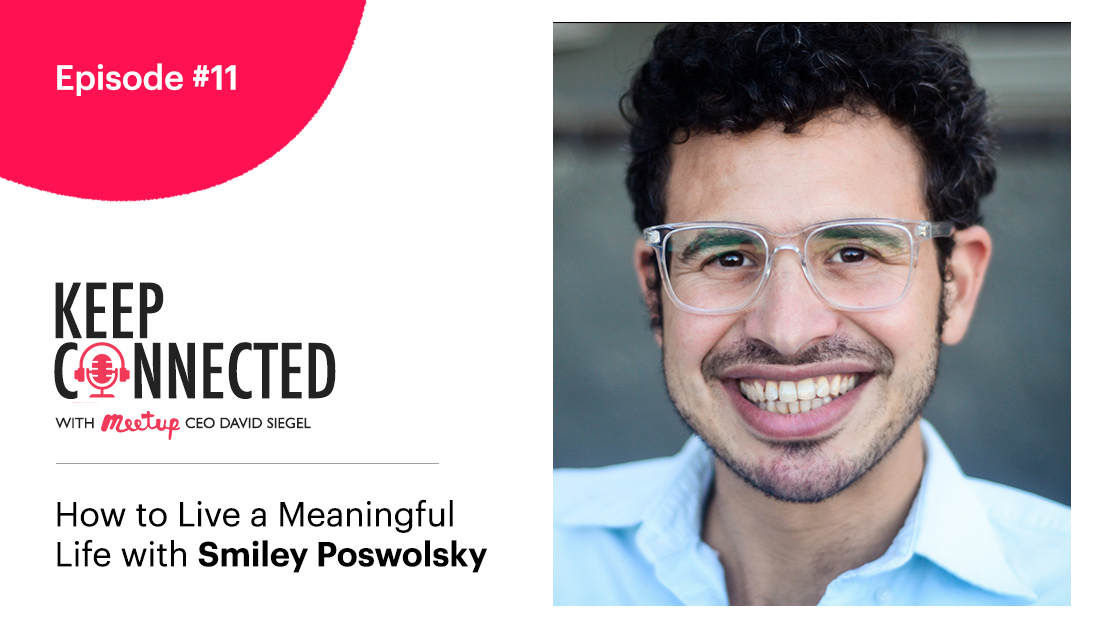


Adam Smiley Poswolsky has published three books, given countless speeches, and has a TED Talk with 1.5 million views. It’s safe to say that his message on finding meaning as a millennial is resonating. In this episode of Keep Connected, Smiley shares advice that’s useful for any generation. You’ll hear lessons from his new book, Friendship in the Age of Loneliness, as well as tips for finding work that works for you, speaking publicly, and making friends. Tune in for a major dose of positivity.
Ranked as one of the top 25 CEO podcasts on Feedspot, Keep Connected with Meetup CEO David Siegel is a podcast about the power of community. For more details on other episodes, visit Keep Connected on the Meetup Community Matters blog.
We hope you’ll keep connected with us. Drop us a line at podcast@meetup.com. If you like the podcast, be sure to subscribe and leave us a rating on Apple Podcasts!
Learn more about Keep Connected host David Siegel’s experience as a leader and decision maker in his book, Decide & Conquer. Pre-order your copy today!
How To Live A Meaningful Life: Show Notes
In this episode, we are talking to Smiley Poswolsky. He is a motivational speaker, author and Meetup champion. We are talking to someone who is Smiley on the inside and the outside. I hope you enjoy this episode.
—
Smiley Poswolsky, I am so glad that you are here and keep connected. Welcome.
Thank you so much for having me. It’s great to be here.
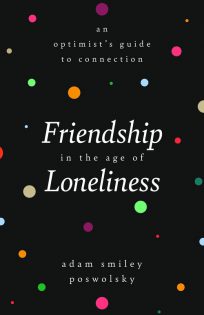
I’m reading about your background. The biggest risk is going to be we are going to run out of time very quickly. Let me tell all of our readers about Smiley Poswolsky. You are like the Millennial whisper. I don’t know if everyone has called you that but that’s going to be your new thing. Let me tell our readers why. He’s the author of a book called Friendship in the Age of Loneliness which is his third book. I watched this TED Talk on The Quarter-Life Crisis, which 1.5 million people watched that TED Talk. You are a camp counselor at Camp Grounded and the Founder of The Women BIPOC Speaker Initiative. You are also a very smiley guy. Clearly, I thought I was a smiley guy.
We need more smiley guys, smiley women and smiley humans in this world.
Let’s talk about Smiley. How did you get the nickname Smiley? That’s the first thing I want to know.
A lot of my close friends don’t even know my real name is Adam. They know it but they never use it. Some people that know me well don’t even know my name is Adam. I’ve got that nickname years ago. It started freshman year of high school. I wanted to play a sport. I went to a very big public high school in Cambridge, Massachusetts. Cambridge Ringe and Latin School with over 2,000 kids. I am a short, scrawny kid. I wasn’t going to play football. I would’ve gotten trampled. Our soccer team was one of the best teams in the state. I wasn’t going to make the soccer team. The only sport left was cross country, which for those of you who don’t know, is running. You go run for 3, 5, 10, even 15 miles on Sundays.
We just go running. I grew up in Cambridge, Boston area. It’s cold in the fall, winter, rainy and snowy sometimes. We are running hill workouts. I’m smiling up the hill, running and mind my own business, “This is great.” My coach is this Boston guy. He goes, “What are you doing, smiling kid? Stop smiling. Stop puking, kid. Why are you smiling?” My coach, who are two brothers, Jesse and Scott Cody, nickname me Smiley. The team started calling me Smiley. That transferred into the rest of high school. There were a couple of kids from my high school that ended up going to the same college as me, Wesleyan University and the name stuck.
You have an amazingly natural perma smile. If you have a serious conversation, your face is in a natural smile. That’s not easy sometimes.
It’s not easy, especially because even positive, happy people go through hard times. Sometimes, I show up. I’m having a rough day, going through something, grieving or something’s going on. People are like, “Smiley, you are not supposed to be smiling.” It’s a little annoying. People that know you well start to know that you have multitudes in are always a happy mascot. It becomes a challenge. Overall, there’s the science that proves that the more that you smile, you help other people smile.
We need more smiley humans in this world.
People think it’s for yawning that you might transfer a yawn but there’s no question that smiling. One of my favorite books out there that I have all my students read, I teach it at Columbia as well is Del Carnegie’s How to Win Friends and Influence People. He talks all about the importance of smiling. They always tell salespeople that when you are on a sales call, have a mirror in front of you and try to be smiling. Smiles are contagious. I believe that as weird as this sounds. I have been more successful in business and life because of smiling because of the positive vibe and energy that comes from it. You have been very successful in business and life. It’s a positive. It can be an albatross. It sounds like it as well.
There are people I remember when some public speaking coaches will say, “If you forget your speeches and you are on stage, get up there and start making eye contact and smiling with people or people be like, ‘That was great. That was amazing.’” It doesn’t matter what you say because people remember, “They were positive, high energy, smiled a lot.” You can’t fake that but if you are excited to see people and be there, people are going to remember that it’s going to make them feel good.
Speaking of speaking and different speaking that you have done, you did a TED Talk on the Quarter-Life Breakthrough, and you have also written a book about it. I enjoyed it. You’ve got 1.5-million people who viewed it, which I have mentioned earlier. Take us inside. When it started blowing up, were you surprised? Did you work hard to get people? How did it get to 1.5 million views? I want to know about that as well.
I will start with the key messages. I was going through my quarter-life crisis at the time. One of the reasons why the talk was successful was I was still not yet a professional public speaker. I had that energy of I’m going for it. I don’t know what I don’t know. I’m just putting myself out there and getting on stage and going to share my story. The authenticity comes through. Nowadays, I give talks at big companies and conferences. It’s the same but you are more polished. I was less polished. I had notes with me because I was worried, I was going to get on there and blank and forget my entire speech but a lot of people have reached out to me and said, “It felt like I was having a conversation with you, that you were just in my living room, that we were talking.” People resonated with that. I was going through it.
“Here are the lessons I learned on my journey.” People remember that. The biggest ones were to stop comparing yourself to others. Millennials, Gen Z, people that spend a lot of time on social media. We all spend a lot of time on social media but anyone trying to build a career in the current environment with our alliance on technology will resonate with the fact that it’s hard to figure out what you want without the influence of all your other friends are doing.
One of the things you said, “My friend just opened up a food truck. I should open up a food truck. My friend just got married. I should get married.” It’s just not right.
They are cool things. Friend going to business school, “I should go to business school. My friend is a social entrepreneur, I should become a social entrepreneur.” These are great things and cool options. Friends starting a nonprofit, “We need more nonprofits. That’s great.” It was much more of realizing, “This isn’t about everyone else. This is about figuring out why I’m here, what I’m looking for and what I’m good at? How I can align my unique gifts with the impact I’m trying to have?”
Another key one that I always bring up is to surround yourself with believers. Find people that believe in the beauty of your dreams because it’s very easy to tell people that you are looking to make a change, you are going to raise money to start a business, you want to do something different or you want to launch a creative project and they kind of roll their eyes and say, “You are talking about that a couple of months ago? You are never going to do it. Everyone’s doing a Kickstarter these days. Everyone is starting a Meetup group. Everyone is starting a substack. Everyone is writing a book. Everyone is trying to get a promotion. You are not going to do it.” The downers, haters, naysayers and finding the people that truly believe in your dreams and are going to support you, being your corner and being your circle that are going to hold you accountable.
They say, “Didn’t you say that you were going to write a book? Didn’t you say you were going to take a course and learn UX design? You said you were going to do that. When are you doing that?” They are going to hold you accountable for it. That was a big thing in my life. I didn’t have as many of those people. I had gone to this program called StartingBloc, which speaking of powerful communities. StartingBloc Institute for Social Innovation brings together a lot of professionals and young professionals that are interested in using businesses for good in supporting social entrepreneurship and social innovation. That was my first taste of real believers that were going to stand in your corner and support you on your way and connect you to the right people, take an interest in your work and try to help you gain contacts and reach out to people that could support you.
The power of positivity and the community you surround yourself with and the challenges of toxicity or negative emotions and negative people. How did that turn into 1.5 million? When it started growing, we were like, “What is happening? Give us a very quick skinny on that because I don’t talk to many people that have that kind of virality happen to their 53,000 likes. What happened?
It seldom happened. I remember when they called my name, I was in the bathroom. I was getting super nervous. I was told in the bathroom. They were like, “You’ve got to come out.” I did that at TEDxMileHigh, which is in Denver, Colorado at the Denver Opera House, which is this beautiful building. I felt like I was hosting the Oscars or something. Maybe that was part of it. I remember that it was the right moment. People say, “An idea whose time has come.” Everyone is looking for meaning and purpose in their work. The quarter-life crisis has been going on forever midlife crisis. This is not a new topic, a new idea but it was a time when people were starting to talk about this as it related to Millennials and careers and the search for meaningful work came out in 2015. It was just the right time.
A lot of people shared it that that knew me. As people started sharing it that I had never met before it got out there. It was also at the time when I think that TEDx Talks were having a little bit more momentum. There were fewer TEDx events than there are now so that may have helped. The message resonated. I always tell people when it comes to writing, speaking and storytelling, “Say what needs to be said. What’s on your chest, get it out there. If it may scare you, maybe intimidates you, that’s a sign that it needs to be out there.”
Even if other people could be uncomfortable or you could be uncomfortable. That’s possibly a sign that you should be talking about it. Let’s talk about that a little more. You have spoken probably dozens, hundreds of times. What advice would you give to people? People will say that the thing they were most afraid of is public speaking. They were second-most afraid of is probably death. Public speaking ranks higher and fear than death. It’s clearly a major issue for people when it comes to even community and community building. Oftentimes, community leaders need to be comfortable public speaking. In addition to saying what needs to be said, smile, as you said, look, people in the eye, what other advice do you have for people around public speaking?
Even positive, happy people go through hard times.
There are several. I love the Jerry Seinfeld line. He always says that, “At a funeral, people would rather be in the casket than giving the eulogy,” which shows you intimidated people are by public speaking. One of the most practical things is to practice. We assume that people that are, “They were not intimidated by public speaking.” Yes. I am. Believe me. I do it as a living and I still am very nervous. I get the jitters when I get up on stage but I have done likely that talk 100, 200, 300 times or a version of it. I know where I’m going, what’s going to be happening, I know that certain jokes work, I know that people resonate with certain stories.
You still get the jitters, though.
If I’m in a big room and there’s a Jumbotron and people are like, “I hope this guy doesn’t suck.” It’s still scary. Definitely practice, I also think connecting it to a higher purpose or trying to inspire and create a call to action. A lot of times, people forget. They were just getting up there and they were like, “Let me tell you about how great I am. Let me tell you about my startup or my company.” What is the why? What is the higher purpose? What is the impact you were trying to have? What will people do if they come on stage with you and follow you and join your movement, join your call to action? That’s what gets people fired up.
When I speak, one of my priorities is very practical takeaways and it has to be about the listeners. What motivation can they have and how can I serve a noble cause. People talk about themselves. No one wants to hear about that necessarily. They want to hear about how that could help someone else.
The practical piece is great too. If you can combine the storytelling aspect because people connect with the story. They don’t want just to see data, statistics or 55 slides. If you can combine the story and the practical takeaways, then you are going to be in great shape.
Tell me about your third book, Friendship in the Age of Loneliness.
This book was born several years ago. It’s very relevant obviously in the context of the pandemic and the last year of social isolation and lockdown. I started writing this book in 2017. The early draft and the early stories came out of the experience of losing one of my best friends. One of my best friends died at the age of 32 from brain cancer. He was a special man named Levi Felix. He started this incredible community called Camp Grounded. A tech-free summer camp for adults. He was one of the pioneering leaders, philosophers in the digital detox space, getting people to realize how addicted we are to technology and the importance of detox, balance and building mindful relationships with our devices. We started this thing called Camp Grounded where we would take several hundred people into the redwoods for four days, take away their cell phones, take away their computers, Apple watches, no technology and people would just get to connect authentically for four days.
You couldn’t use your real name. You couldn’t talk about what you do or where you work. You weren’t allowed to talk about work, no drugs or alcohol, no talking about age, no bios. It was about to play authenticity connection. It changed my life and the lives of hundreds of people. We ended up doing nearly 15 or 16 camps, several in California, North Carolina. It was an incredible movement. It wasn’t just losing a friend. Losing a friend is hard. It was losing someone that changed my life and made me rethink the importance of community and friendship in my life. That’s where the book was born. As I started writing more and more, I realized this isn’t just about play and community. Those are important. We are living through an epidemic of loneliness. The data is alarming before COVID. Nearly 2/3 of Americans are lonely, 80% of Gen Z, those are people that are right under the age of twenty or so. Seventy percent of Millennials experienced loneliness.
It has gone up. Mental illness is massively exacerbated during this time.
I read a study that was published in the New York Times. That was saying, “Nearly 1 in 2 young people, ages 18 to 24 are experiencing what would be considered a ‘Mental Health Clinical Disorder’ during the pandemic.” This has been documented with skyrocketing rates of teen anxiety and depression, even suicide. It’s real stuff. It’s alarming. I believe that many things come into play here of how we can approach the issue of loneliness and social isolation. One that doesn’t get talked about as much is friendship, deepening our relationships and remembering that technology is important. It connects us and brings us together but remembering how crucial it is to go deeper and build meaningful, authentic relationships with people so that we are using the technology as tools to create a meaningful connection. Not just hurt something or give a thumbs up but remembering, these relationships are going to lead to healthy and happy lives. Science shows that people live longer and have the healthiest lives it’s because they have healthy relationships.
The challenge for younger people, Millennials specifically, is that social media is the foundation and the infrastructure of the vast majority of their friendships. That’s how they connect. If I connected through our phone, the phone wasn’t that necessary that infrastructure in the same way that social media is. How do Millennials deepen friendships in the absence of the world that they live in nowadays? Is it leveraged social media fully or try to avoid social media? What’s the answer?
I believe it’s a balance. One of the things that surprised me in my research, first of all, the amount of time that young people are spending on social media is alarming and astronomical. That has to be part of the conversation. People are spending 50 minutes a day on Instagram and Facebook. TikTok is being used by young people, teenagers. It’s alarming just too much, 3, 4, 5 hours a day. The Pew Research Center said that 18-to 29-year old’s use the internet almost constantly which is frightening, not just a lot a couple of hours a day. It’s like the whole day.
Does the answer use the internet positively or avoidance?
I think it’s a balance. I don’t think it’s practical to say to anyone that lives in an urban environment as part of society that they should avoid the internet or avoid social media entirely. That’s not fair to a young person to say they are going to miss out on stuff. They probably aren’t going to do great in school. That’s not okay. It needs to be a balance. There are a couple of sides to the coin. The tech companies need to be able to say, kick people off the platform or not get them addicted in which they are doing and they are building technology that’s addictive but also we need to say, “Remember the power of the in-person. Remember the power of going offline,” even using the apps or the connection. Meetup is a great example. There’s a tool that says, “We are connecting online.”
Do something with these people. We couldn’t do that in person but even having the virtual connections and facilitating those in-person relationships, encouraging people to go deeper, to find connection, find common bonds, work on projects together, learn together, that’s the sweet spot there. I came across a lot of people in my research that said, for some people, technology is important to building those connections. I profile a woman in my book who had chronic Lyme disease. She was able to find this connection of support from an Instagram hashtag that led her to Facebook and Instagram support groups all around finding solutions to her sickness and illness that she couldn’t find from her doctor. She has built a healthy, happy life because of the connections on social media and technology. It’s not a simple thing to say, “No technology, no social media.” On the flip side, if people are just on their phone or playing video games and not building social relationships, that’s not healthy, either.
It makes me think that social media, the primary outcome is comparing yourself to others is incredibly dangerous. Social media facilitates real connections. For example, my daughter was thirteen. A lot of tweens use house parties. That’s just a forum, almost like a Zoom where people are talking to each other, jumping in and out and having conversations like the one at a cocktail party. That’s quite wonderful. There’s this comparison that gets a lot more dangerous because it results in jealousy, results in feelings of inferiority and anxiety, etc., that becomes more problematic. At Meetup, we always say, “We use technology to get people off of technology.”
That’s actually what the science shows too. There’s research that was done by John Cacioppo who is one of the leading pioneers and scholars on loneliness that social media and technology is used as the waystation to find directions, to get offline. A great example is Camp Grounded. A lot of people found out about Camp Grounded, which is a digital detox on Facebook and Instagram, which is the most ironic thing.
They are the ones that might need it the most.
Where are they? They are spending tons and tons of time scrolling on social media. The thing helps them go offline. These people have a transformational experience, then technology is being used. It has been shown to have a positive impact on people’s lives, a positive impact on their emotions. If it’s the endpoint, not the waste station, not the place where you find directions but just the place where you are in a hamster wheel that goes on forever, the endless scroll, then it has a very adverse effect on people’s mental health.
That’s a great differentiation, whether it’s an end in itself or more of a means to an end. You mentioned Meetup in the book and I can’t wait to read it. Thank you for doing it. Have you participated or you know people who have participated in Meetup events as well?
I love Meetup. I have been a follower for many years. I have gone to Designers + Geeks Meetup events and to a bunch of my friends that have given talks there. I’m always a fan of tools that are allowing people to initiate their ideas, to share their creativity and say, “I’m going to start this. I want to build a connection around this. I want to build a community around this.” To find other like-minded people and to get out there. I think Meetup is an incredible service that does that.
The amount of time that young people are spending on social media is alarming and astronomical.
Thank you for helping to support it as well. We talked about speaking and how much speaking that you do. How many times do you think you have publicly spoken?
Formally, probably 500 to 1,000.
You bring that same energy every single time. I suppose you feed off of your audience when you are speaking. You started something well which I want to spend a little time talking about because I think it’s important in the world we live in nowadays which is The Women BIPOC Speaker Initiative. Tell our readers a little bit more about it. Tell us about why you felt it was so important and some of the things that you do. It’s a great example of you have this strong capability and experience and you are able to help so many people with it that that truly are underprivileged or need help. How did that start and walk us through that journey?
As I started to build up my speaking business, which takes some time, I started speaking probably in 2014, 2015. You get on the speaker circuit, going to these conferences, speaking at companies. I started to realize that there’s a good percentage of these people who look like me. They are older versions of me. In other words, they are older white men but they are generally white men. This is not something new. This is common in not just public speaking but in venture capital, tech and boards. It’s a big issue. I started realizing this is a huge problem. You go to panels where it’s all men or all-male panels or just one woman in a panel, one female speaker on the entire conference, one speaker of color or if any speakers of colors of the conference, this is a huge problem.
I said, “I’m starting to build all these relationships with influential people. I’m doing all this speaking. I’m in a position of immense privilege and power. I have only been in the game a couple of years. Some people have been doing this a lot more time. Maybe if I get them on board, too, we can do something about this.” There have been a lot of efforts to increase representation inclusion in the speaking industry but it’s still a big issue. In 2017, I started a Facebook Group called The Women Speaker Initiative that expanded to being the women, black, Indigenous, and POC speaker initiative. We would match up and coming speakers with mentors that had more experience specifically in their specific area of focus, whether it was speaking about design, diversity inclusion, techs, entrepreneurship, AI, whatever kind of the sector was to get people to hear from a more experienced speaker.
Now that Facebook Group has about 4,000 people in it. People share resources, speaking gigs, opportunities. “What should I charge for this?” Another big issue is pay equity. I started to realize that I was doing similar events with female speakers and speakers of color that had about the same experience as I did. They were getting paid $5,000 less than, $2,000 less or not getting paid at all when I was getting paid. This is also a huge issue in the speaking industry and business as a whole in terms of pay equity. Talking about it more and creating a platform and a community for people to connect on it is important.
I believe that anyone that’s in a position of influence in their industry can do something. You don’t have to be the person to start the initiative but you had to be part of the conversation. It’s just such an opportunity to pay it forward, to talk about it more. To think like, “How did you get to where you are now? Who are you going to support to get there too? Is the industry you work in inclusive? Is it fair? Is it equal? Is it truly inclusive?” Likely it’s probably not in an equitable world. How are you going to make it more equitable, just or inclusive? There are steps you can take at every level of what you are doing in terms of who you are featuring in your book, on your podcast, who you are recommending for gigs. Other speakers are like, “Let me think about who am I recommending? I might not just recommend my best friend. Let me think about who’s not being represented at this conference.” I hope that the initiative is not about me. It is more about people being, “How can I translate that into my work, my industry, my business?”
What’s so awesome about that is you took something being a book writer, being a speaker that is a solitary type thing to do. You created this community around it. When I was debating about whether or not to become the CEO of Meetup, I went out and visited a whole lot of Meetup groups and saw Meetup in action which convinced me I had to become the CEO of Meetup and why what we did was so important. We visited a group that was a bunch of PhD students who were all working on their dissertation together, something that was a very solitary activity. It’s those solitary activities that could be the most lonely type of activities. Being an author, a solo speaker that we are a community is far more important than if you are a part of a group, in which you do everything together. The community that you created not only does incredible positivity and good around diversity inclusion but you are also building a real community for people.
One of the things I learned in writing this book is the power of bringing people together at any scale. We are talked so much about numbers, followers, growth, scale, and all this stuff. What I realized and learned from this book is the power of the Meetup group you were talking about fifteen PhDs. A few people were coming together to write their book together, start having a dinner party, having a virtual dinner party during the pandemic, getting people together on a house party. That’s enough. It doesn’t have to be huge.

You don’t have to launch your own nonprofit. Enormously influential to 10, 15, 20, 50, 100 and truly changed their lives. Getting together in person isn’t easy because people naturally are reluctant to go out. It’s easy to watch that next show on Netflix. I love that you said that. What strikes me in talking to you about all the different things that you do, whether it’s the quarter-life breakthrough or this Initiative or Camp Grounded, the community is truly at the center of every single stage that you have gone through. Did you have a first experience in the community at a young age that made you realize, “This thing is important to me when you are on your track team and running in smiling the entire time?” Was that it or did you lack community? How did it become so important to you?
Early on, I realized the power of belonging. That was one of the biggest things with the team. I was one of the slowest kids on the team. I barely placed, I wasn’t breaking records but we were a good team. We were a State Championship Team and I was included. I became a captain senior year, not because I was that good but because I was smiley. I was a cheerleader. I was important to the team and that made me feel like I belonged and I mattered. I think I learned that at a young age, the power of making people feel welcome. I also think that in my creative career, I realized the community was essential. That experience at StartingBloc, where I met these believers that were like, “You can do this. You are allowed to leave a job that’s not working for you. Even if you are almost 30, you are allowed to switch it up, to change careers, to change paths, to try something new.”
That is the only reason I’m here and doing what I’m doing. They created that container for me. I’m like, “I’ve got to get that back.” I had that experience at StartingBloc. I self-published my first book because of my community supporting me and helping me do a crowdfunding campaign, an Indiegogo campaign to raise money to do it. That’s the only reason I’m able to do the work that I’m doing now of writing books and speaking is that a few people believed in me. I had a community.
You have already influenced millions of people, literally. It’s exciting to me to see the butterfly effect of what’s going to happen as you hit your 1/3 life and your midlife.
I have already hit my 1/3 life.
You probably have figured your 1/3 life. Although you never know with technology, do you think you are going to have a mid-life crisis or do you not think you are going to have one?
I have had many. That’s the other thing you learn at this. You have bombs, curves and there’s no answer. A lot of people will assume that once you start to be public, getting published by a real publisher or speaking at a Fortune 500 company, all the problems go away. You have new problems and new challenges. One of the things I have learned in my creative career is that those obstacles, those challenges shaped the work.
Each of those “crises or bumps” are the growth opportunities that propel you to become the person that you want to be and then help to influence others. The absence of those bumps means the absence of the continued evolution development of the Smiley that we know and love. We are going to hit some Rapid-fire questions. I’m going to hit you with a question and then a quick response answer. Are you ready for it?
I’m ready. Let’s do it.
First job?
Ice cream scooper in Ben & Jerry’s.
What favorite ice cream at Ben & Jerry’s?
Chunky Monkey.
Anyone that’s in a position of influence in their industry can do something.
If you could access a time machine and go anywhere, any time and place you wanted, when and where are you going?
I will go to the ’60s. Put me in the Woodstock.
The first thing you do when you get up in the morning?
I go for a run.
I tried to do that 4 or 5 days a week as well. Favorite quote?
“Don’t worry about what the world needs. Find what makes you come alive and do that because what the world needs is more people who have come alive.” That’s from Howard Thurman, a Civil Rights activist. That’s one of my favorite.
I can certainly understand why and why that you live that. You are doing a lot of things but you still want to do more. Let’s hear what’s on your bucket list.
My partner, Allie, taught me a lot about learning to cook. My bucket list would be becoming like a food critic and having my own food show on Netflix. I want to learn how to cook all the things and become an incredible chef. I love food.
Netflix, you hear that? He’s ready. He’s open to getting his own show.
Get me on there.
Watch out, world. The last question I tend to like to ask, what are you most want to be remembered by?
I made people feel a little bit happier, a little bit more excited to be alive.
I do not doubt that, with your name, what it is. Even if you didn’t have the name with the perspective that you have, you have already done a lot of that and you are going to continue to do all of that. I know that just myself, I feel happier just talking to you. I was excited about this show. You did not let me down. Thank you so much, Smiley. I appreciate it.
Thank you so much for having me, David. It’s great to be here.
—
Thanks so much for reading. Even though this is a podcast and you couldn’t get to see Smiley, you probably felt the smile coming through. Let me share a couple of my quick takeaways. Using tech as a waystation. That tech should be a means to an end but not an end in itself. Some of his advice about public speaking is something that I learned a ton from and plan to use myself. His notion of a digital detox as a solution for loneliness certainly resonated. If you like this episode, subscribe, leave a review. I love to hear it. Don’t forget, keep connected because life is better together.
Important Links:
- Smiley Poswolsky
- Friendship in the Age of Loneliness
- The Quarter-Life Crisis – YouTube
- Camp Grounded
- The Women BIPOC Speaker Initiative
- How to Win Friends and Influence People
- Quarter-Life Breakthrough
- The Pew Research Center – Article
- John Cacioppo – Article
- StartingBloc
- The Women Speaker Initiative – Facebook Group
About Adam Poswolsky
 Adam Smiley Poswolsky is a millennial workplace expert, motivational speaker, and author of The Quarter-Life Breakthrough, The Breakthrough Speaker, and Friendship in the Age of Loneliness. Smiley regularly speaks at Fortune 500 companies and has advised heads of state and foreign leaders about millennial talent, multigenerational engagement, and fostering belonging in the digital age. Smiley’s TED talk on “the quarter-life crisis” has been viewed over 1.5 million times, and he has spoken in front of fifty thousand people in twenty countries.
Smiley’s work has been featured in the New York Times, the New Yorker, the Washington Post, Fast Company, CNN, and the World Economic Forum, among many other outlets. Smiley is a 13-time camp counselor at Camp Grounded, a tech-free summer camp for adults. In 2017, Smiley launched The Women, BIPOC and Inclusivity Speaker Initiative, a community that aims to increase the number of women and people of color speaking at conferences and companies, as well as ensure that women and other underrepresented speakers are paid competitively as compared to their colleagues. The group now has over 4,000 members.

Last modified on December 13, 2021