
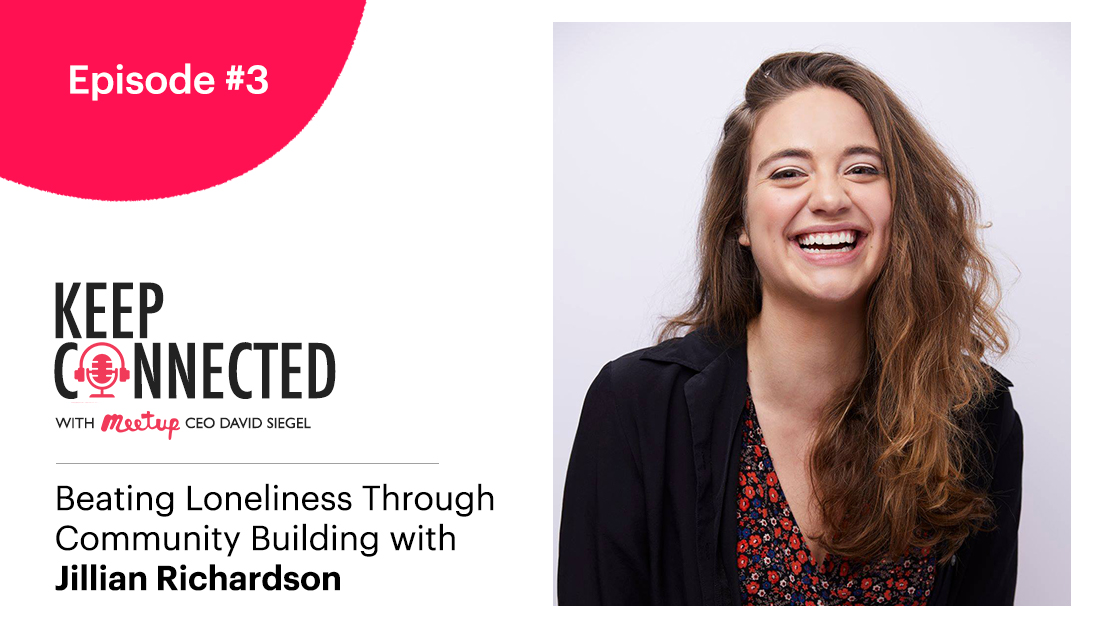
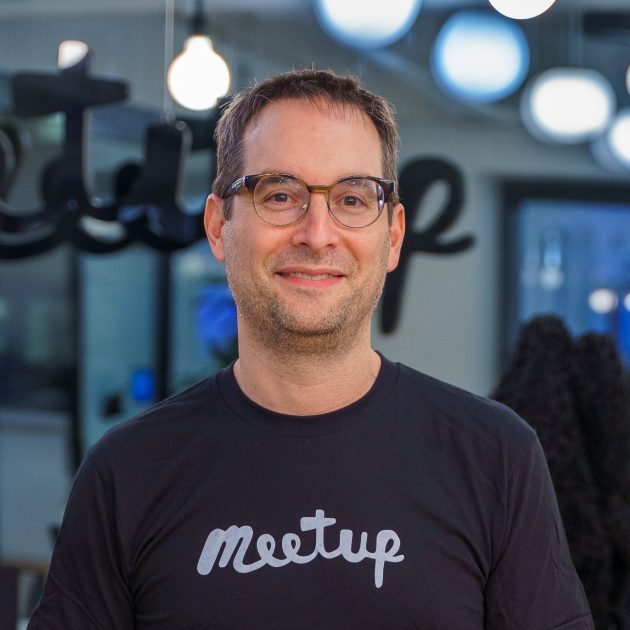


Since high school, Jillian has felt the need to bring people together. In this episode, David speaks with Jillian Richardson, author of Un-Lonely Planet, about growing up in a high-achieving environment, the surprising prevalence of loneliness in urban areas, and strategies for hosting inclusive events.
Ranked as one of the top 25 CEO podcasts on Feedspot, Keep Connected with Meetup CEO David Siegel is a podcast about the power of community. For more details on other episodes, visit Keep Connected on the Meetup Community Matters blog.
We hope you’ll keep connected with us. Drop us a line at podcast@meetup.com. If you like the podcast, be sure to subscribe and leave us a rating on Apple Podcasts!
Learn more about Keep Connected host David Siegel’s experience as a leader and decision maker in his book, Decide & Conquer. Pre-order your copy today!
Show Notes
In this episode, our guest is Jillian Richardson. She is the author of Un–Lonely Planet. She is a speaker, an ecstatic dancer, and an incredible human being. If you’re looking for practical ideas on being a great community organizer and inspiration, this is the episode for you. Welcome, Jillian, to the show.
Thank you for having me, David. I appreciate it.
You are an amazing person. You are an inspiration. We’ll talk about all the different things that you’ve done. Where do you get your inspiration from?
I think of myself as the classic archetype of the wounded healer. The things that we try and bring to others are the areas of our lives where we’ve struggled the most. I’ve felt a lot of personal pain in my life from feeling disconnected and alone. I know how much it hurts. I want to help people not feel that way.
What doesn’t destroy us makes us stronger. Your strength is amazing. Take us back a bit. If you’re open to sharing some of those challenges and some of the strengths that came from that, we’d love to learn.
I grew up in Fairfield, Connecticut, which is a wealthy town. One of those towns where all the kids are competing against each other to see who can garner the most achievements.
It’s a pre–Ivy League town. I lived in Fairfield, Connecticut from age three to five. It’s a very competitive preschool that I went to back there.
I wouldn’t even be surprised if there’s a competition to get into preschools. That was the culture I was raised in was of always thinking about your next steps, how are you going to be the best? In my family, I joked that if my dad was an action figure that had a little pull string, it would say like, “What’s your bullseye? What are you shooting for?” Which in some senses served me because it allowed me to think that I can achieve big things and have that self-esteem, which is a gift. On the other hand, it pushed me farther than I should have gone.
Looking back at my high school self, I had anorexia for six years of my life, a classic thing for a girl in that environment. I didn’t love my body. I was in four Advanced Placement classes. I was in two choirs. I was running a club while holding a job. I have no idea how I did it. In hindsight, it’s that I had this deep belief that I wasn’t enough, and I had to prove that I was special in some way. Moving to New York City as an adult and realizing this is a time for me to restart, to become a new person. I originally moved to the city because I wanted to be a comedy writer, which might be a surprise thinking about this very high–achieving person.
I’m looking forward to hearing your material.
I don’t have the material anymore. I quickly transitioned out of that dream. It was a dream I held all through college. I over-performed in comedy instead of school. I wanted to write for late-night TV shows. It’s why I moved to New York City and met people who were successful in that world. Not to speak for everyone in that field, but the people who I’d met who were TV and comedy writers genuinely didn’t seem that happy. I was just in this beautiful, rare position where I hadn’t found a job in New York City yet, which to me was a point of shame at that moment. I couldn’t find a job. I felt like such a failure.
Especially with the background that you had, where sometimes the people that look like they have everything the most together are the people that are oftentimes struggling behind the scenes the most. It sounds like there was some of that with you as well.
I realized since I was in this position, without a job, I could do whatever I wanted, which was awesome and at the moment was terrifying and I hated it. I became a freelance writer. I was ghostwriting and writing for a bunch of publications. In November 2016, when Donald Trump was elected, I had this interesting juxtaposition in my life where I had done a lot of work to find my own people in New York City. I had finally found a community where it felt like people were loving and generous and gave of themselves. Communities like Medi Club, which was a meditation community in New York City, and Camp Grounded, which is a digital detox summer camp for adults.
I finally had these people in my life that were incredible and gave me hope for humanity essentially. Meanwhile, with Trump being elected, I heard people in my community saying, “I feel like I don’t have faith in people anymore. I feel I’m losing trust in humanity.” I wanted to let people know that no matter what day of the week it is in New York City, you can be in the community and you can find beautiful people, which was why I started this newsletter, to be like, “This sucks right now and look at all of these amazing things going on that you might not know about.”
You turned a challenge that not just you face, but it’s amazing how in the biggest of cities, people could feel the greatest of loneliness. It’s not just true in New York City, it’s true in LA, Rio, you name the city. There could be even a reverse correlation where the bigger the city, probably the greater the numbers and percentages of people that do feel lonely because they’re surrounded by many people and you could feel even more empty.
Like, “What’s wrong with me? There are many people here. Why do I feel this way?”
“I had finally found community where people were really loving and generous.”
Sometimes even why, for some people, it’s more difficult during the summertime. They look around, they see everyone’s happy during the summertime and therefore they should be happy, but in the wintertime, everyone’s a bit miserable unless you live in San Diego, then you’re happy all the time. You were lonely when you first came to New York City. You found some people, but they weren’t all that happy. You start to build a community and find a community for yourself. How did you go from finding a community for yourself to building community and taking on that leadership role?
I had this feeling when Trump came into office that I want to do something. You saw at that moment in history so many people creating projects around nonprofits, political organizations and that’s not my strong suit. That’s not where I excel or where my knowledge is. At that point, I was like, “What I do now is spaces where there’s love that I think could be helpful to people.” I didn’t know how long I would do it for. It was a spontaneous idea that I put together quickly. What happened and why I continued to do it was I started to get emails from strangers saying, “This is exactly how I feel. I feel lonely and I’ve never heard someone express this before.”
It got to the point where I’d be at a party or something and people would come up and I became this weird, watered-down priest where people would start confessing these feelings that they thought other people were feeling. For me personally, it’s helpful that I’m someone who is a bit bubbly and extroverted and I don’t seem, to a lot of people, socially awkward. To see that someone like me feels disconnected, sad and lonely, permits people to say, “If she’s feeling that way, it makes sense that I’m feeling this way. It’s not just these social hermits who feel this way.”
For our readers, each time that you come over to someone and thank them and tell them that they are playing a role in helping you, it’s this positivity that can ignite them into doing even more positivity for others. When people come over to me and they happen to see me ordering at Starbucks and wearing a Meetup t-shirt and they say, “You work at Meetup.” They start pouring their hearts out and sharing about what the community has done for them at Meetup, it gives me strength and it helps me. I want to encourage everyone to give that positive feedback to people, the Jillian’s of the world because even people that are leaders do need that help and strength. Fairfield has probably helped you. All that goal–setting that you learned back in the Ivy League preschools and elementary schools that you went to. It’s served you well in terms of becoming the leader that you are now.
That’s a fair point.
It’s not all bad, but the challenge is that environment isn’t optimal for many people that learn from it. Let’s talk about something that I read in an article that you had that you’ve written. You quoted The Beatles and you wrote, “All the lonely people, where do they all come from?” Personally, I think they come from a lack of in-person opportunities for young people to connect with each other in meaningful ways. Can you talk about that a bit more?
The reason why in my newsletter I make an effort to only feature events that have facilitated connection is because we’ve lost the ability, especially young people, to drop in with others and to go deep in our conversations because it’s a skill. Speaking for myself personally, it wasn’t in the culture. I know there’s a whole element of this conversation that’s about technology and social media and for me, the thing that has impacted me more is not seeing that modeled by an older generation. I was moved by these events that I went to in New York City where we were asking each other what we were struggling with and we were sharing vulnerably with each other and we’re meditating together. They hit me deeply because I had never experienced a space like that before. It wouldn’t come naturally to me to come up to someone at an event and ask them anything other than like, “What do you do?” because I’d never seen it modeled. These spaces serve as a model for what a relationship can be. That’s why I’m such a big fan of facilitation because when we’re left to our own devices, we’ve got a sucky model for how to talk to each other.
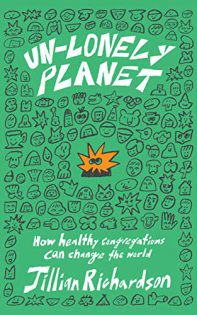
In your book, Un–lonely Planet, which is a must-read for everyone, you’re talking about four different models around creating a great space. I don’t know if there’s a cliff notes version of it yet. Spoiler alert, if you don’t mind giving us the cliff notes version of each of the four, behavioral modeling, clear hurdle rates, unity through intention, and greeting with intention. Every Meetup organizer and Meetup member can learn from you. Help us to learn a bit around these four areas.
This is also inspired by Priya Parker, who is the author of The Art of Gathering. One of those that she mentions in her book and I mentioned in mine with different languaging is creating rules for your event. That could be as simple as, “We’re not going to check our phones when we’re in this space. We’re going to leave our phones at the door,” or “Everyone who shows up has to be wearing footie pajamas.” If you have a dinner for CEOs, for example, and you’re worried about people bringing their ego and bringing their mask of “I’m this professional person,” to do something to force people to strip that away. A great thing would be, “Everyone who shows up at this dinner has to be wearing footie pajamas.” Getting big footie pajamas, you can’t be too serious with that. That’s an example.
The reason why that’s powerful is because when you’re in this space, first of all, you’re stripping away the people who aren’t comfortable with that, who they’re saying, “This isn’t the space for me.” Also, so that when everyone shows up, they know that they have something in common with the people there. It’s a unifying factor. To add to that, another rule that I share with your suggestion is to remind your attendees multiple times during your event what they have in common with each other. An example of that that I’ve seen at my own events is before quarantine, I hosted an event called The Joy List Social. The intention was for everyone there to make new friends. People are going to come into that space with a lot of anxiousness. They’re in a space where they don’t know anyone.
I’ve read that people were creating fake tickets to get into that space.
We started selling out these events. There are many events for singles who are looking for romantic partners and there are not many spaces where the clear intention is for friendship, which ironically also makes it a much better space to find dates because the pressure is not there.
A friend of mine went to a Meetup event. He wasn’t looking for it as a singles event. It was a kickball game and that’s where he ended up meeting his wife. You never know. Serendipity strikes when you least expect it. Something that I’ve thought about quite a bit and I’d love to hear your perspective on it. On the one hand, a community is best when you find your people, on the other hand, a community is also best when there’s an amazing amount of diversity in that community as well. How do you reconcile the finding people which you talk about and also the criticality of diversity in terms of making a great community for a community organizer?
What I’ve seen work well is having a shared goal or something that you all value, which can then naturally bring in, also with intention, a diverse group of people. An example of that in my life, before I wrote this book, I was not a member of a church because I’d never found a church that matched my values or that I thought represented the vision that I hold for a loving world. I discovered Judson Memorial Church, which if you know the Ecstatic Dance Community, it’s a dance community, they meet at Judson Memorial Church in New York City. They’re the church with no pews by Washington Square Park. I joined their community ministry program, which essentially is a program for people who want to learn how to be a minister in their own community. It’s not necessarily a religious minister.
I was talking to an organizer of an Ecstatic Dance Meetup group. She was telling me that she had a virtual Ecstatic Dance Meetup group and there were twenty people from fifteen different countries represented all doing an Ecstatic Dance together. I said, “I’ve got to be a part of that.” That’s awesome that you do that. I also love your point around the commonality of goals but different ways in which each person has gotten to that point. That’s where diversity is critical and special in a community. For all the Meetup members and Meetup organizers out there, any additional advice that you would give to someone who has never attended an event all the way through to someone who has been an organizer for many years?
A tip that I would give to someone who is an organizer who wants people to feel at home in your space would be, first of all, to greet people with intention when they come in. The worst feeling in the world is to walk into an event alone and sign in, show them my ticket and then I have no idea what to do. It’s like, “I guess I’m going to go up and start talking to a stranger.”
That first impression is important, especially since there’s a lot of anxiety that people would have, especially if they came by themselves. It’s why many people will bring someone to a Meetup event or another event because it gives them that security blanket. If you don’t have that, then being very intentional around greeting.

To give an example, because it’s like, “What is greeting someone look like?” First of all, to train your volunteers, say like, “Your job when this person comes in is to be a source of support for them, be warm, look them in the eye, greet them by their name and tell them your name. Say like, if you ever want someone to talk to, I am here. Our invitation is when you go inside, find someone you don’t know and ask them this question, whatever you want the question to be.” In that way, people have permission to talk to somebody new and they know that they’re not being weird because everyone was given the same instructions.
Give me, another nugget for our organizers and members may be given on the member side this time. People who not just organize events, but people who attend events. Let’s hear another from the secret sauce of Jillian Richardson. What else do we get?
No matter what day of the week it is, you can be in community.
If you’re going to an event and you’re on your own and you want to talk to people and you’re not sure how to start, I would be honest. I’ve had some great conversations with people where you start by saying, “Hi,” obviously this is how we start and just share like, “I came here alone. I don’t know anyone. I’m feeling nervous. What brought you here?” By sharing how you’re feeling permissions the other person to be like, “I came here alone too. I moved to the city. This is weird.” You can bond that way. You’re signaling like, “I’m an honest person. I’m a vulnerable person.” They’re probably going to trust you more if that’s genuinely how you’re feeling with authenticity.
I would want to bump into you at a Meetup event or any other event for that matter. Let’s talk about distraction a bit. I’ve seen your writings about it. On the one hand, I’ve always felt like a distraction is not necessarily good because you’re not being present. Being present is important. On the other hand, we all need distractions in our lives. If you need to be present and need to occupy every second of your time, that’s also a challenge. What are your thoughts around the pros and cons of distraction generally?
Given where we’re at in history now, a thing that I’ve seen online that drives me nuts is people trying to get folks to live their best lives during the quarantine. I’m like, “Can’t we got to give ourselves grace. We are surviving.” Anytime I share something on Instagram that’s around the idea of giving yourself compassion and saying like, “You’re not going to look back on this time in history and think, “I wish I watched less Netflix. That was a waste of time.” You’re going to think, “I’m glad I lived through that period of time.” Whatever you got to do, you’re probably going to be eating more junk food or watching a lot of Netflix or zoning out on social media. I want to give you a permission slip to say that’s okay. It’s probably not what a lot of people are saying, but it’s fine. We’re living through this time. We don’t have to be #Thriving.
That’s an important message for people. You don’t have to be on and be okay all the time. Before we get into rapid–fire questions, I’ve got to ask you about Camp Grounded. At Meetup, we always talk about how we use technology to get people off of technology and how technology is such a double-edged sword in people’s lives. During the pandemic, technology was essential to keeping people connected when we couldn’t get together in person. Talk a bit about Camp Grounded. On a personal level, I keep the Jewish Sabbath. I don’t use technology for 25 hours each week and it’s important to me. Talk a bit about how separation from technology has helped you in Digital Detox.
In that particular space, I was lucky. It was one of the first things I did after I moved to New York City. It was the summer I moved here. Camp Grounded is a four-day summer camp for adults, no substance used so it’s sober and no technology. You also use a silly fake name instead of your real name. My Camp Grounded name is Lady. The other rule was you don’t talk about work or your age. It’s on purpose stripping away all of the identities we hold on to. When I went, I’m a 22-year-old writer who lives in New York City. If I’d held onto that tightly, I don’t think there’s a woman named Dolphin at camp, who at the end of it, I found out was twenty years older than me and a lawyer.
We were best buds the whole time. We were having so much fun. We still talk years later. We are intentionally creating a space where you have no choice but to be present with the people in front of you. Also, you have permission to tap your childlike joy, being in a space with adults of all ages who are being silly and playing with each other. It was beautiful and also weirdly, it was the sense of grief of like, “This exists in all of us? What percentage of our life do we get to express this side of ourselves as adults?” It’s seldom.
You talked about the importance of commonality in the community. Stripping all those things away created more commonality between people who could have been different. I‘ve participated in something called laughter yoga. As a comedian or former comedian or someone who thought they were going to be a comedian, laughter can be great medicine. The last question is about advice on how to make for a great online event and how it needs to be different than in–person?
I would, first of all, name the things that people are thinking and be like, “This is a digital space. We’re going to connect with each other differently and to think about the benefits of virtual spaces that might not exist in real life.” I know people who run fitness organizations and they found that their attendance is going up in their classes because people get to have their video off and not feel self-conscious about exercising in front of other people or because folks can close their computer or turn their camera off at any moment, they’re bringing more honesty and vulnerability than they would feel comfortable within an in-person space. There are some interesting benefits that people can lean into in a virtual space that I want to highlight because it’s easy to be like, “This sucks, in-person is better.”
It goes to the double-edged sword of everything that sometimes people’s best traits are also their most challenging traits about themselves and the need for people to find the good and challenging times as well and there is. Online events can be, at times, even more powerful for certain people at certain times than others. It’s up to each of us to figure out that path where it’s using chat. I teach at Columbia and this is going to be my first semester teaching online. I’m finding a whole bunch of different ways to make it, hopefully, an even better experience for students. Now we are going to hit some rapid–fire questions. I’m going to hit you with a question and a quick response answer. Number one, one time that community had the biggest impact on your life?
The Get Down in New York City, it’s a dance party.
Why?
It helped me stop being afraid of being in my body.
Number two, what is your favorite quote?
This is a quote by Alan Keightley and it says, “Once in a while, it hits people that they don’t have to experience the world and the way they have been told to.”
Number three, what is your favorite leadership book? Something that you think that the readers should read or listen to.
This is not a business book, but I’m going to shout it out anyways. It’s called A Religion of One’s Own by Thomas Moore. It’s about developing your own personal sense of spirituality and sacredness. A lot of leaders are drained because they don’t have any sense of the sacred in their lives.
You didn’t list Un–Lonely Planet, but I’m sure that’s the top book for you. I know you’re writing another book around secular places. That probably has a prominent role in your next book. I’m excited to read that myself. What is your first job ever?
I worked at a snack stand at a country club.
That sounds like Fairfield. When is the first time you saw yourself as a leader?
Maybe in high school. I started a chapter of a club called STAND, which is Students Taking Action Now: Darfur in my high school. This is the experience of saying like, “I wanted to do this thing.” People are willing to join. People are willing to contribute and organize. I’m like, “Come to Washington DC with me.” That was a powerful experience.
This is a digital space. We’re going to connect with each other differently.
How energizing was that?
It was cool.
My first leadership was also a club in high school that got me out of my shell on a personal level. The final question to ask you about, I’m genuinely interested in hearing it. Jillian, hopefully, life will last for a long time. What are you most want to be remembered by?
I want to be remembered as someone who leaves people in a room feeling better than before I was there.
The aspiration is something that everyone could potentially achieve. It’s something that everyone can do multiple times a day. That’s what’s beautiful about it. Jillian, you rock. Keep up the amazing work. I feel inspired by you. I hope each of our readers feels inspired by you. Thank you for everything that you do and for the communities that you build and the communities you’re going to be building in years to come.
Thank you, David. I appreciate it.
Take care.
—
Thank you for listening. We hope you enjoyed this episode. My favorite part of it was the discussion around all the practical tips that Jillian shared. As the CEO of Meetup, I learned a lot that I could bring back to the company. If you have a review for this episode, share it. Give us five stars. We’ll take it and just remember, let’s keep connected because life is always better together.
Important Links:
About Jillian Richardson
 Jillian Richardson helps people find a sense of belonging within themselves and their relationships. She’s the author of Un-Lonely Planet, a guide to creating a strong sense of community. She’s also the creator of The Joy List, a weekly newsletter of events and tools that help people create more connections in their life. When she’s not facilitating workshops or coaching one-on-one, you can find Jillian studying as a community minister at Judson Memorial Church and talking to every dog she meets.

Last modified on September 22, 2023