
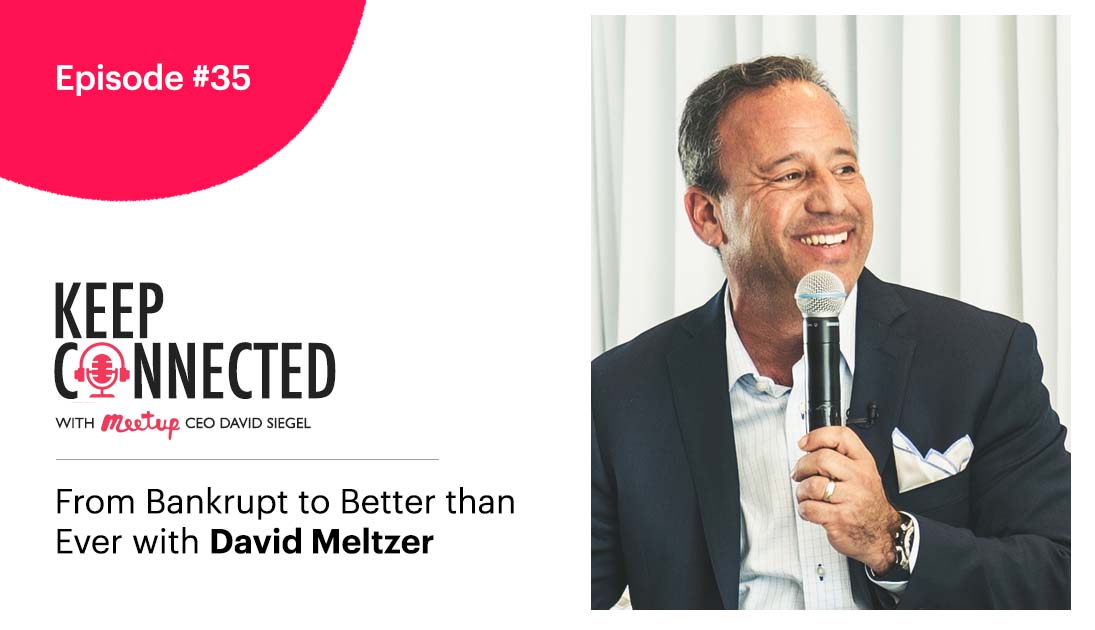



David Meltzer is a three-time international best-selling author, top 100 business coach, host of the top entrepreneurial podcast, The Playbook, and so much more. It’s easy to see why David Siegel thinks he “may be the busiest person alive!” The two Davids sit down to discuss Mr. Meltzer’s transformative path from multi-millionaire business prodigy to losing it all, then building his life and career back the right way. They touch on the dangers of arrogance, the power of an open heart, how to stay energized, and how to move on from mindsets that are holding you back.
—
Ranked as one of the top 25 CEO podcasts on Feedspot, Keep Connected with Meetup CEO David Siegel is a podcast about the power of community. For more details on other episodes, visit Keep Connected on the Meetup Community Matters blog.
We hope you’ll keep connected with us. Drop us a line at podcast@meetup.com. If you like the podcast, be sure to subscribe and leave us a rating on Apple Podcasts.
From Bankrupt To Better Than Ever With David Meltzer
Before we get into this episode, I have something important to share. Check out my new book Decide and Conquer to get to know my story at Meetup. The hardest thing about community leadership is making tough decisions when the stakes are high. They were never higher than when Meetup was owned and sold by WeWork. In my new book, Decide and Conquer, I’ll walk you through a counterintuitive framework for decision-making and the epic journey of Meetup’s surprising survival. Good leaders deliberate. Great leaders decide. Order my book by visiting DecideandConquerBook.com or anywhere books are sold. You will like it.
—
In this episode, we have David Meltzer. This is someone who has learned the hard way. He is someone who has gained tremendous amounts in his life financially and, in other respects, lost so much in life and has learned tremendous amounts from that process. Let’s learn from this episode from David Meltzer.
—
Welcome, David Meltzer, who might be the busiest person alive. He’s a three-time international bestselling author, a Top 100 Business Coach, the Executive Producer of Entrepreneur’s number one digital business show, and the host of the top entrepreneur podcast, The Playbook. Do you not sleep? How do you do it all? How do you have this drive to be able to want to do it all?
First, I don’t believe in being busy. My mom always said, “Ask someone busy to do something if you need it done.” I take on the point of accessibility. Shifting my perspective on how accessible I am to others allows me to be more productive and gracious. Those are things that allow you to be more inspired. To that end, I hate to get so early in the conversation but I’m a faith-based person. I believe when people ask me, not that I have extraordinary physical strength or size, “How can you have so much energy? How can you outdo so many people in the energy field?”
I said, “That’s because I’ve focused on clearing that which interferes with my connection to that which is greater than me and that loves me more than my mom.” I used to think I had to get healthy, happy, wealthy, and worthy. Instead, I realized that I was part and parcel of that. What am I doing to interfere with it? I expect miracles in my life because of who I am. I know that I’ll receive those miracles because of who God is and offer those miracles to others because I’m part of God. It’s a simple philosophy. Whatever religion you believe in, it applies. You don’t have to necessarily believe in what I believe or David believes. It’s for everyone.
What you said was so beautiful because of the fact that when you’re “successful” or whatever successful means, it’s very easy to get arrogant, not appreciate how lucky we are, and let ego take charge of everything. It sounds like you use faith as well as a way to keep you in check a little bit. I have struggled personally with ego and thought that I am the cause of success versus other things being the causes of success. Is this something that you have struggled with in life or not?
It cost me over $100 million. I had to learn those lessons about what I consider the two types of people in the world. Both types of people in the world are ignorant people. There’s arrogant ignorance that I carried with a lot of egos, which means I know that I don’t know what I don’t know but I’m going to pretend that I do. I always need to be right, offended, separate, inferior, superior, angry, anxious, frustrated, guilty, and resentful or I learned the lesson through my experiences that I’m ignorant and humble, meaning I know I don’t know what I don’t know but I know that I’m connected to and through this great source that is omniscient, all-powerful and all-knowing.
I got to clear that interference so that I can get as much of the good stuff as I can so I can expand and accelerate what I do know, help other people with what I do know, and share that with humility. I had this great interview with Tim Schurrer. He talked about the third seat in the Apollo 11. Everybody knows the astronauts Glenn and Armstrong, that walked the moon but nobody knows Michael Collins.
I didn’t even know there was a third seat.
Michael Collins was the one that orbited 36 times and was the Uber for John Glenn and Neil Armstrong to get on. What’s so significant about that is it represents my life. I’ve always been in the third seat. I was CEO of the world’s most notable sports agency. I was partners with Hall of Fame Quarterback Warren Moon. I’m partners with Marshall Faulk, yet I have not lost the appreciation of what other people are dreaming of.
I am not going to take for granted not only what other people dream of but also what I dream of. Many times, we get into the “successful experience” as you have, forget about it and take for granted what we have. It’s so important to appreciate what we have and ask for more so we can give it all away. That has been the key to my radical humility instead of the ignorant arrogance that got me into big trouble.
Speaking of big trouble, in Seinfeld, there’s an episode where Jerry says something like, “You yada-yada the best part.” It’s not to say losing $100 million is the best part. It’s probably the worst part.
It is the best part.
Maybe it’s the best part because of what that did for you. Give us all a little bit more background. Where were you? What happened? How did that happen? How is that the “best part” now?
I was blessed to be a millionaire nine months out of law school because I didn’t listen to my mom. She told me, “The internet was a fad. Nobody will ever do research on the internet,” but I didn’t believe her. I ended up in my first exit of $3.4 billion in 1995, the Samsung CEO and then a multimillionaire running Leigh Steinberg Sports & Entertainment. Not only was I a multimillionaire but I also had access to things that even billionaires could afford to do, like sidelines at the Super Bowl and the cabins at the Masters. This was the cause of all the arrogance in my life.
It’s so important to appreciate what we have and of course, to ask for more so we can give it all away. That’s what you call radical humility instead of ignorant arrogance.
When I lost everything over $100 million, I had 33 homes in San Diego, a golf course, and a ski mountain. I had to move into a rented house with rented furniture. I had one car. I had three beautiful, healthy, and gorgeous daughters under ten. My wife stuck with me. She’s my dream girl from the fourth grade. She was pregnant with my fourth child, a boy. It saved my life because I realized at that time what I should have learned at three years old.
My mom was this extraordinary woman. She worked 2 jobs and raised 6 kids. All five of my siblings went to the Ivy Leagues and graduated summa cum laude. They are a mom’s dream. At three years old, my mom treated everyone like a second-grade teacher. She was like, “Sweetheart.” She never yelled and hit. My wife always says, “My biggest problem is that my mom never hit me.” I tell her, “She hit me one time.” I, at three years old, reached out to touch a burning hot stove. My mom quickly slapped my hand very hard and screamed at me, “No.”
I had never been yelled at or hit. I immediately started to cry and said, “Mom, why are you punishing me?” She hugged me quickly and said, “I’m protecting you. I’m promoting you to a better place.” That’s what happened when I went bankrupt. I shifted and did not do anything myself. I realized that I was interfering with my potential and that I had been reaching out all the time at hot stoves, the wrong people, and the wrong ideas. I kept getting slapped.
There were lawsuits, friendships exploding, family members exploding, and all the things. I had bad health. I was partying way too much and doing things I should not be doing. I kept getting hit, thinking I was being punished when I was being promoted and protected in the final promotion. The final promotion of my life was to take everything away so I had the freedom to start over and do it the right way. I now sit in a position where I have more than I’ve ever had, making more money, helping more people, and being happier than I’ve ever been.
When good things happen to you now is it a little bit almost oddly PTSD and that there’s a worry that you could end up going back to the same place that you have gone to? Do you have such a different mindset? It’s easy to go back to a mindset you had in the past. What do you do to guard yourself?
First of all, know that it’s there. I’m in the practice of acknowledging and identifying the needs of the ego. I still have a terrible need to be offended. It’s inherent in my religion and genetic inheritance to be offended. It’s so easy to be offended when you have a need to be offended. It’s amazing what can offend you. I’ve learned to identify this ego-based consciousness. I make and utilize time a lot in my life to facilitate expansion, growth, and acceleration. I use a stop, drop and roll methodology that says, “I’m only going to spend minutes and moments in the old David.”
The fact that you don’t say, “I’m going to avoid the old David completely,” is pretty transformative as opposed to saying, “I’m going to spend minutes and moments in the old David.” It’s because it’s a realization that you still are the same human. You’re still David Meltzer. You are still the same “person.” For you to completely extricate yourself from that is perhaps less valuable than trying to experience it in moments.
The faster you get, the better you get and the more you’re productive, accessible, and gracious. It has worked for me. I have this four-step thing. Number one, identify the ego-based consciousness. The second step that’s critical to that transformation is instead of resisting it, going over, under, and through it, lying to it, cheating it, and manipulating it, which we do with this ego-based consciousness, I simply stop. This is where the faith comes in.
I surrender, stop and breathe through my nose and out through my mouth until I get to the center, neutral or a clear connection with that which is more powerful than me. When I get inspired again, this is where the energy comes because I don’t waste energy in an accelerated movement towards a trajectory I don’t want, what’s missing, or what other people want for me, which the ego loves to grab onto. I simply get to peace and center. I remind, remember and recollect. It’s all indicative of a higher source. It’s reminding because there’s a difference between the brain and the mind.
Remind and remember. What do you remember? It’s recollecting. What am I collecting? It’s the higher power, the higher source, and my higher self. What do I do? I identify and list them out. It’s the need to be right, offended, separate, inferior, superior, anxious, frustrated, angry, guilty, and resentful. Worrying and complaining are duplicative negatives. When you’re worrying and complaining, not only are you creating interference between you and your source and between being a resource and a source but more importantly, you’re wishing for what you don’t want.
I’m not honestly deeply familiar with AA but I know the superficial areas of it. It seems like there are opportunities for learning around that. Is that correct or not?
I never went into AA myself. I had a drinking problem and a drug problem. Leigh Steinberg is an admitted alcoholic. More importantly, I was born in Akron, Ohio. Leigh and I represented and marketed the Pro Football Hall of Fame, which is in Canton. When we went to the Hall of Fame because we had several clients being inducted, we went into a meeting about the inception of the Twelve Steps where Bob and Bill were a block and a half from my grandparents’ house in Akron, Ohio.

I lived in Akron, Ohio, blocks away from where they started AA. I never knew it until I was in my 40s with Leigh Steinberg and we went and visited the birthplace of AA. The Twelve Steps have a great influence and impact on what I believe. I’ve tried to make it like I have religion more to the masses to unify more people with the ability to enjoy and be consistent every day, persistent without quitting, and in pursuit of your potential.
I love that because it’s genius for me. Is it complete innovation from zero to something? It’s taking concepts from other areas and figuring out how to apply them potentially to much bigger and more impactful audiences. You pulled from a whole lot of different areas to build what you have. Community is a big part of AA. Community is an enormous part of what you do. How important is the community and why? Share a little bit about that, please.
Let me talk about community in a different way. I believe community is about sponsorship and power sponsorship. To have sponsorship and power sponsorship in your life, you need to find people with open minds.
What is power sponsorship?
First, a sponsorship person in your life is someone that knows someone that can help you. A power sponsorship is someone that can help you themselves and they know people to help you. My whole community is based upon surrounding myself with people that feed me. People that feed me are people that have open minds. People who have open minds have open hearts and hands. They become sponsors and power sponsors. Even more importantly, they surround themselves with open minds, hearts, and hands.
You get this exponentiality. When I started my brand Super Bowls with Gary Vaynerchuk, I was trying to help him with his sports agency. He told me that he loved my book and that I should build a community online. I said, “I’m a middle-aged Mutant Turtle. Nobody is going to want to see me on Instagram.” He said, “Trust me. I’ll help you. What’s your goal? What’s your budget for your first year?” I said, “I will spend $1 million to build a community.”
He said, “How many followers do you want?” I said, “I don’t want followers. That’s not who David is. I don’t want followers. I’m an intelligent follower. What I do want is sponsorship and power sponsorship.” He said, “How many?” I said, “I would like two.” He said, “You’re kidding.” I said no because I was 50 years old at the time. I said, “By the time I’m 70, I will be the most powerful and influential 70-year-old on Instagram.” He said, “How do you figure?” I said, “Do the math.”
2 to the 28th power is a pretty large number.
It’s over $2 million. That’s in two people a year. I’ve been able to accelerate it like your company with Meetup. It’s a sponsorship and power sponsorship community. That’s why when I saw you, your shirt, and your company, I said, “Somebody has figured out to do what I do at an exponential rate and already has 36 million people.” They’re all open-minded, open-hearted, and open-handed people. This is where the world is going to be impacted most through this type of community.
I am glad I was wearing a Meetup shirt when I met you. That’s all I have to say because the schwag stuff we all get clearly works. The concept of how good people like you attract other good people around them is something that’s a powerful part of the community. The opposite occurs as we all know. You might have had that in your life as well. Bad people attract other bad people around them. It’s this continuous loop.
How do you know if a community that you’re in is a good community that’s attracting these good people around you? How do you identify the opposite? You are the sum total oftentimes of the people you surround yourself with. They say, “Look at your five closest friends. That’s you.” Is there any advice on that?
I give this advice all the time to my three daughters especially. It’s easy. I have a great chain of feeding and it’s based on feeling. If somebody is feeding me, I’m going to feel good. If somebody is bleeding me emotionally, I’m going to feel bad. Here’s the tricky thing where people get confused. There are light, love, and lessons in everyone and everything but we have to be pragmatic and reconcile time. It means you have to know yourself well enough to say, “Is it worth my time to find the light, love, and lessons in this person, group, situation, event, or even food?”
You have to be aware when you’re interfering with your potential and that you had been reaching out all the time to the wrong people and wrong ideas.
If I spent enough time, I could learn to love certain foods but there are certain foods I walk by a stand that I’ve never had. It makes me feel hungry and good like, “That’s delicious.” How do I know? It’s the same thing with people. I had this great chain of feeding that I quickly assess, “At what level does someone feed me? Is it worth the time to feed them?”
I’m very clear. I will allow people that believe in me, including family members, to fall away and even fire people from my life that truly have negative intentions to bleed me or are unintentionally so messed up that I don’t want to be around that. You will take on the frequency and energy especially with the people you are most frequent with. That’s why they call it frequency. It includes your bank account. You look at those five people you surround and spend the most time with. Your bank accounts can equal the average of the five almost all the time.
When you’re meeting people, you have to say no to someone. It sounds like you’re able to do that. I have two parts to this. One is the no and one is, “I need a separate.” You started talking about people in your life. It could be close friends or even family members. You have to fire them or separate from them. Without names, can you give me an example?
I’m most interested in what you said and how you said it. Was it effective? I personally struggle with that because perhaps too often, I’ll be like, “What’s the big deal?” They will call me 2 or 3 times a year. I try to help them out. It’s not a big deal but it sounds like you’ve had that “breakup conversation” with people. How has that gone? Has it ever turned around? Share a little more. A concrete example would be great.
Falling away is easier now than ever. Letting someone fall away is what you described. There’s so much outside information now. It’s not like we live in these little towns of Knox, Indiana. It is very obvious that you’re not showing up. Trust me. Falling away is easy but not firing people from your life.
People ghost all the time but people aren’t directly firing. Tell me about that.
That is something that changed my life. Two years before I lost everything, my wife recognized that I wasn’t doing what I was supposed to be doing and paying attention and intention to my family and work. I was partying way too much. She told me she was leaving me. She told me I better take stock of who I was and what I wanted to become or I would be dead. When I realized I was ready to hear this, which initially I wasn’t, I told her, “What can I do? You’re everything to me. My girls are everything. You are right. I’m going to work on this.” The first thing she said was, “You need to fire these three people from your life.”
This was my first experience because I’m a person-pleaser. I want everyone to love me at that time. I don’t want everyone to love me now. I tell people all the time, “I would rather you not like me for who I am than love me for who I’m not every day of the week.” This is how I did it. I went to these three friends, two of whom I’ve known since elementary school, and said, “X, I will not be able to be around you, speak with you, meet with you or be with you anymore. I don’t like myself when I’m with you. This has nothing at all to do with you.”
It’s perception, not reality, which is important.
“This is about me. I’m not happy about who I am and the choices I make when I’m with you. You’re such an important person in my life. I love and respect you so much. You have a great influence on me that I don’t like myself when I’m with you and what I’m doing. I’m going to have to part ways. Know that I love you and appreciate you. I pray for your happiness.”
What did X say? What were the different X reactions? You did this three times.
All three of them told me that this was also a critical place in their lives. All three went to rehab, came back to me, and asked me for forgiveness. I said, “That’s not what I’m about.” They said, “Could I talk to your wife?” My wife has not worked through this as well as me. She does not want to talk to them and I’m not allowed. I’ve been married for years since then. The joy of my life is how strong that marriage is.

You have to prioritize. That’s it. One important thing in love and relationships is it’s not about what’s logical or illogical because are they going to have a detrimental impact on you, the David Meltzer you are now? No. It’s about understanding the person you love and prioritizing, doing what’s the right thing for them, and appreciating that’s the reason.
I do many things because I love my mom. There are so many things that are important to my mom that is not important to me but it’s important to me to let my mom know what’s important to her is important to me. That’s where I stand with my wife. Here’s the cool thing about doing it. You fire people that have been here for a long time. You’re not going to ever have to fire anyone when you’re to the point where I’m at because you’re not going to allow someone that bleeds you to get to that point in your life.
I stay away from it so early on. This is why these friends have been there since elementary school. That’s why they had so much influence on me. I’ve never had to fire anyone from my personal life. In business, it has also helped me because I’ve taken the approach. Gary Vaynerchuk taught me this. Fire fast and let people know, “This isn’t a good situation for you. How can I help you find a better situation?” I spend more time offering.
You’re doing them a serious favor by doing that.
Here’s my favorite story about that. I had to fire my office manager. I adored her but it wasn’t a good fit. She was very upset with me and didn’t talk to me for a year. She left crying and told me that it was unfair. She hated me. She learned through what happened and found a better position and place. She was promoted and protected. We were so close. I officiated her wedding.
That is way more amazing than the story I’m about to share. A similar related story was when I joined Meetup, there were a number of people who were working on projects and not just adding value but subtracting value because they were taking up a lot of time and resources from things that were more important. I had to shut down a couple of the business areas. I remember two people came into my office afterward. We had to let go of 30 or 40 people.
They walked in and both gave me a hug. They said, “You are right for ending this area that I work in because it wasn’t helping Meetup. It was a distraction for Meetup.” Both those people I stayed in touch with. To one of them, I gave references for her to go back to school and get a Master’s degree. It’s something that she’s so passionate about. You don’t know at the time whether you’re doing someone a favor or not. It’s about understanding that to rip the Band-Aid off is very painful but sometimes it can help. Clearly, you appreciate that.
That’s the protection and promotion side for everyone. Both you and I have had experiences that our kids or we don’t get into where they want to be into. It’s difficult to say. Here’s one great example. I went to Tulane Law School but I wanted to go to Stanford. They rejected me for undergrad, rightfully enough but I was a close call for law school. I was right there and they rejected me. I had to borrow $100,000 to go to law school. I would not accept a Stanford scholarship to their law school over having to pay $100,000 to go to Tulane. That’s how much of a promotion it was in my life or the perfect fit. Even more ironic is they will pay me to speak at Stanford or beg me to speak there now. How it all ends up is protection and promotion are beautiful.
I got to hit a little bit on because when you go to different cities, you will have Meetup events before we meet. I love what you do. Can you walk through it a little bit? When you go to a different city, when you’re speaking at a place, when you were in South by Southwest, which is where we met, or when you came back to Manhattan, where we met a second time, how have you used Meetup? How have these Meetup groups helped you personally?
I couldn’t believe it when there was a company that did what I’d been doing for years. I travel to over 200 cities a year. My mission is to empower others to be happy, make money, help people and have fun. As the community traveled and coordinated, I would invite people because so many of them are like, “Can I sit down with you and take a coffee? Can I meet you?” You got to be a special person to meet me for coffee. I keep it to twenty minutes regardless.
I aggregated all the requests when I came to the city and said, “Let’s meet up.” Two things happened. 1.) I learned what people were listening for. 2.) I helped people not only with the answers that I had from the situation and knowledge in dummy tax but I also saw a networking component that I didn’t expect. Everyone gave me credit for the Meetup event. All of a sudden, they’re like, “I met Joseph from Harlem Standard at your event. We’re doing millions of dollars of business.”
I started coming up with the overlap agreement and saying, “Don’t forget Uncle David here. I put us together. I’ll get 10% of the goodies.” I’ve made almost eight figures a year from creating business and helping other people by simply creating not a legally binding agreement. I call it a memorialization, “To anybody you meet here from these introductions, I would like 10% for the intro if possible.” It’s open but not signed. It’s a memorialization. People are so happy to pay me. It has been amazing.
You want to be remembered as one with kindness, simple kindness.
People are honest. They can get away with you having no idea. People could not tell you about what they built and you wouldn’t be any the wiser but when you’re around good people, you learn to trust those people. Good things ultimately happen. David, we have a segment called rapid-fire, which is learning some little more details. Give me 3 or 4 questions. Here we go. When was the first time you saw yourself as a leader?
In football in college, I was the defensive captain. That was the first time.
If you could access a time machine and go anywhere in the world at any time in the world, where are you going?
The Last Supper.
What are you eating?
It’s something Kosher.
What are you asking them at the Last Supper?
I’m asking Jesus himself a whole bunch of questions. Number one, are you real? Where are you going? Where have you come from? It’s as many open-ended questions as I can to learn more.
Name one thing on your bucket list.
I got one, which was taking my son to the Masters. It’s taking my entire family to a sporting event. I don’t know which one it’s going to be that all the girls and my son would enjoy. I don’t know what it is yet but there has to be one out there that I can spend a weekend only with my family without my phone and the internet as you do at the Masters. All of them enjoyed it as much as my son enjoyed it. It was the best three hours of my life.
Here’s the last question. What do you want to be remembered by?
Simple kindness chokes me up, “What do you remember about David Meltzer?” They said, “It’s kindness.” That’s all I ask.

People would say that about you now. People will say that about you in decades and God-willing 100 years from now, your great-grandchildren will know, say the same thing and hear about great-grandpa David and how much kindness he brought. That’s my hope and blessing.
Thank you for all your help with that as well. It has been an honor to be here. I look forward to doing so much more with Meetup. It’s inherent in my nature.
Thank you again, David. Have a good rest of the day.
Bless you. Thank you.
—
Thanks for reading this episode with David Meltzer. It is not often that you get to sit down with someone who lost $100 million. It’s probably even less often that you sit down with someone who lost $100 million and is so grateful that he did. David is focused on appreciation, gratitude, humility, and the concept of reminding, remembering, and recollecting to figure out how to be your best self. Those are poignant words from an incredible person. If you enjoyed this, subscribe, leave a review and check out my new book, Decide and Conquer. Remember, let’s keep connected because life is better together.
Important Links
- Meetup
- WeWork
- DecideandConquerBook.com
- David Meltzer
- The Playbook
- Tim Schurrer – Apple Podcasts
- Masters
- AA
- Pro Football Hall of Fame
- South by Southwest
About David Meltzer

David Meltzer is a three-time international best-selling author, top 100 business coach, host of the top entrepreneurial podcast, The Playbook, and so much more. It’s easy to see why David Siegel thinks he “may be the busiest person alive!” The two Davids sit down to discuss Mr. Meltzer’s transformative path from multi-millionaire business prodigy to losing it all, then building his life and career back the right way. They touch on the dangers of arrogance, the power of an open heart, how to stay energized, and how to move on from mindsets that are holding you back.

Last modified on April 27, 2022