
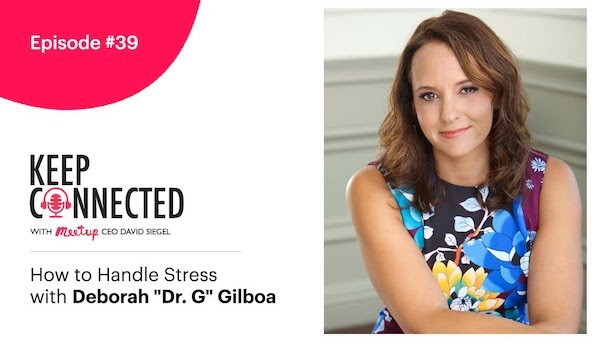
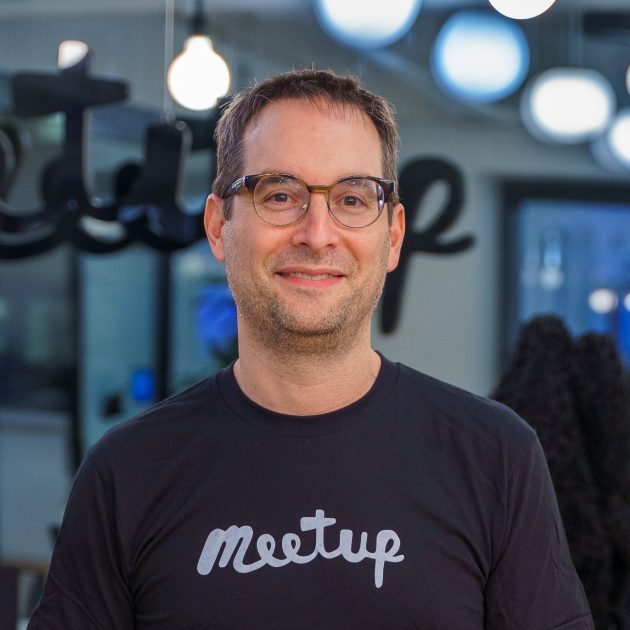


Deborah Gilboa (aka “Dr. G”) is a family physician, as well as a frequent feature on TODAY, Good Morning America, and The New York Times. She’s fluent in American Sign Language, a leading expert on stress management strategies, and the author of From Stressed to Resilient: The Guide to Handle More and Feel It Less. Dr. G and David sit down to discuss why change of all sizes is so hard for people to cope with. They chat about everything from anxiety-relief life hacks, brain chemistry, and runaway feelings to Dr. G’s mission to redefine the word “resilience” in everyday usage.
Ranked as one of the top 25 CEO podcasts on Feedspot, Keep Connected with Meetup CEO David Siegel is a podcast about the power of community. For more details on other episodes, visit Keep Connected on the Meetup Community Matters blog.
We hope you’ll keep connected with us. Drop us a line at podcast@meetup.com. If you like the podcast, be sure to subscribe and leave us a rating on Apple Podcasts.
—
How To Handle Stress With Deborah Gilboa
Before we get into this episode, I have something important to share. Check out my new book, Decide & Conquer, to get to know my story at Meetup. The hardest thing about community leadership is making tough decisions when the stakes are high and they were never higher than when Meetup was owned and sold by WeWork. In my new book, Decide & Conquer, I will walk you through a counterintuitive framework for decision-making and the epic journey of Meetup’s surprising survival.
Good leaders deliberate, great leaders decide. Order my book by visiting DecideAndConquerBook.com or anywhere books are sold. I think you will like it. In this episode, we are talking to the one, the only Dr. G, an expert in resilience, the author of From Stressed to Resilient. After reading this episode, you will feel less stressed. You will have some practical tips on how to handle stress and change and how to build resilience. Happy reading.
—
Dr. G, the first time we spoke, we absolutely bonded and I thought, “I have to have Dr. G on the show.” You have been a fan of Meetup for some time. You are the author of the book, From Stressed to Resilient. It is killing it. I’m so glad you were here. The first question I have for you, though, is you are the expert in resilience but everyone has different definitions for resilience. What’s resilience? Why is it important?
Resilience is the ability to navigate change and come through it to become the person you are meant to be. Specifically, change is not only a struggle, adversity, difficulties or obstacles because it turns out that our brains think of every single change as a potential tragedy. I don’t mean anxious people or pessimistic people. Our brains chemically react to the possibility of every change.
Is it even for a crazy optimist like me?
A crazy optimist like me too. Let’s do a little test of that to see if I’m right.
I said that I was worried so that was a change from the plan.
You can choose whether or not to tell us what it is but can you think of a positive change, news you got that you would definitely classify as good news but it was news. It was something you didn’t know was going to happen. You might’ve wanted it to happen. You hoped but you found out something good was happening.
Yes, I’ve got it. I know what the positive news is. I found out that my book is being translated into Chinese.
Where did you find that out? Via email or phone call?
I got an email.
You get that email that says your book is being translated to Chinese and even at the same time that, I hope you feel happy, proud, and excited. Your brain also says, “Loss.” We lose control of, “I don’t read Mandarin. What if they say stuff I didn’t say?”
“Are the Chinese, in the translation, going to add things that had nothing to do with what I said?” I absolutely did think that.
Did you also think of distrust? “Are these the right people to do this for me? How do I know that they have my best interests in mind?”
It’s like a mind melt here.
Resilience is the ability to navigate change and come through it.
Even as you started to say, “It’s still probably worth it. I could get somebody who does read Mandarin to tell me if it says what it should say.” You still thought, “But it might be uncomfortable to have people, for example, in New York, come up to me and speak to me in Mandarin thinking that because my books are in Mandarin, I will understand them or something uncomfortable about it.”
I also thought, “Much of China’s in lockdown now. What if it’s still locked down and not a good time?”
Our brain has these three safety mechanisms, loss, distrust, and discomfort, not only for bad news but for all news, even the possibility of news. If there’s a new COVID variant, you can imagine loss, distrust, and discomfort. If it’s something smaller like your phone is updating its operating system. “What could I lose or, David, we decided that one vending machine, we are going to switch it from Pepsi products to Coke products.” It’s because our brains have a million functions but one job, and that job is to keep us alive. The good news is we are currently alive. The bad news, any change is suspect. Resilience is not the ability to navigate difficulty. It is the ability to navigate change.
I know why it’s important because we have a potential thousand changes, small, tiny, and big ones, that happen every day. We need to navigate that but you are the expert. For people to learn, why is navigating change and resilience so deeply important, professionally, personally, and everly?
It’s because it’s the only way to get the life you want. If you want a new relationship, if you want to move your aging parent closer to you so you can help take care of them. If you want to apply for a big proposal, grant or promotion. If you want to launch a new product, all of that involves change. This isn’t just the ability to get through the punches in life and keep getting up, which is how a lot of us have been taught to think about resilience. It is the ability to move towards the relationships, the accomplishments, and the experience that you want from life.
Many people have status quo bias. They are afraid of change. Why? Is it because they had a bad experience in the past but other people had a bad experience in the past? They are not as afraid to change. What’s the reason for status quo bias and fear of change?
At the most basic, it is what we already spoke about. It’s that our brains are suspicious of all change.
Is it the amygdala or some other part?
It’s the amygdala and the central core amygdala that kicks on at the possibility of change with fear, loss, distrust, and discomfort. That stays loud until we take an action, and there’s a pretty easy action you can take to quiet. You cannot silence the amygdala. It does keep you alive. It does say while you are driving at 70 miles an hour down the road, “My car has never made that noise before. Maybe I should pull over.” It gets your attention.
It keeps you alive to all kinds of changes but you can quiet it by about 50% by asking yourself what choices you have. Not even listing them and choosing them and moving forward but asking the question, “What choices do you have?” My mom used to say when I was unhappy with a situation, complaining or whining, “If you are still breathing, you have choices.”
That reminder, snarky though it was, was enough to get me into my thinking brain, the ventromedial prefrontal cortex, and it quiets the amygdala by at least 50% so that you can start to move forward. When you are in that situation where status quo and I deal with this as a doctor a lot. A patient will come to me and will say, “I want to be healthy enough to dance, God-willing, at my kid’s wedding someday.” Their blood pressure is sky-high and out of control.
I say, “To get there, I would like you to consider taking this medicine every day.” They are like, “That feels scary to me. That feels dangerous. I don’t trust it.” We have lore in our society about trusting your gut. We also have lore about not trusting doctors, which is a whole other episode and understandable but just because your brain says, “I’m not sure I trust that.” That doesn’t mean for sure it’s wrong, and you should say no. It means you need more information or time.
Could you do a brain scan and see an amygdala or prefrontal cortex lighting up during times?
I can’t because they don’t let me use the toys at the hospital like that but yes, that has been done.
That speaks to how biological it is, and there are actions you could take to decrease the impact. I tend to take a lot of risks. I feel like if someone did a brain scan, they would end up seeing my amygdala would be underdeveloped, perhaps but there are things you could do to train your biology and your brain to be less or more. Is that true or not true?
It is true. The truth is you cannot turn off your amygdala. For the few people who are born without that reflex, it is hard to keep those folks alive.
They don’t survive.
They tend not to procreate and have more kids like that so that it slowly dies out. When I was leading a Meetup about some of these ideas, somebody said to me, “Just the idea of taking action feels scary to me. How do I get over that hump?” I want to point out that you don’t even have to take action. You have to have thoughts to change this path, and that’s easier because we know we don’t have to act on every thought. It is easier to realize that your thoughts have a role in helping you get ahold of your runaway feelings. You cannot control your feelings. When you realize, “I can choose some of my thoughts.” We can’t choose all of our thoughts.
You made me give you an example. Give me an example of cognition can be sufficient and not behavior in building resilience.
My boys are 13 up through 20 in 2022. My fifteen-year-old wants to go do a free program abroad in 2023. He tells me this and my brain says, “Loss, distrust, and discomfort,” but I also have tried hard to position my kids to be advocates for themselves and take some cautious risks to get out there in the world and build independence. Instead of letting every single thing I’m feeling fly out of my mouth, I say out loud, “Let’s see what choices we have about that.” I use that phrase as a way of not saying yes and not saying no, which is, as a parent, you know it’s an important skill. I’m not committing.
They are not going to be able to come back and be like, “But you said.” It’s a way of getting my amygdala to settle down a little bit so that I can think it through. “Do I think this was a reasonable thing?” You can use that in a business sense all the time. You say, “People, don’t just bring me problems, bring me solutions.” They come up with something that seems so far out of the box to you that you want to fire them on the spot. They are like, “Let’s sell all of our products on Craigslist and start over.”
That was our big strategy. Now, you ruined it.
You can say, “Let’s see what choices we have.” That reminds your brain to start thinking and not just feeling but does not commit you to a course of action.
I’m going to say it out loud because when I say things out loud, I remember them. “Let’s see what choices we have.” Everyone should say that out loud who is reading. Let’s talk about you for a moment and your resilience. It’s okay to be this way because people hate saying positive things about themselves? It sounds egotistical or whatever. From a younger or earlier age, you were a particularly resilient person, and that’s okay to say or do you think you lack resilience? It’s hard for me to believe that you were just average in resilience before and average in resilience now.
Yes, I wanted to devote my life to that.
I find that either you have the story that you were terrible and you became great or you were always great or you are still terrible. Where are you in the spectrum?
It turns out that our brains think of every single change as a potential tragedy.
In retrospect, I got to say I’m an only child, a latchkey kid. We moved around a ton as I was growing up. I went to a different school in a different city for the 2nd, 3rd, and 4th grades, for example. I had a lot of resilience and the ability to navigate change and be the person I wanted to be. My story is that I got to medical school and got very confused about the idea of resilience, especially change and stress. I get to med school, and this goes back many years. One of our teachers said, and then lots of people parroted this phrase, “Tell your patients to avoid stress because stress is the new smoking.”
It’s the late 1990s. Smoking is vilified but lots of people still do it. There were tons of campaigns to get people to quit smoking. They say to us, “Stress is the new smoking,” in class. After class, they say, “You should be doing a big research project, leading another group, and keeping your relationships up. Don’t forget to exercise. Your grades need to be better. There are more clinical opportunities you are not taking advantage of.”
The shoemaker’s children aren’t just barefoot. They don’t even have feet at this point.
I’m thinking either they are trying to kill us so we don’t take their jobs when we graduate or there is some nuance we are missing because if stress is the new smoking, you should just avoid it. Abstinence from smoking is the message. If abstinence from stress is the solution, nothing else that I’m seeing makes any sense.
Stress is healthy. There’s good stress.
It turns out that stress is not toxic. It can damage you. The analogy that works for me is that stress builds resilience, very much like exercise builds body fitness. First of all, both stress and exercise from my point of view are awful. They are something I like to have done, maybe but not anything I enjoy doing. I’m going to take on something admittedly unpleasant. If I try to exercise with an injury or over-exercise, I can damage myself. I could even die. That has happened to people who got up and said, “I’m going to run a marathon today with no training.” A couple of those people have died.
It can be dangerous to exercise wrong and experience stress from too many directions or too big a stressor all at once. Worse than that, whereas you can usually control your exercise, you can’t control some of your stressors. It’s more complicated. In the same way that if I want to be more physically fit, if I want to be able to run a mile without being super winded, I need to run to get there. If I want to experience change without being super winded, I have to go through stress to get there because all change is stressful for all those reasons we talked about.
Does that show up in the free prefrontal cortex like in the synapses, etc. being created in the brain? Does stress help you biologically as well?
It isn’t that stress helps you. It’s your reaction to stress that’s building the muscle in the same way that if someone said to me, “Lift 200 pounds,” my muscles would say, “No.” I could injure myself but I would not get those 200 pounds up off the ground. If I worked on it for 6 months or 1 year, I could get that 200 pounds up off the ground.
Things like PTSD, for example, are an overwhelming amount of stress that is lifting that 500-pound thing at the gym when you’ve never lifted a weight in your life and how damaging that could be.
If you were to have a bad physical injury and then decide, “I’m going to exercise without any experts involved, without any help to know what I can do and can’t do first. I’m just going to exercise my way to health.” You would be likely to do more damage. Once you’ve had a major trauma, you can’t get to resilience without some expert help.
Were you highly resilient in that situation back in medical school or not?
I don’t think that I especially was resilient but unknowingly, I use the skills that are baked into resilience. I got interested in this in my professional life because I saw so many of my patients get somewhat better from an illness or an injury but not be able to get themselves to what they would call well. It was because while they were recovering, change was still coming at them. Change doesn’t stop. You can stop exercising. You can go on exercise rest but you can’t go on change rest.

Stresses and changes were still coming at them, and I do use stress and change pretty interchangeably because our brains do. All change is stressful. I thought, “We’ve got to get people to a point where they can have some extra effort, have tapped some extra resilience, and deal with the stuff that’s coming at them that never stops. What is that? How do you do it?” I put all of my research into understanding when we say resilience, what skills do we mean? It’s because of skills we can build.
That’s a great setup for what I was thinking about, which is that you have these eight resilient skills, and you’ve spoken about a number already. You can’t hit on all of them in the time that we have, and asking you about it is like saying, “Which child do you love the most?” The answer is you love all three.
I know which child you are going to love the most, David.
Let’s hear it. Which resilient skill am I going to love the most?
Build connections.
I do like that one. Let’s talk about that one.
It turns out that if your goal is to navigate change and come through the kind of person you want to be or more formally, come through it with integrity and purpose, you can see that as a business leader for your organization to navigate change. When you had to navigate pandemic things that came up, you said not just, “What could we do?” You could say, “What could we do and still serve our mission?” That’s the difference between what are all the choices in the world and what are the resilient choices?
When you think about that as an individual, “What can I do to be on a mission? My mission means coming through this with integrity and towards my own purpose.” Your purpose can change. This doesn’t have to be your lifelong purpose. It doesn’t have to be your purpose five years from now but this day. Here’s an example for me personally. During the pandemic, I was hacked. I got an $8,000 check in the mail from the State of Pennsylvania for support loan money I had not applied for. One of the programs that sprung up during the pandemic to help people, someone had fraudulently applied for under my name.
Why do they even do that?
“Why would they do it and not have the check go to them?” I couldn’t wrap my head around it but I got chunky checks that I was not expecting that I could use and had choices on how to navigate that change. I had a few different choices or rather, I had lots of options but the person that I want to be isn’t incarcerated. The person that I want to be doesn’t face fines and penalties later. The person that I want to navigate this somehow in a way that hurts me as little as possible. There’s some kind of integrity that I was looking for there. That’s what I mean, navigating a change with purpose and integrity.
Your integrity might be different than that. This isn’t to say what your value should be. This is to say, “Figure out what your values are and then navigate change while sticking to them.” They are going to be different for everyone. Building connections is a great way to navigate a change. That change, I thought, “Who do I know that knows more about taxes, governments, and finances than I do?”
I reached out on pretty flimsy relationships because this was too important to mess up but I wasn’t ready to go right away to the police. I thought that might be my next step but I first wanted to understand it better. Also, I was holding out hope that maybe I was misunderstanding this and it was my money. Building connections is about reaching wide, and it can be hard.
The power of loose relationships sometimes. You can have five close relationships, which are very important generally, especially during times of stress but loose relationships could help you to reach out to those people that are experts in those areas. What happened?
Stress builds resilience, very much like exercise builds body fitness.Stress builds resilience, very much like exercise builds body fitness.
What happened to me was that I reached out to somebody. Someone at an accounting firm said, “I’ve heard a lot of people are getting this done. They have an anonymous tip line that you can call at the state to get some more information about what you do next.” I tried that. It is something that was well-known to them. It was easy for me to figure out. I did have to send the checks back but there are no negative penalties or anything like that.
I was like, “I’m still worried that my information got hacked somehow. How do I dive into that?” I had to reach out to somebody I know who knows some IT stuff. Some of it is about wide connections and being willing to say, “David, I don’t know anybody who does anything about this? Do you?” Also said, “Do you mind if I use your name when I contact them?”
That is hard for some people. Reaching out to someone you’ve never sat across the table from or looked in their eyes, asking in the essence of favor, and trying to trust them can be hard. To your point, those five connections that are valuable to you in times of stress can be helpful to be more resilient later. Some unknown change in the future if you go deeper now with the connections you have.
I’ve never asked you, David, if you’ve dealt with identity theft or hacking or anything but if I take the time to ask you and my four other close connections about that, then I will know who to go to if that happens. If I just sit, listen to your stories and ask good questions, I will know more because we don’t even know what we don’t know about the people we are close to.
Let me ask you about connections. I missed our connection with a person. Meetup is all about connections but isn’t there some connections during times of change, and that could potentially decrease resilience if it’s the wrong connection or the wrong conversation and could add to the fear of change? Do you think reaching out to connections is the right one or should we be more thoughtful about whom we reach out to? What’s your perspective on that one?
That is such a good path to follow. There are two issues. One, I will not ask you who it is but do you have someone in your life that you choose not to tell about all of your struggles because it’s harder on them than on you?
It’s called family, many. Yes.
It’s because some people in our lives don’t effectively express empathy for us. They mirror us. Sometimes they amplify. People who mirror our emotions, and in their defense, we were taught for years that mirroring was empathy. It isn’t, but those who mirror or amplify like a carnival fun house mirror, amplify our worries, our loss, distrust, and discomfort. Those connections can undermine our resilience, our strength.
It’s knowing who not to connect with during times of change is also very important. If it’s resolved, that’s a different story.
Sometimes it throws them into a tailspin, even just the story. Those are people to share your joys with because if they amplify your emotions, then great. You get that back tenfold but that’s another resilience skill, which is setting boundaries. When I say setting boundaries, powerful people who, in general, aren’t great, especially entrepreneurs, at setting boundaries because we don’t want to say no to anything because it might be the thing that’s the most amazing, they think that setting boundaries is all about saying no, and it isn’t.
It’s limiting.
First of all, there are ways you can build the skill of setting boundaries, just practice in yourself but setting boundaries is about aligning your choices with your actual goals and purpose. If your purpose is to be all in your feelings about someone who did you wrong, then go ahead and call the person who mirrors and amplifies. If your purpose is all about solving this problem with the least fallout possible, then you know at that moment that you wouldn’t be the right person to call.
You’ve given examples about your life. You made me give examples of my life but as a doctor, you obviously have many patients, clients, and individuals whom you work with. Without naming names, is there 1 or 2 examples around either resilience or connections? It could be about anything that could be illustrative for some of our readers to learn about.
I had a flat-out epiphany about all this stuff many years ago in my work, and it was one morning in the office. I’m a family doctor. I see kids and grownups in my practice. I’m at a federally-qualified health center, so mostly we serve folks who are low-income, immigrants, and refugees but we have a wide variety of patients. One morning, I walked in to see a patient who was in her middle 50s, White, college-educated, and socioeconomically middle-class.
She suffered from a disease called progressive MS. This is a rare subtype of multiple sclerosis, where when you have a flare, however bad that flare gets, it, unfortunately, becomes your new baseline. There isn’t recovery back towards your previous baseline. She had had that illness for about four years on that particular morning that I was seeing her. I had known her for a while.
I walked into the room. She, at the time, was using a wheelchair. She had a toggle at her chin to move the wheelchair because she couldn’t reliably use her hands and arms yet or anymore. I walk in and say, “Miss so-and-so, how are you?” She said, “Wonderful.” I said, “Tell me, what’s going on?” She said, “My grand baby turned one this weekend and he’s getting to be so big. The flowers by my front door are beautiful, and I’m going to that Friday Night in the Park concert series this week. They are starting up again and I’m so excited.”
We went on and had our medical visit. I would have never noticed, except it was only two patients later, one room over, when I walked in to see another woman, the same demographics and medically speaking, only some mild and occasional low back pain. I walk in and say, “Miss so-and-so, how are you doing?” She said, “Terrible.” I said, “Tell me, what’s going on?” She said, “It’s just that nobody seems to care about my back problems. My work doesn’t offer me accommodations. My family doesn’t consider it when they plan things.” I say, “Has your pain been much worse?” She looks at me and says, “No, but it could be.”
I went on to help her as best I might but I couldn’t help but think, “How do I get my kids to grow up behind door number one? How do I help? What is it that my patients need from me or how can I help them to have more of whatever it is that my first patient had that my second patient doesn’t?” I didn’t believe that it could only be how you were raised or did you do chores as a kid or had you been through hard things? By that point in their lives, both these women had been through hard things.
Also, we all know people who have been through hard things where it never gets any easier for them. It’s always the end of the world. If just going through hard things were enough, that wouldn’t happen. That was what started me on this journey of trying to define what the medical literature calls patient resilience and trying to figure out everything that you and I have talked about.
It was impactful for me because I realized for a while, I thought I just wanted to know so I could teach my boys.” At the time, my boys would have been 9, 7, 5, and 3 but as I’ve come to learn about it with my patients, the researchers I have been lucky enough to work with, the companies that I consult for, and the speaking that I do, it’s that this ability to navigate change, not to be less change fearful. The goal here is not to control our emotions.
I did a TikTok of all things where I said in the fifteen seconds I had, “Stop making rules about my feelings. Feel your feelings and try to understand what they are trying to teach you.” We have rules about behavior and we should about actions but not about feelings. I wasn’t trying to help my patients to have different feelings but what is it that we need as adults in our behaviors and our actions that will make all of us more change-competent?
We are parents of similar-aged kids and similar ranges as well. The discussion around talking about feelings and building resilience is so apropos for many of our readers. I do want to spend a lot more time on this because I believe that you are an incredibly resilient person, and you described how and part of that was that latchkey kid experience and the moving, etc. People aren’t going to go to those actions for that reason, and they shouldn’t. Many people, including myself, have said numerous times, “What doesn’t destroy you, you grow from it.”
What doesn’t kill you makes you stronger but that’s the thing. What doesn’t kill you makes you miserable, and we don’t want that.
That’s maybe not a good thing. Tell us some additional tips, please, that I’m going to take notes on personally as a parent so that I can help to build resilience among my younger teenage and teenage children and also, younger than that.
I mentioned that some people go through hard things and get stronger and some people go through hard things, and it never gets easier. Just saying, “My kids have been through some stuff, and I’m sure that will make them stronger,” is a little bit like me saying, “I’m going to train for that marathon by losing my car in the parking lot and wandering around looking for it.” It might make me a tiny bit more fit but it lacks that structure that is helpful if you want to be more effective at something.
Don’t worry if your kids have been lucky enough to make it through their first decade or two without major trauma, wonderful and fantastic. I can’t say congratulations because you only had control over a little bit of that but two things. One, they have now all been through the pandemic and that upheaval and disruption, if they were lucky enough not to lose someone very close to them, can with a little bit of intention on your part, make them stronger.
Setting boundaries is about aligning your choices with your actual goals, with your actual purpose.
It’s intention. What should I be doing because my kids did go through it?
You can ask them, “What did you learn?” The next time you experience an upheaval or disruption, it’s unlikely to be global. Most people go through upheaval and disruption several times in their lives but it’s personal, familial or maybe it’s a whole community. Asking them now, When you experience a big disruption or upheaval in your life, “What will you try to do the same? What lessons will you take from this? What would you do differently?” You saw adults go through this. What do you think they handled well, and what do you think that we could’ve done better?
I will have to ask you that question to put you on the spot. What could you have done differently? What did you do well during the pandemic vis-à-vis resilience? After that, we are to go to a couple of rapid-fire questions.
Personally, I would say some things I did well is I was open to how technology could make it better. We now will never have a family celebration of anything without inviting everybody from all over the world, and they can come in however they can come in. If they can get here, fantastic but if they can’t get here, they can still be here.
One of my best friends in the world, her daughter, got engaged. Although they are seven times zones away, we are going to play the engaged, newlywed game on Zoom with all the people who want to celebrate her daughter and her new partner. What I did badly was I had the ice-cream-for-everybody attitude towards technology for too long. You can just eat whatever you want. I have the, “You can be on every device as long as you want, as many devices you want all the time,” because it felt too hard to figure out how to grade all the different uses of technology and put appropriate limits around some of them but not all of them.
In all fairness, Dr. G, you didn’t know how long it would last. If you thought it was only 1 month or 2 months, then the behaviors wouldn’t have been as deepened in terms of technology.
Sometime in May of 2021, I might’ve said, “We got to dial this back some, for myself as well as for my family.”
Thank you for being so open and sharing about yourself. Let’s go to the rapid-fire questions. Here we go. Quick answers. Quick questions. First job.
Scooping ice cream at a Häagen-Dazs storefront store.
If you could be in a time machine, go to any place anywhere, where are you going and when?
I’m going to Jerusalem to go back 2000 years and see what actually happened.
Do you have a favorite quote?
My favorite quote is a Japanese proverb about planting trees because my son, who loves Honeycrisp apples more than any other food in the world, just planted a Honeycrisp apple tree in our yard. Anyone who knows anything about growing is like, “For your grandkids.” That proverb is, “The best time to plant a tree is twenty years ago. The second best time is today.”

Also, that’s not true just for planting trees.
It’s a good analogy, which is probably why people quote it all the time but we planted an actual darn apple tree.
I love Honeycrisp. I’m going to stop by your home one day and get 1 of those trees 20 years from now.
One day in 2037, yes.
These are the last two ones. What’s left on your bucket list? Go big.
I want to go to all the places. For me, it’s about the where and I don’t want just to go and do the touristy things. I’m a sucker for those. I want to go and live in other countries when I don’t have to get a job there.
You are a perfect candidate for why Airbnb exists and is thriving because I only say Airbnb is not a hotel, so it can feel a little bit for a week or two like I’m living at a place. The last question is, what do you most want to be remembered by?
I am aiming for Oprah-like change in our society’s vision of not fearing stress and change. Not for ourselves, not for our kids but figuring out what is useless and avoidable and from everything else, “How can I use this to have the life I want?”
Are the answer books and speaking or is it something bigger than that, Dr. G, we are going to be learning from you?
It is something bigger than that. It is lifelong name recognition and not my name of the idea that change should be on purpose.
I have a sad part of the change coming up, which is that this show is ending, and much like all change, there’s some loss that’s attached to it. I know that our readers are feeling that or they may be feeling the joy as part of it as well. You are such an incredible delight. I learned a ton, and you are going to be getting a follow-up meeting with me very soon on a couple of the topics that we’ve discussed. Thank you so much for being on the Keep Connected.
Thank you so much. What a fun conversation.
—
Thank you for tuning in. It was filled with practical advice. Let’s share and summarize some of that practical advice. When you are faced with a challenge, ask yourself, “What choices do I have available to myself?” You can never go on change rest. When you have stress and change, figure out how to align that to your purpose. Figure out what you learned, whether it’s COVID or other challenges, and what you could do differently.
Lastly, stress isn’t necessarily negative. Sometimes you go through stress in order to get the change. A great way to deal with change is through connections, the power of connections, and hopefully, the power of Meetup. If you enjoyed this episode, subscribe, leave a review and check out my new book Decide and Conquer. Check out Dr. G’s book From Stressed to Resilient, and remember, let’s keep connected because life is better together.
Important Links
About Deborah Gilboa
 Popularly known as “Dr. G”, Deborah Gilboa, MD is a practicing physician, resilience expert, on-camera personality, author and parent. Considered a go-to media expert on creating resilience in your community, your team, even your own family, Dr G travels the world speaking at conferences, businesses and universities.
She is a regular contributor on The Doctors, The TODAY Show, Good Morning America, Today Show, The Rachael Ray Show, and Pittsburgh Today Live. Dr. G is quoted regularly in online and print publications including Today.com, The Washington Post, The New York Times, Real Simple, and the Wall Street Journal. Author of “Teach Resilience” (and three other titles), Dr. G has the strategies to recruit, retain and rewire employees for resilience.

Last modified on June 22, 2022