
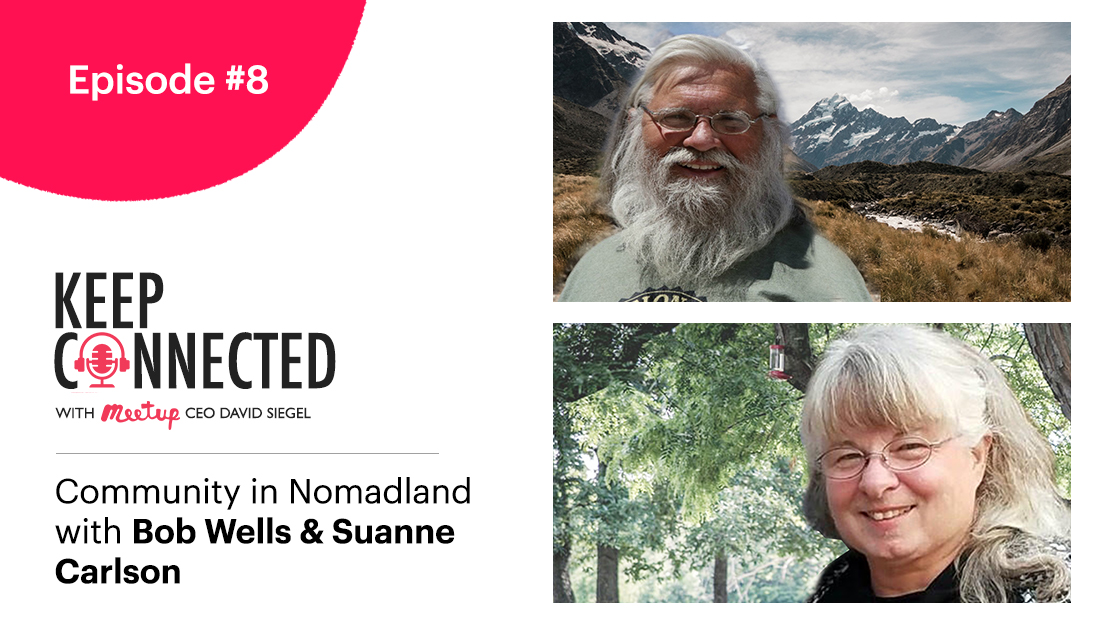


At Meetup, Bob Wells and Suanne Carlson are well-known group organizers who help nomads and van dwellers find community on the road. You may know them from their autobiographical roles in the award-winning film, Nomadland. In this episode of Keep Connected, Bob and Suanne discuss their film debut and the liberating life philosophy behind nomadism. Tune in to learn how community is an essential part of, rather than a contrast to, the nomadic lifestyle.
Ranked as one of the top 25 CEO podcasts on Feedspot, Keep Connected with Meetup CEO David Siegel is a podcast about the power of community. For more details on other episodes, visit Keep Connected on the Meetup Community Matters blog.
We hope you’ll keep connected with us. Drop us a line at podcast@meetup.com. If you like the podcast, be sure to subscribe and leave us a rating on Apple Podcasts!
Learn more about Keep Connected host David Siegel’s experience as a leader and decision maker in his book, Decide & Conquer. Pre-order your copy today!
–
Community in Nomadland: Show Notes
Welcome to Keep Connected. I’m David Siegel. We have a real treat for you today. We have Bob Wells and Suanne Carlson, the inspiration of the award-winning film Nomadland are here to talk about the way in which they have built a community that has helped millions of people, and how Meetup has been so instrumental as part of building that community.
I really enjoyed listening to the two of them. They come from a completely different perspective than many of the other people we’ve had on this podcast. That fresh perspective is going to make this really enjoyable. Happy listening.
Bob Wells and Suanne Carlson. We are deeply honored to have you on Keep Connected. Many of our listeners may have read or see Nomadland. So Bob, you’ve influenced millions of people through cheap RV living, 50 million views, which is just amazing and mind boggling. Help us to hear a little bit more about what motivated you when you first started and what continues to motivate you today and how those two things may have changed.
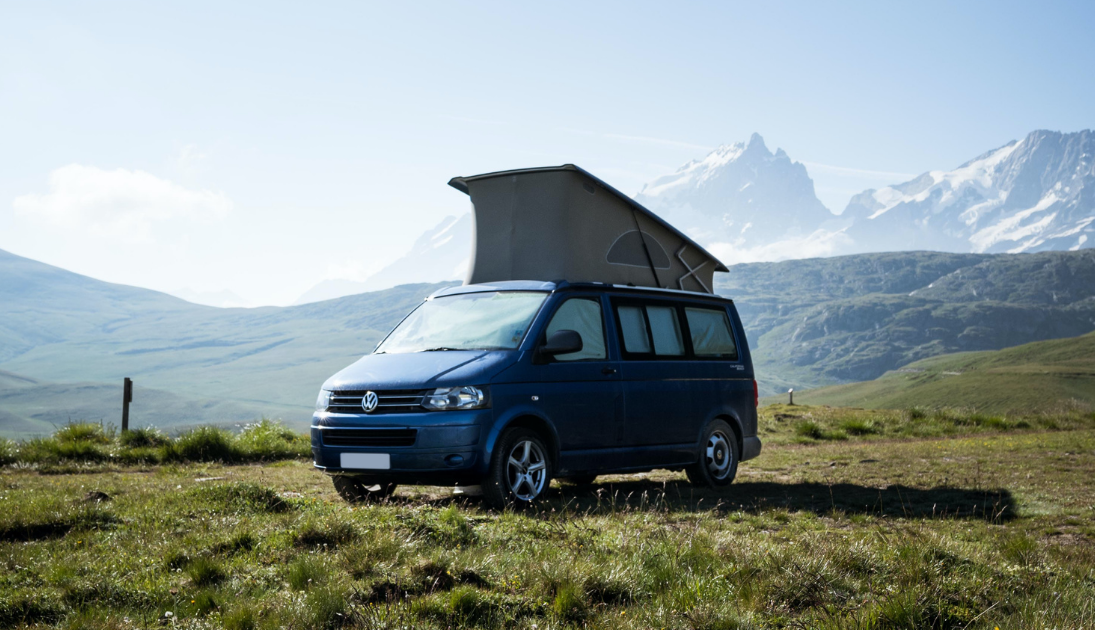
BW: Well, it was pure selfishness and what motivated me initially is I needed a place to live. I was going through a divorce and I couldn’t afford to run two households all of a sudden. I had been a camper and a backpacker all my life. I knew how to camp and I thought, “Well, I’m good at camping, aren’t I? That’s the cheapest way I know to live.” I drove to work every day past a car lot that had a van for sale, an old beat-up box van. I said, “I can live in that really comfortably.” I bought it and moved in and that’s how I was introduced to living in a van.
Initially, I was actually ashamed of it. You’re going through a divorce and you’re fighting about everything. the emotions are in complete turmoil. It was a bad time already. Then add on top of that, I’m a homeless bum living on the street. It was a hard time. Then eventually I fell in love with it. It so radically changed my life. I looked at all the people that I worked with, and a lot of people around me, and they didn’t like their lives any more than I did. I had found a way out and so I felt an obligation, over a period of time, to tell people about it, that they had a choice, that their lives could be better. So that’s the reason all of this has happened.
Bob, do you remember the moment when the shame that you talked about kind of turned into love and acceptance? Was there a particular moment or did it just happen over time?
BW: It was a very gradual thing because I was a backpacker. So right away, the first thing you have to do is, “How am I going to live in a van?” I mean, that’s crazy. No one lives in a van. The first few nights in particular, but months and months afterwards, there’s a lot of fear. Who’s going to … I’m living in a van. You’re not supposed to do that. Someone would knock on the door and arrest me and shoot me and beat me up or what’s going to happen?
It was a very long and gradual thing, solving all the problems. How do I cook? How do I eat? How do I sleep? As I solved them all, because I knew how to camp, and that’s basically I’m going camping in a big steel tent. I figured it all out. Then the big thing was the first of every month when I didn’t pay rent. I kept that money in my pocket. That’s a pretty life-changing experience. Then over a period of time, I did. I just found the freedom of it, all the positives, which that first few nights, I had no positives, just negatives. As the positives built up, gradually, I fell in love with it and the positives drastically outweighed the negatives.
I’m guessing as you start to help people, those positives just kept increasing multifold.
BW: Right. Very, very, very much so. Yeah, quite a bit later, I started the website. I started the website before I did anything else, cheapRVliving.com. I had joined a Yahoo group. Back then, this was … I first moved into a van in 1995. Well, the internet was not much in 1995. It was there, but nothing compared to what it is today. Then later on, I joined a Yahoo group. I mean, that dates it. That was back in the day.
It does.
BW: That was one of the very early successful attempts to gather together on the internet. But I loved it and I love the community that it was building and the ability to help each other. That was the motivation to start the website in 2005, was to teach and inspire. I said that, and I’ve said it all along. The goal here is to teach and inspire.
No doubt you have. Suanne, you certainly teach and inspire as well to millions of people that you reach in all the different avenues. You had come out of a ten-year retirement, if that’s right, and have always been interested in the van dwelling and van life. You’re not just the day-to-day leader of Homes on Wheels, but you are also a member, shall we say. Tell us a little bit about what motivated you initially and what motivates you today?
SC: When I retired in ’08, I had this kind of thing in the back of my mind that I wanted to travel. It’s something that I had not done before. But concurrent with my retirement, my daughter was diagnosed with brain cancer and subsequently passed away eight months later.
Somehow in my core, I knew that being on the road and being in nature would be a healing experience for me. I’m a researcher at heart and I Googled and I found that Yahoo group, — the same Yahoo group that Bob just spoke of– and then also found his website and other people’s website. I thought, “Well, I could take my Prius and I could travel.” True enough my instincts were right, that the going down the road was indeed releasing of that grief and that anger and everything else that one goes through when you have such a death. And then being in nature was that filling up and that healing and just the experience of becoming different, but still whole again.
For me, that’s a huge motivation for having Homes on Wheels Alliance and being a proponent of the nomadic lifestyle. Just like Fern in the movie and what you just heard from me, it is a whole making experiencing. It is something that I want everybody to know about, that you can heal.
Then one of the really huge bonuses for me is when I went out for this, it was a six-month National Park tour is how I coined it. I met Bob. He had said that he was going to be bringing a few people together. It was like 13 of us or something like that.
BW: Yeah.
SC: Actually exactly where we are now, right now, I’m from Nevada. In addition to the healing on the road and in nature, I found my people, which I had never had before, my community. I just can’t say enough about that. These are friends and comrades like I’ve never had before.
The goal here is to teach and inspire.
Suanne, you just spoke about community. It’s such an interesting dynamic, individualism and community, and that when you think about certain forms of social structures or the kibbutz, for example, it’s all about the community and the individual is kind of oftentimes subsumed. Then the capitalist life that many of us lead, including myself, is all about the individual, unfortunately, and too little about community. It’s a fascinating thing because actually when I close my eyes and I think about the nomad lifestyle, I actually think about incredibly high individualism, but also incredibly high community. That’s a really fascinating duality that it’s kind of both of those things. I would love both of your perspectives on how could something be both when in theory they’re both potentially conflicted with another, or perhaps they don’t conflict with each other, just riff on that a little bit, because I’m sure you have a whole lot of thoughts on it.
SC: The thing that comes to mind is that yin and yang. They’re part of the same hole. I think some of us need more yin than yang and then some of us may need more yang than yin. The thing that’s really cool about this community is that I can be with other people when I went to and I can be alone when I want to, and nobody thinks that’s weird. Bob and I will camp together and be so many feet apart and maybe not even see each other for the day. But then the next day we’ll spend a couple of hours chatting outside of one or the other’s rig. I think it really is a recognition among community members that it’s okay to be introverted, that there’s nothing wrong with you if you don’t want to come out to the campfire.
BW: Well, I like to research and learn in everything I do, because I have become a leader in a community and fashioned myself to be one who says, “Follow me. This is a good path.” I like to make sure that I have a scientific, reasonable, rational basis for everything I do. That’s very, very, very important to me.
I’ve done a lot of research on my own self and my own journey through nomadic living. I think the key is to return to being authentically human. Because when you’re in a society, you are no longer authentically human you’re molded by the society. You’re molded by every society. You cannot have a civilized society that does not mold its people into what it wants them to be. It’s just the nature of the beast. I started researching the anthropology and the psychology of humans, and we have lived in civilized societies for about 10,000 years. Well, homo sapiens have been around for around 250,000 years and only 10,000 of it have we lived this way. Can you call something that’s 10,000 years out of 250,000 years or millions of years of evolution before homo sapiens?
No, this is not authentic human living. And in the world of evolutionary science, and evolutionary biology and psychology, they have a phrase. It’s called environment of evolutionary adaptiveness. So how did an organism evolve? What was the environment? That is the healthy, normal, rational, reasonable environment for any organism, any biological organism, to live in. You take it out of that, the organism suffers, period. And radically alter it, and the organism dies.
And almost by definition, that’s what it was in its initial state. It evolved into that for a reason. And taking it out of that, so please continue.
BW: So it evolved in a round peg, round hole, but if you’re taken out of that and put in a square hole, just to make it as simple as possible, you don’t fit. Something’s wrong. You’re pounding away. You’re not fitting. This isn’t right. And you know it’s not right.
Well, we live in a society that is not right. And it is an objectively not right because we have 2 million years of history. Carl Jung speaks a lot about the archaic self, the 2 million year old self. So what would an authentic human life look like? It will look nomadic because that’s what they all were. You gathered together in small units and small tribes. And when you outgrew this area, you moved to another. When the climate changed, when the season changed, when the game changed, when the growing season changed, you moved. That’s an authentic human life. And so, really, my goal has been to return to an authentic human life.
And so in any hunter-gatherer society, no person could tell another person what to do. That was just not… It couldn’t happen because they would just walk away. They didn’t like what you said, they’d walk away, or they joined another tribe. They create their own tribe. They’d kill you. So at once in all hunter-gatherer societies, the individual is primary, but the group is primary. And while there are opposites, look at the Native American peoples before the arrival of Europeans, no Native American could speak for the group. No Native American could tell another Native American what to do. And yet they existed as an integrated whole. That’s the nature of being authentically human and we are returning to it. And so that’s the goal.
Beautiful. I love how you speak about the primacy of both the group and the individual, as well as the yin yang side of things.
Suanne, why have we lost that authenticity? Is it because of, whether it’s guns, germs, and steel, and power dynamics, what is your hypothesis of why we’ve lost that?
BW: Well, to me, it goes back to the simple fact that, instead of allowing earth to provide, you ripped it away from the earth. That’s the essence of domestication. So you go in, you clear a field, you kill every single living thing in a field. And then you grow only what you want. And anything that competes with it, you kill. So you are now at war with the earth. And until then, we had lived in harmony with the earth.
And once you decide that you’re going to live at war with the earth, a very close second, is you will live at war with each other, because now this is my land and these are my crops. And you need a lot of people to do that work, but I don’t want to share. And now, while the basis of all hunter-gatherer tribes, the highest value was generosity. You have extra food, the best place to store it is in your neighbor’s stomach, because tomorrow when the hyena was after you, he was there to help you and he was strong and healthy. So it’s a completely different world view of self versus group and domestication by its nature sets you in conflict with every other person in the tribe. This is mine. And I can’t share it with you.
There’s a scene in the movie (Nomadland), Bob and Suanne, where someone has a flag on their van. It looked like a pirate flag or some other flag. And it meant that you shouldn’t be disturbed during that time. Is that authentic and true to allow people to have their space?
SC: Sometimes we do use indicators that were available or not available. Charlene Swankie, that is truly what she uses. She puts that pirate flag and you just don’t bother her. When we’re at larger gatherings, when there’s a lot of nomads together, sometimes we’ll use surveyor tape. Green means I’m available. Red means don’t, don’t bother me. Kind of the universal way that we often use is if I’m outside of my rig, sitting in my chair, that means I’m available for a conversation. If I’m inside my rig, even if my door is wide open, but about 20 feet away, you call out my name. One thing the movie showed, that we rarely don’t do, it showed that people knocking on other people’s rigs, we don’t do that. We actually call out and say… My thing is, I’ll be 20 feet from Bob’s rig. And I’ll say, knock, knock, Bob, are you there? Or something like that.
So there are clearly languages and behaviors that are developed within the community to really build the primacy of both the individual and the group, which is incredibly interesting.
The topic I wanted to kind of hit a little bit more on is, in the movie, I was really moved by the healing power of van dwelling and the nomad life that Fern needed as after her husband passed away. And when I talk with the two of you and, and Bob, you spoke so movingly in the movie about your son and Suanne just shared with us some thoughts about your daughter, obviously for those going through pain in their life, the road, the community, travel, being one’s authentic and real self is cathartic beyond. For those people who don’t necessarily have those pains, although everyone has some pain, don’t necessarily have those pains, all about joy, not necessarily needing the road to recovery, shall we say. Talk about that a little bit in terms of van dwelling and the nomad lifestyle and how it’s helpful really for all people in terms of, from a community standpoint?
BW: Well, the way I like to think about it is that nomadic living is a big tent. And so in the tent, you’ll have many different age groups and economic groups, and it is a very wide range. So for example, I, because I’m older, I am mainly speaking to older people. And and you get to be our age, there’s been death in your life, and there’s been loss, and there’s been grief. And for a lot of us, there is economic catastrophe in our lives. And so that paints this group broadly and it’s not always like that, of course, but there’s quite a bit of that in the older group.
And yet what you’ll find now is a whole new younger group for whom that is not their experience at all. They have maybe never experienced death, maybe never experienced loss, or financial disaster. They are pursuing simply a better, higher quality of life, a more authentic life. They can see, this is not an authentic life I’m living. There has to be more to life than this, and they get wind of this remarkable way to live nomadically and their heart just says, “I want that.”
And so it’s a big tent with a wide spectrum, and yet it’s almost like politics. If you go far enough right and far enough left, they come back together. Well, if you’re 30 and you’re just pursuing a great life, or if you’re 70 and you’ve just had so much hardship and grief, and you’re pursuing something better, we come together under the joy of this commonality of the nomadic life. So we can verge and meld in that.
That’s really beautiful. One of the things I frequently say about Meetup, one of my favorite things about Meetup, is when there’s a Meetup event and there are people in their seventies interacting with people in their twenties and thirties, and they wouldn’t necessarily do so. People in their thirties spending time with people over double their age. There’s, unfortunately, a lot of age-ism in this world in both perspectives and both sides. Oh, those millennials they’re terrible. And, oh, those seniors, what do we have to learn from them? And that’s just so unfortunate.
A friend of mine goes to a horror show, a Meetup group once a month. And he said, there’s an 80-year-old and there’s a 20-year-old. And he’s 50 and it’s the greatest experience for him. So I absolutely love that. It really works well on both sides. We’re just talking about Meetup a little bit. I know you created Caravan Connection, which is all about helping to share some of the best practices that Bob has shared to 50 million+ people, which is absolutely amazing, on cheap RV living and help people. And you created Meetup groups and you use Meetup and we’re so appreciative of it. Anything you could share on how you use it and why you use it, and just would love to learn from you here.
SC: Sure. Bob’s brainchild is the in-person caravans. And he started that under the auspices of Cheap RV Living and then shared it. We adopted it. And so the idea was to bring people together, especially people new to the road so that they were not alone. And they could have that kind of community in person to just learn the ropes around the campfire. It’s one thing about classroom learning, but there’s nothing like doing it for real and with people around that can apprentice you.
So we have some constraints when we meet in person and we can’t have too many people, and it can’t be organized like teaching or anything like that. Everything has to be recreational and kind of impromptu. In order to do that, we needed a way to manage the numbers. So I did some research and Meetup popped up and that was our initial introduction to Meetup.
I love it.
SC: Yeah. It really worked. Now what Meetup has continued to do for us is it provides not just a way to RSVP so we can manage numbers, but it also promotes the community, and the chat. They can talk, they can share pictures. And what they started at their two-week caravan camp can continue on. They can share contact information and that kind of thing.
What happened then with COVID is we’re not going to meet in person, right? So now what do we do? We morph that into the virtual Caravan Connections. So now we meet weekly. And it’s the same thing. It’s community building, it’s people learning from each other. It is in fact a virtual campfire. So you have newbies and you have experienced nomads. Now what’s really cool about the virtual Caravan Connections is that you don’t have to be a nomad to be there, unlike the physical ones. And it’s been so successful that we are now taking steps to formally call it a program that will continue beyond the end of COVID. I really appreciate Meetup’s ability to turn on a dime and provide the functionality that allowed us to have online meetings.
Oh, thank you.
BW: The Meetup app really has provided a huge service to us. I don’t know how we would proceed without it.
Have you, just, I’m curious, have you had people from other countries during the events now that it’s online and you’re online, you see someone coming in from Kenya? Or tell us about that a little bit.
SC: Yeah, mainly the other countries are Canada. But we do have some folks visiting from European countries. We have the pro version of Meetup that allows me to go in and see where people are from. And for our annual report, I just did an analysis and there’s a scattering of folks from European countries. Not a whole lot, but enough that it makes me call our virtual Caravans international.
Nice. This is only the start of Homes on Wheels and many international additions I’m sure to come. For someone who’s living the more standard, as Bob might say, less authentic, not to cast dispersions, of course, but less authentic, less connected type life, what can we learn from van dwelling, from the nomad life, and incorporate that into our daily lives? Because our goal isn’t necessarily to always be extremes, but it’s to take things from all different experiences and incorporate them into our lives. But what are the two or three things, I’d love to hear from each of you, that we could take and bring to our lives the way we lead them today?
BW: Well, I think that is a very, very important point. And I love my life so much that I kind of give the idea it’s all or nothing, and it is not. It can’t be for everyone. Not everyone’s going to go out and do this. So I like to think of it as nomadic principles rather than the actual nomadic life. Well, for one thing, we’re not all going to go back and be hunter gatherers again. I mean, there’s not enough game around. It’s not going to happen. But there are certain principles in nomadic living that you can adopt right in your home and just take with you to your job.
And I like to think of them as minimalism. For a nomad, things are a burden. They’re almost more of a negative than a positive. So that’s number one. And number two for me is we need each other so desperately. Yeah, I have to have my individuality, I have to have my space, but I need you. And so making a connection with you and I, and keeping that proper balance, I’m me, you’re you, but we’re we as well. I, you, we. And so those are just principles you can start to adopt where you are. Generosity, thinking about other people, connecting other people. I tell everyone, you can start right now by reducing the number of things you have around you.
I kind of like to think of it this way. We love people and we use things. That’s the nomadic idea. And in this society, we have warped that and twisted that around until now we love things and use people. And so if you could just chase that idea down. And the third most critical thing, and anyone could do it, is start to reconnect to nature. Wherever you are right now, there’s a green space near you. So if you just went out and had a picnic, try and do it as often as you can, but go get a camp stove and go and make camp, make dinner on a picnic table and your life will be become better.
I love it. And Suanne I want to hear yours, but before, I’m just going to comment on one of Bob’s which is I was talking to a friend of mine this morning and he said, “How are you doing?” I said, “Well, it’s 60 degrees outside, I am as happy as can be because I am outside and walking and feeling the sun.” And it’s an amazing thing, I could look at the weather and that’s my happiness index. If I see a 30 degrees in New York in April, I know I’m not going to be happy, and rainy. And if I see it’s 60, 70 degrees, I know I could be outside with the sun, walking, hiking, and be connected. And it’s human, it’s human. And that’s the bottom line. We have to connect to who we are, ultimately. Thank you so much for that, Bob. Suanne, you might have some of the same things, but I would love to hear them.
SC: Well, for Bob, I’ll just say ditto, ditto, ditto. Those three principles are right on. And so I’m just going to spin off on a few of them. I think being on the road and being in new places that you’ve never been before, in cultures that you never experienced before, even if you’re going from let’s say the Midwest into New Orleans, those are two very different cultures. And it expands your appreciation for the human being and for ways of experiencing life that you’ve never ever experienced before. Also, trying new environments in nature that you’ve never been before. I come from the Pacific Northwest, green, rain. And when I first saw the desert, I thought there’s no way ever I’m going to love this. But after being a nomad and spending so much time in the desert, I absolutely adore it. Not only do I adore it, but I can tell you what kind of desert we’re in based on the animals that are there or the plant life or the seasons. A personal expansion experience, that is part of what nomadism is.
Beautiful. And I think when you’re traveling and you’re exposed to people who are totally different than you or you’re in a community that’s totally different than you, to me, that’s the ingredient for reducing ignorance, reducing xenophobia, reducing racism. The ability to connect with other people when you become a part of their lives and what they surround themselves with. And the other thing that I think it engenders, Suanne, and you were certainly talking about is just gratitude. When you able to see how some people are living and the challenges that people have and the opportunities that people have, you feel a greater sense of gratitude for yourself. And I’ll take a big heaping of gratitude over almost anything else, because people could be healthy and not have gratitude. They can be happy and not have gratitude, but gratitude can compensate and support everything, for that matter. And I think that’s a lot of things that you were talking about.
I just have one other thing I just have to ask you about, which is the movie (Nomadland), nominated for an Oscar, it’s already a win between the book and the movie and everything that you’ve been able to accomplish. I have to ask, favorite part of the movie for each of you? And maybe the part of the movie that you could have done without?
SC: I think Chloe, the director, Chloe Zhao did an extraordinary job of showing who we are as a nomadic community. I think it showed the community, I think it showed our connection to nature, and the healing power that Fern had. So I think that’s my favorite part. This is really nitpicky, but I wished it wouldn’t have showed people knocking on people’s vans. I don’t want anybody knocking on my van. In the van dweller community, when we hear the knock, that means that law enforcement has found us. And so that’s the knock.
David Siegel:
Not good, knock good. Okay Bob, let’s hear from your perspective. What are the one or two add-ins that just really struck a chord for you?
BW: Twice in the movie, a friend or a relative offers Fern a way out, they came to rescue her. Because it just had to be obvious that what a horrible life that is living in a van, I’ll rescue you and take you out of it. And she said in both cases, no. “No, I don’t need rescuing. This is my choice. This is what I want.” And so the other thing that I think is too often missed is when she goes back to her sister because she needs help to get help, her sister says, “You were always this way. I’m not surprised you’ve ended up like this.”
And so in a sense, it’s not spelled out, that’s the great thing about this movie, nothing is spelled out. You’ve got to pay close attention and gather information and find the heart of it. I think that was true of Fern, the fictional character, Fern. She had always been called to be a nomad, but she had found her husband and she found a wonderful life in Empire. And she looked back on it with gratitude and love, but it was never her authentic self, and she knew it. And so as soon as she had the opportunity, she grabbed it.
Even when she was in Empire, the thing she liked the most about it was her backyard which had this open desert. As we all get older, we look back on decisions that we’ve made 10, 20, 30, 40 years ago and are like, “Wow, I don’t know why I made that decision, but now I know, later on in life.” And what had resonated with her so much in her standard life that she had was actually a nomad component to it and the nature component to it, as you said.
BW: She always was looking out at the mountains and thinking, “I’ll just walk out there one day.” Our society doesn’t let us be our authentic self. Part of my goal is to say there is an option. You could have both that life with your husband in Empire and go. We both knew a lot of women who are married and are older and they go home in the summer and they might spend two, three, four months out on the road alone because that is their authentic self. And they’ve found that balance in that way. It’s amazing how often it’s the woman who’s the adventurous one and not the man.
SC: Right.
That’s super interesting, actually, incredibly interesting. And is there, if you don’t mind me sharing, is there a part [in the film Nomadland] like the knock on that door that you just, “Oh, I wish they didn’t necessarily do it that way.”
BW: No, I really found it to be incredibly, incredibly authentic. Yeah. For me, my knock on the movie. Let me just say that, not any individual thing, because I can’t really think of any. My knock on the movie is that I personally would have liked to seen more of the balanced towards less of the sorrow that she’s moving out of and more time on the healing and the joy. But it’s everyone’s experience is different and this was the authentic journey of Ferm, one person. And it was truly, totally authentic for her.
And that leaves time for Nomadland 2, when it comes to a theater near Austin in a few years. So one of the things we like to do before we fully wrap up is just ask you to a couple of super rapid fire questions. So are you ready for some rapid fire?
BW: I’ll do my best.
SC: Sure.
Okay. Earliest, earliest memory for you of where community helped you in your life.
BW: I don’t think I can answer. I don’t think I have an answer.
Teen years, early twenties.
BW: I got nothing.
Perhaps that’s what drew you to community, because you didn’t necessarily have that. And you knew how important, how much missing it was perhaps, but I’m not going to psychoanalyze. Suanne, how about you?
SC: Yeah. I would definitely say what your statement that I really did not have friendships growing up. And so I was going to expand the idea of community to family. And I remember my aunt showing kindness toward me when I was a younger child, because I felt lonely in that particular situation. But when I say I’ve never had friends like I have now, that is an absolutely a hundred percent true statement.
Wow. Well, thank God that you found this group. Second one, Suanne, first job.
SC: My first job was a bookkeeper for Culligan Water.
What is Culligan Water?
SC: It’s a water softener company. That was right out of high school. I was unhappy and found a place where I felt like I could serve people in a drug rehab.
That makes a lot of sense. Bob.
BW: When I was 16, I got a job as a bagger in a grocery store, my first job.
Okay. You can access a time machine. You can go anywhere you want, anytime you want, you go back to 10,000 years ago when we were hunter, gatherers, where would you go? Not to live, but just to visit.
BW: I’d go to see Abraham Lincoln.
SC: You took my answer.
BW: Really?
SC: You seriously did.
BW: Just someone I admire.
SC: Yeah. For me, the country was so divided, not unlike we are now. And I think he was a great bringer together. And I’d like to pick his brain. I would like to be inspired.
Well said. Is there a first time you saw yourself as a leader, Suanne?
SC: Probably Girl Scouts.
Very nice. What’s nice about that is a connection to nature, of course, as well.
SC: Exactly.
Bob, how about you?
BW: I guess here in Cheap RV Living and HOWA is the first time I really saw myself as a leader.
Did it take a while to see yourself as a leader, Bob? Or do you feel like it was fairly natural to you once you got started?
BW: I think of myself as primarily a number two. I think of myself as a follower, as an assistant to someone. That is how I’ve always thought of myself primarily. And here, I hope it’s my goal to remain that and to surround myself with really smart people, and to be the number two while I’m number one. One of my favorite quotes is, “If you’re in a room with a bunch of people and you look around and you’re the smartest people, smartest guy in the room, you’re in the wrong room.” And that’s how I look at myself, is I look around and see that I surround myself with really smart, capable people.
Well, it speaks about servant leadership. And your leadership style is not to tell, it’s to serve. Both of your leadership styles are to serve. And it’s evidenced by everything that you do, how you occupy your time and how you build your energy. Really, truly the last question, how do you want to be remembered, Suanne?
SC: She led me into nature.
Bob.
BW: Right after the year my son had taken his life, I really severely broke my elbow and my wrist, really severely. And I was camping outside of Victorville, California, where I was going for physical therapy to recover. The doctor said if I didn’t work really hard at physical therapy, I’d lose all use of my right hand, my dominant hand. So I was working really hard. And so I was there and that’s where I was there. I lost my son. I was facing the loss of all use of my dominant hand. It was a really, really bad time. I was in town one day, probably in for physical therapy, and there was a horrible accident and a person was killed. There was a big article about the accident, because it was a really big actually, it closed the freeway, I-15 through Victorville.
And I was told that this guy was killed because someone, an older person who had driven, gotten on that freeway by accident was driving the wrong direction. And I had just drove past it, that’s part of the story. I watched the accident happen in front of me. I was the last person to get past them before they closed the freeway. So it really stood out to me. It was an experience. And I’m going through all this other stuff. My life is coming to an end all around me, very powerful moment in my life. And so I read this guy’s, the story on the paper the next day or the day after. And they talked about this guy who was killed. They tell the story of… I mean, there must have been two dozen people talking about him, about how he had impacted his life. And he was no one, no one would know him from Adam.
And I remember thinking to myself that, what does that mean? This is the kind of thing I’m thinking about. I’m facing the loss of the use of my hand and my son has died. And I’m wondering if I should live. Every morning, I wake up and think to myself, “Why am I alive on this planet when my son is gone?” And I had to have an answer to that question every morning for a long, long time. So it was just this moment in time in my life. And I read this guy’s story and I think, “This is a reason to wake up in the morning, every morning. That when you die, all these people come out of the woodwork and say, ‘Oh, I’m so sorry to hear that. He was one of the good ones.'” And so that has been a motivating factor in my life. What does it mean to have lived a quality of life? That it is, that when you die, people say, “I’m so sorry. He was one of the good ones. He impacted my life in this way.” That’s very, very important to me.
It’s a powerful story. I have oftentimes said to people that my most motivating thing in life is actually death. Because if you didn’t die, you wouldn’t have the finality and the focus to make sure to live the short life that we actually have to the absolute fullest. And a big part of that is, as you said, Bob and Suanne, is trying to help other people to be their authentic selves, is to help to show up for each other, and really ultimately make the world a better place one person at a time. Thank you for your inspiration. Thank you for motivating me personally. I look forward to seeing if I could join a online Meetup nomad event. And I really enjoyed today’s conversation, and best of luck in terms of the awards. But obviously, the ultimate award and reward, you already have, and that’s the important thing.
BW: Yes.
SC: Thank you very much.
BW: Thank you.
SC: It’s been my pleasure, our pleasure to be here.
BW: And thank you for your service for Meetup. It is service. You are changing lives. Most of us don’t know you and know what you’ve done, but you have, you’ve changed lives.
Thank you so much. Enjoy the warm weather that you have. And that is a wrap. Thanks for listening today. So many takeaways, I’ll just choose our top three. Here we go. Number one, the nomadic principles that could apply to all of our lives. Not everyone is going to become a nomad, but we all can learn from nomads. Number two, to return to being authentically human really resonated. And finally, that rugged individualism and being a deep community member are not antithetical to one another and how they truly support each other. We’d love for you to subscribe. Review us on Apple podcast. And remember, let’s keep connected, because life is better together.
–
Important links
About Bob Wells
Bob Wells is an American vandweller, YouTuber, and author. He is noted for being an inspiration to thousands of people who embrace a minimalistic and nomadic lifestyle centered on vandwelling. Wells founded the Rubber Tramp Rendezvous, an annual gathering of vandwellers in Quartzsite, Arizona, and Homes on Wheels Alliance, a charity organization dedicated to the promotion of vandwelling. (source: Wikipedia)
About Suanne Carlson
Suanne earned her Master’s degree in Education, Adult Education Administration. She worked for the Washington State Community and Technical Colleges for 24 years, serving her last nine years as the Director of Online and Distance Learning at the statewide policy level. For the ten years of retirement before co-founding and accepting the Executive Director position for Homes On Wheels Alliance, Inc., she immersed herself in the nomad lifestyle, thriving as a minimalist, exploring back roads, and being in nature. During those 10 years, Suanne served the nomad community as an online administrator, forum moderator, leading women’s gatherings, writing how-to articles, and chronicling her travels. As Executive Director for Homes On Wheels Alliance, Inc., Suanne will manage the day-to-day operations of the organization and steers it to success and long-term sustainability.

Last modified on December 13, 2021