
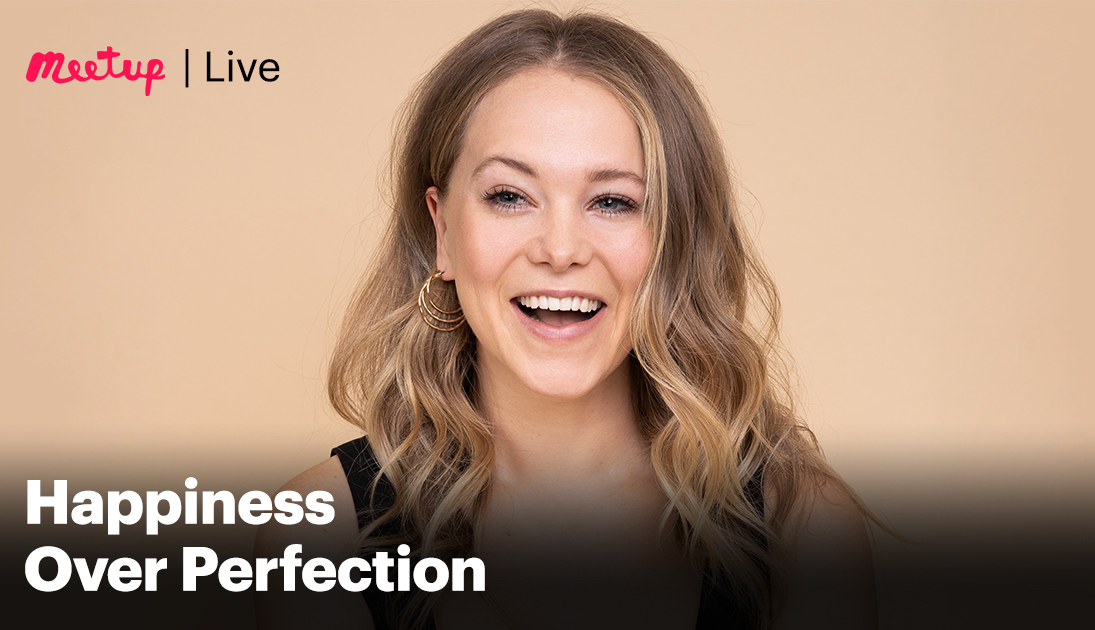



Watch Poppy Jamie, author of Happy Not Perfect: Upgrade Your Mind, Challenge Your Thoughts, and Free Yourself from Anxiety, for a discussion on how to reshape your mindset and adjust destructive patterns. Poppy will share the science behind rewiring our brains and the power of flexible thinking. She’ll also explain how to let go of setbacks, lean into love, rise above fear, and create a future that is exciting.
Main Takeaways:
- Our basic human needs is to feel love, to feel safe, and to feel accepted. Social media has almost taken those basic human needs and put it on steroids, because suddenly this idea of belonging comes along with the double tap of a like which became a form of external validation. If you take us back to our more primitive beginnings to feel a sense of belonging and a tribe, that was an easier thing to accomplish, than it is now. Now, we compare ourselves to millions of human beings, not just seven people in a village. Our worth is now attached to this idea of a digital identity that we have part ownership of. Other people’s approval is linked to our self esteem, which has put a lot of additional pressure on our lives and our sense of identity than it ever has done before.
- I personally think that burnout and anxiety are human problems. I think we often think of the young, there are more statistics coming out around young people, but from my understanding, from my workshops, from my research, every single age struggles. I think that perhaps with younger people, there’s less stigma so they’re a bit more vocal about their struggles. The pandemic was one of the first collective threats that we all had against our health, and so I think this is a universal human problem because as I said, we all have human needs, we all want to be loved, we want to feel safe, we want to feel like we belong and that happens to every single age that is the human, that is that is the human journey. So it’s important to ensure that every single age knows that it’s okay to struggle and it’s okay to talk about it.
- I created the flex method, the flex is the idea that we turn ourselves from stiff thinkers, which a lot of us are into flexible thinkers. As stiff thinkers, all of us have a habit of jumping to conclusions and jumping to assumptions. Our stress bubbles up when we expect our day to go perfectly and then suddenly when something goes wrong, in that moment we are not taught how to manage the gap between expectations and in reality. When we’re able to negotiate with our absolute and move into flexible thinking, it preserves our health. It supports our immune system and allows us to be our greatest self which is definitely when we’re relaxed. The flex method is a very quick method that you can use throughout the day. You can use it preventively an act as a practice in the morning or you can use it in the moment when you’re in these hot emotional moments, and it’s based on four steps; connection, curiosity, choice, and commitment.
Top Q&A Questions/ Resources:
- What is one of the best practical ways to get through the stress and over analysis of making decisions?
- Sometimes I think what’s quite helpful is to allocate a decision making time. Actually, say, okay, I’m going to write this in my notes section, and I’m going to think about the decision at 6pm tonight and what you’ll find is throughout the day, you realize that actually maybe the decision didn’t need to be made, or you were able to gain structural perspective on the decision at hand. I think we often get caught up in this pressure to make decisions quickly. So, when we really have to ask ourselves like why do I need to make this decision right now. This enables you to have more space in the day but I haven’t felt like you’re constantly on a treadmill of decision making.
- What would you say to someone whose perceived inadequacies and unworthiness hold them back from meaningful friendships?
- I think learning tools for compassionate thinking is really helpful. Also, I think group therapy is super helpful because in group therapy you’re aware that we’re really not alone. I think often your inner critic can be so loud and then we want to isolate ourselves or separate ourselves because of it. But when we realize how vulnerable other people are, we can take our attention away from us and actually put it on other people. This amazing man called Adam Robinson says your attention can only be in two places on another person, or on ourselves. So when we focus on the other person, we have less time to think about ourselves. Also, practice using the kind of voice you would use to a friend experiencing the same thing. In the book, I talk about naming your inner critic, that’s a really helpful way to separate yourself from that voice. It is a constant negotiation, but there is definitely a lot of the exercises in the book would be able to help with that.
- In this 100% connected world, how do you celebrate rest?
- Boundaries, it comes down to all self-appreciation and also to redefining rest as something that isn’t weak and it’s not being lazy. Rest supports our productivity and really explore what that means to you, there is not one generic solution that is going to be the same since all of us are so different.
- Resources:
- Poppy’s book: Happy Not Perfect
- Happy Not Perfect Website
- Poppy’s Instagram

Last modified on December 7, 2021