
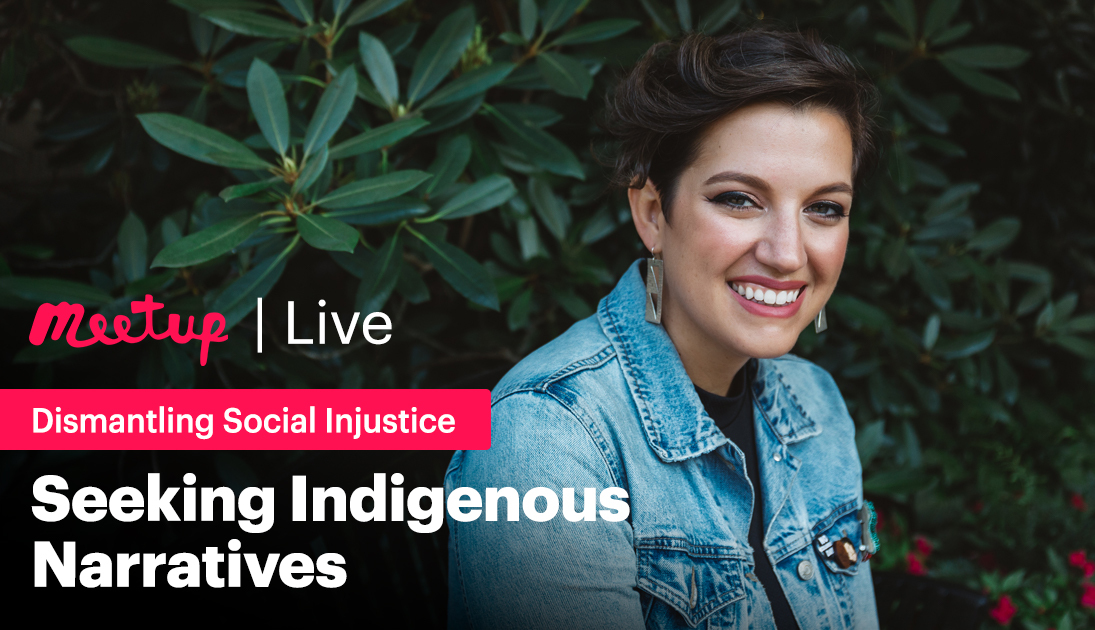


November is National Native American Heritage Month. To mark the occasion, watch this special edition of Meetup Live, where we’ll explore Indigenous perspectives and representations in the media. In this installment of the Dismantling Social Injustice series, learn how to honor and respect the people of the land we occupy.
Adrienne Keene, a citizen of the Cherokee Nation and author of Notable Native People, discusses the invisibility and silencing of Indigenous narratives in popular culture, and the importance of including Indigenous perspectives to challenge stereotypes and misrepresentations. Learn how to seek out Indigenous stories, and how to unlearn the harmful narratives perpetuated by mainstream media.
Main Takeaways on Indigenous Narratives:
- When we talk about indigenous people and what is currently known as the United States, we’re talking about an incredibly diverse group of people. The reality is that for today, the majority of the time we experience misrepresentations, stereotypes or complete erasure.
- 10 years ago, I was writing a ton about Indian mascots and things like the Washington football teams and Halloween costumes, whatever it was. But I didn’t actually think that I was going to see substantive change in any of those areas in my lifetime, But in the last couple of years we’ve just started to see these misrepresentations fall one by one and a lot of that is due to the momentum gained by the Black Lives Matter movement.
- We talk a lot in the media world this idea that representation matters. And I obviously believe in that but I also don’t think that representations are the thing that’s going to save us all. We can correct a lot of this by letting Native people tell their own stories
It’s not enough to hire one Native person on a TV show in the writer’s room. It really needs to be somewhere where the power is in the hands of indigenous people.
Top Q&A Questions / Resources:
- Can you talk about when cultural appreciation crosses the line into culture appropriations?
- I think there’s a lot of misunderstanding of what cultural appropriation actually is, why it’s harmful. The bottom line is that cultural appropriation is taking from a culture that’s not your own with no respect to where those practices or designs came from and ignoring the power structures that are in place.
There’s this great tweet from 2015 by a twitter user that I use in all my presentations. And basically the tweet is how to respectfully participate in someone else’s culture. The first is be invited. Two, follow your host’s lead. And three, respect their boundaries.
- I think there’s a lot of misunderstanding of what cultural appropriation actually is, why it’s harmful. The bottom line is that cultural appropriation is taking from a culture that’s not your own with no respect to where those practices or designs came from and ignoring the power structures that are in place.
- What’s your opinion on land acknowledgements and ways to make them meaningful?
- Land acknowledgement which is the idea of acknowledging whose homelands you occupy at the beginning of an event, or on a website, or as an institution – I think it comes from a good place. I think it is important to do that work of figuring out whose land you’re on. But I think in the past couple of years as they have become more widely spread, it’s become a checkbox without a lot of meaning behind it.
How do we move it from a checkbox to something that has meaningful action behind it? I think that’s where the conversion needs to go.
- Land acknowledgement which is the idea of acknowledging whose homelands you occupy at the beginning of an event, or on a website, or as an institution – I think it comes from a good place. I think it is important to do that work of figuring out whose land you’re on. But I think in the past couple of years as they have become more widely spread, it’s become a checkbox without a lot of meaning behind it.
- Resources:
- Adrienne’s podcast: All My Relations
- Adrienne’s book: Notable Native People: 50 Indigenous Leaders, Dreamers, and Changemakers from Past and Present
- Reclaiming Native Truth
- Native land digital
- TV show: Reservation Dogs
- Hayden King on writing Ryerson University’s territorial acknowledgement
- Newspaper:
- Indian Country Today
- Many tribes have their own newspapers
- Radio: Native American Calling
- Bookstores:
- Birchbark Books (Minneapolis)
- Red Planet Books and Comics (Albuquerque)
- Nā Mea Hawai’i (Honolulu)

Last modified on November 16, 2021