
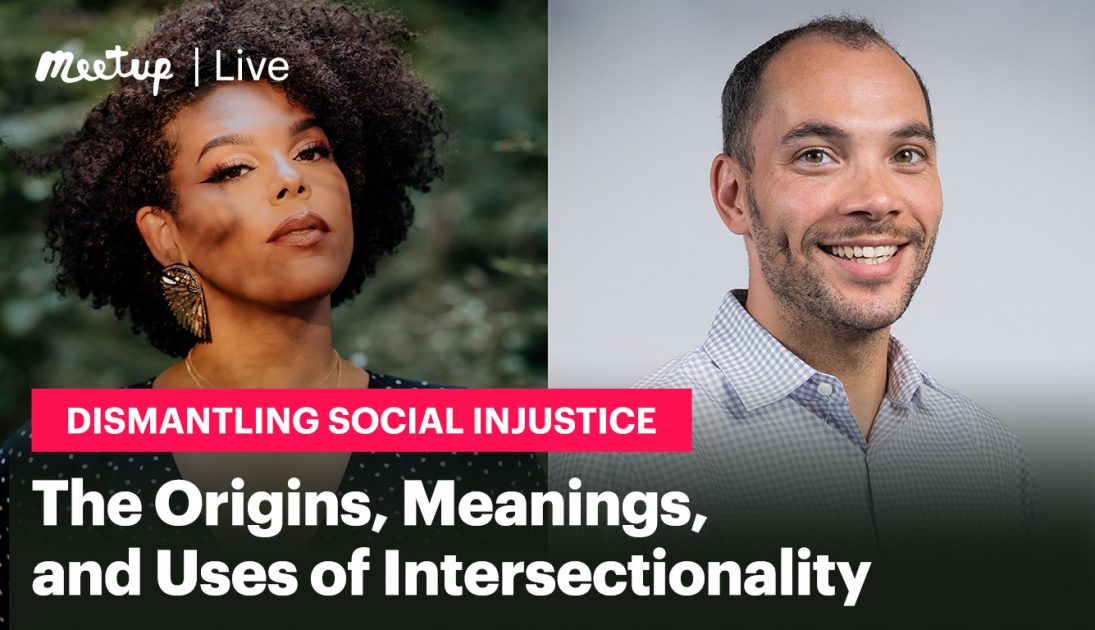


In the next installment of Meetup Live’s Dismantling Social Injustice series, tune in for a discussion of intersectionality, a term coined by the legal scholar Kimberlé Crenshaw more than 30 years ago. In this talk, you’ll learn what the concept of intersectionality is and why it’s had a recent surge in use.
Special guests Aurora Higgs (she/they), Advisor, The Rise Journey and Paul Brown Tucker (he/him), Advisor, The Rise Journey will discuss the origins of intersectionality, why it’s a useful framework for understanding discrimination, and how organizations are using intersectional approaches to combat inequality. Learn how you can apply these principles and make progress toward a more equitable and just society.
Main Takeaways:
- Aurora: intersectionality is the Idea that none of us come to the table as a monolith. When we talk about identities, you know, whether it be your sexual orientation, whether it be your race, or your citizenship status. All of these are different identities, and none of us are just one of these
- Aurora: A really interesting trap that I’ve seen is that people will tend to engage in this oppression Olympics and say, “Well, I can’t be racist or I can’t be ableist because I’m a diverse person and I understand what marginalization and oppression is.” And even for me, intersexuality does not give me a free pass to say, “I’m a minority, and I’m all these different intersections of minority and so therefore, I don’t have anything left to learn when it comes to diversity and inclusion.”
- Paul: None of us who are here today were necessarily responsible for the way this country was founded and yet, we all live here, and the walls are falling, the roof is caving in and there’s water damage. And we can’t ignore that or the house will cave in on us. But we have a history that suggests, “Oh, we threw some wallpaper up, it’s beautiful, there was nothing ever wrong here. And nothing ever bad,” which is not the case. So I think that’s really where some confusion, where some pushback comes from. (Concept attributed to Caste:The Origins of our Discontents by Isabel Wilkerson)
Top Q&A Questions:
- Recommendation on any resources for people who want to learn more?
- Article: Age, Race, Class and Sex: Women Redefining Difference
- Website/Sources: Racial Equity Tools, The Rise Journey
- Podcast: Race Capitol
- Can we hear a specific example and oppression evident from intersectionality?
- Aurora: I’m black, I’m transgender, and I exist as a feminine person/woman. As a black trans woman my community actually experiences fatal violence and are murdered at a much higher rate than any of our peers. We are violated more than just women, more than just black women, and more than just queer people in general. So what that tells us is that the oppression that faces us can not be one-for-one traced to just one of our identities, so it’s a result of our collective identities.
- Many references are being made to “do the work”, can we break that down any further?
- Paul: Thinking about the personal, the interpersonal, the cultural, the institutional and noting that those different levels, different things are going to be called for. Thinking about those levels of analysis and thinking about the strategy we use at each of them.

Last modified on September 2, 2021