
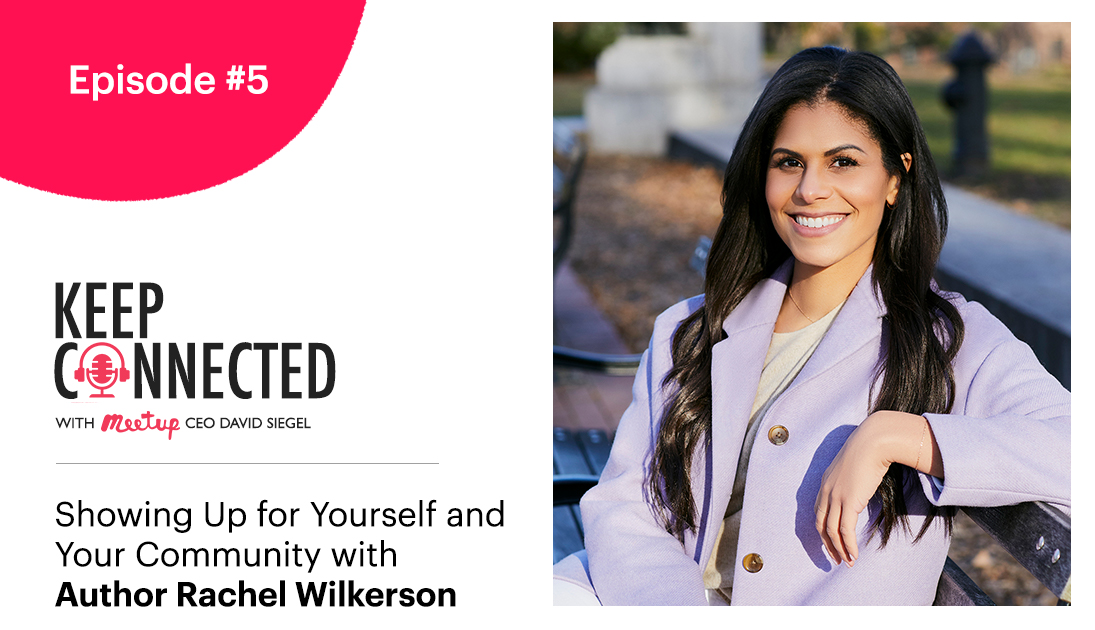



In this episode of Keep Connected, Rachel Wilkerson Miller, Deputy Editor of Life at VICE and author of The Art of Showing Up, explains why being there for yourself is an important part of being there for others. You’ll hear her concrete advice for caring for yourself and your community in the midst of a pandemic, tips for staying organized, and lessons on how listening to your needs can lead to more meaningful friendships.
Ranked as one of the top 25 CEO podcasts on Feedspot, Keep Connected with Meetup CEO David Siegel is a podcast about the power of community. For more details on other episodes, visit Keep Connected on the Meetup Community Matters blog.
We hope you’ll keep connected with us. Drop us a line at podcast@meetup.com. If you like the podcast, be sure to subscribe and leave us a rating on Apple Podcasts!
Learn more about Keep Connected host David Siegel’s experience as a leader and decision maker in his book, Decide & Conquer. Pre-order your copy today!
Show Notes
In this episode, we’re talking to Rachel Wilkerson Miller, the author of The Art of Showing Up: How to Be There for Yourself and Your People. You’re going to learn a lot about community and friendship, and you’re hopefully going to learn a lot about yourself. I hope you enjoy this episode.
—
Rachel Wilkerson Miller, thank you for joining us. We’re so glad to have you.
Thank you so much for having me. I’m excited to be here.
Before I give the introduction, we were supposed to record earlier. I ended up coming down with COVID, you ended up coming down with COVID. It is bizarre. I hope you’re doing better.
I am. How about you?
Everything except for smell. I have three teenagers at home, so sometimes having less smell is not a bad thing.
Fingers crossed that it comes back soon.
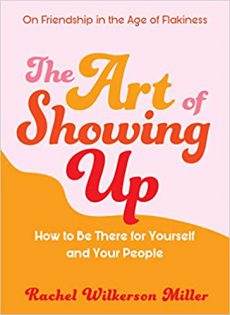
I hope so. I’m so happy to have you here. You are the Deputy Editor at VICE Life and the author of The Art of Showing Up: How to be There for Yourself and Your People. You’re also the author of other books, and you host a podcast. When I hear about showing up, the first thing that I think about is how important showing up is to community. Clearly, community is something that’s always been important to you. I’d love to hear about what motivated you around community and what inspires you around community. Let’s start with that.
It starts when I was young. I grew up in suburban Michigan and went to a Catholic school for most of my life that had a wonderful built-in community. People were loving and showed up for each other as second nature. My mom and my grandma were both very much that way, that if something needed to be done, if somebody needed to borrow something, if they needed something fixed, we jump in and did it. It instilled in me this sense of service to your community. I went to college and I joined a different community, which was the Greek Community at Michigan State. A community with a different purpose.
That was not a Catholic community.
It was not though. There were some Catholic girls in my house who were happy to be free from Catholic schools. A different vibe but a lot of the same lessons, which is the importance of being there for other people, bearing witness to the other things that other people are going through, and that sense of if somebody needs something done, you jump in, you offer to do it, you offer to help. Post-college, I moved around quite a bit. It’s a lot harder to find community after college as everybody probably knows.
Possibly even more important because you don’t necessarily have that infrastructure like you had when in Catholic school like you had in college, and that’s sometimes the most daunting time for people.
I floundered a bit here and there. I developed great friends online, which is wonderful, so that sustained me. I kept in touch with my friends from college and from when I was younger, but we were all spread out. It was a different thing. It wasn’t until I moved back to New York, because I had moved here and moved to Texas, then moved back. I moved back here in late 2014 and started working at BuzzFeed. That was a good opportunity to find community, which I don’t think most people have in the workplace, but I was fortunate that it was a lot of young people, a lot of like-minded people. Those are some of my closest friends to this day. I’m grateful for that community.
What does Jonah, the CEO of BuzzFeed, or others do at BuzzFeed to have created that sense of community for employees? It sounds like that was a special place.
I’m grateful to Peggy Wang, who’s the person who hired me and is great at hiring. That is what it comes down to in the workplace, is hiring for people who show up, whether in ways big and small, who care about being good at their jobs, which is an important part of showing up because people are depending on you, but who also bring their whole selves to work, see each other’s whole selves. A big part of it was the content that BuzzFeed was creating was attracting people who are interested in that environment. I applied there because I was like, “They’re doing things about race and about women’s rights and about queer rights.” Those things appeal to me because that was the work that everyone is putting into the world, those are the values that people had, and they extended behind the scenes too.
You talk about showing up now in the context of being your authentic self, which is beautiful. Because you are this showing up expert as the author of the book, define for us a little more, what does it mean to show up and how can each of us show up in our lives, for our communities? What does that mean?
I think of showing up as something that can be reflective, so you’re showing up for yourself, and it can also be something that you’re turning outward, showing up for other people. The definitions of both are roughly the same. It’s about bearing witness to the reality of what is happening in a given moment. Showing up for yourself might be saying, “I’m tired lately, or I’m sad lately, or I don’t feel myself lately, I’m going through a rough time.” Naming your experiences and then responding to them in the appropriate way, which could be, “I need to go to bed earlier tonight or I probably should eat some more vegetables.”
It could be something bigger like, “I need to have a serious conversation with this person because we’re having conflict.” It’s that observing what’s happening and then responding to it. When we think about showing up for other people, it’s the same thing. It’s seeing a friend and saying, “You seemed a little tired lately, are you okay? I bought this for you because I know it’s your favorite color and it reminded me of you.” It’s paying attention responding accordingly in a way that makes either you or the other person feel seen and known.
The words that resonated for me that you said were around authenticity. When I think about that term, I’d love to hear your perspective on, because perhaps it’s a terrible term, which is fake it until you make it. It’s almost the opposite of the way that you described things, which is don’t fake it, be in touch with how you’re feeling, be in touch with yourself, be in touch with who you are, be in touch with what you need, but do you disagree? Is there something about faking it until you make it, or is that anathema to showing up?
Fake it until you make it is a tried-and-true advice for a reason, and there are instances when you do have to. The way to do that authentically is to admit to yourself that that’s what you’re doing to say, “I don’t feel confident right now, but I’m going to act it until I get there.” Which is different from faking it to yourself, saying, “I’m so confident, no one can tell me anything,” when you know in your heart that’s not true. Sometimes you might have to fake it, whether it’s to your coworker who doesn’t need to hear all the details of your messy breakup or whatever the case may be, but it’s still about being true to yourself and being self-aware in that moment to be like, “This isn’t, I’m doing this for a specific reason, but here’s where I am.” Being honest about what’s going on with you.
Thank you for that. It’s about being conscious of what you are doing and not faking it to yourself. I also teach at Columbia. For my class, we’re going to be going over the book, How to Win Friends & Influence People by Dale Carnegie, which is a book you may have an opinion on, especially because of The Art of Showing Up. The Art of Showing Up does such a great job of talking about building deep relationships and deep friendships. This is such a big topic, and we hope that everyone buys the book, but for those who may not, tell us a little bit more about building deep relationships and friendships around The Art of Showing Up, and what as Meetup members and Meetup organizers, we can learn from that.
Friendship has been an important and maybe underserved topic for the past several years. In 2020, I’ve seen many articles about it appropriately because this pandemic has made us think about all of our relationships and our friendships. It’s so important. I’ve often thought, what if we treated these relationships like we do our romantic relationships? Which is to say that we give them the attention that they deserve. We give them the thought they deserve. We recognize the role they play in our lives for better or for worse. A lot of times, you’ll hear the cliche of like, “My friends are my family, and they mean the world to me.” Without the reverse of it, which is that sometimes your friends can let you down or be a toxic influence or can make you feel bad. We need to have language around friend breakups or handling conflict. We have a sense of how to navigate that in romantic relationships, but it’s only now that people are realizing this applies to all interpersonal relationships that they fluctuate, they change over time, and we need to be approaching them with that in mind.
People have asked me, for me, what has been a “positive” although this is a trying time during the pandemic. My number one answer is I’ve been lucky enough to have 5 to 7 close friends within a 4 to 5 block radius of my home in the suburbs here. I would see them maybe once a month or every other month. I created a WhatsApp group, and almost every morning or in the evenings, we send a message and say, “Let’s go for a walk.” I had a deepening of these friendships during this time and I paid more attention to friendships, and perhaps it’s because normally I deprioritize it because I prioritize family, but now with family everywhere around me, it gives me an opportunity to prioritize it. It’s been a little bit of a silver lining, even seeing other people during COVID pandemic find ways to enrich their friendships.
It is a clarifying time to think about your friendships because we have to be so intentional about how we’re approaching things. You don’t just see your coworkers every day and see your friends for your regular happy hour or a trivia night or whatever the case may be, you have to seek them out. This is a time where you don’t want to necessarily have a Zoom hangout every single night because everyone’s being pulled in a million directions right now. You’re forced to prioritize and also to think about who you value and focus on them and make sure you’re showing up for them, because from the beginning, it’s been clear that this pandemic is going to be hard on a lot of people. I was heartened by how that immediately motivated everybody out of the gate.
If you’re struggling to take care of yourself and you feel pulled in a million directions, starting with your most basic needs is important.
As early as mid-March of 2020, there were articles about what is the loneliness epidemic going to look like? How can we offset that? I feel like people were like, “Say no more. Got it.” We’re reaching out in a wonderful way. I don’t want to paint over the fact that a lot of people have felt let down by friends throughout 2020. Clarifying can be good and it can be bad. That’s not great. People are struggling with the isolation. I’ve been heartened by the way everyone’s been open about it and been talking about their struggles because I don’t remember a time in the past several years where that’s been the case.
The world has become increasingly, over multiple decades, comfortable with being more vulnerable and sharing personal challenges. Several years ago, you wouldn’t, unfortunately, hear people say things like, “When I went to my therapist, I did X, Y, Z.” It’s typical and normalized. That normalization around self-care is incredibly important. Speaking of self-care, we have many Meetup members who are struggling during this time. We have a Meetup live event and it’s about a friendship. We’ve had over 10,000 people RSVP to this one event, which says a lot about the importance of meeting friends and self-care, and before you show up for someone else, you show up for yourself. How can you help our members think about self-care in as practical a way as possible?
If you’re struggling to take care of yourself and you’re feeling pulled in a million different directions, starting with your most basic needs is important. You need to eat regularly. You need to move your body in some way. Are you drinking enough water? Are you getting enough sleep? Are you taking any medication you need to be taking? Are you going to the bathroom or are you holding it all day because you can’t be bothered to get up? Those basic things. If we’re not sitting comfortably wherever we are, it’s hard to think about anything beyond that. Those are important.
Whenever I’m struggling, I always try to go back to basics, go to bed a little earlier, clear your schedule a tiny bit. That always is a good starting point. That’s a great place to start, but I also think that community can be part of your self-care and should be. From there, it’s about reaching out. It’s about saying to people, “I’m so sorry to do this, but can we reschedule because I’m pulled in a million directions this week. I’m not going to be my full self if we meet up.” Being willing to reschedule or cancel, if you need to, or to say no if somebody invites you to do something and you know you don’t have it in you.
When you do that, you’re also doing them a favor first then, because they don’t want to hang out with you if you’re on another planet. It’s not fun for them, but also because then you’re giving them permission to do the same when they need to. It’s this cyclical process that is helpful. That’s a huge part of it. Also, thinking about serving the community as a form of self-care. Make sure you’re taking care of yourself first. I’ve interviewed multiple therapists in the past year for articles about coping with the pandemic and every single one of them said, “If you’re feeling overwhelmed, get outside yourself, volunteer somehow, take to the streets to protest, call your senator, make your voice heard in whatever way is meaningful to you. Take groceries to somebody who needs them, get an elderly pen pal, whatever the case may be, volunteering is one of those tried and true methods that does help.” Think about how you can potentially serve your community in a way that isn’t going to make you feel depleted afterward, but it’s going to make you feel like you have a sense of purpose and that you feel connected to something bigger than yourself.
The energizing that can occur when you’re serving other people is one of my favorite things about being a CEO of Meetup. When I think about my style and my prioritization around being a servant leader, it’s so much more energizing to be a servant leader than to be a directive leader. It results in more growth. I love the examples that you gave. There’s so much to unpack, especially when you start talking about loneliness prior to this, 46% of people regularly felt lonely prior to the pandemic, and that was 63% of people that are Gen Z-ers, and people who are younger disproportionately feel much lonelier. These are all pre-pandemic. It’s probably about 75% or 80%. It’s terrifying because I have a son in college. For people in college, think about your college experience.
I can’t even imagine now what that would be like. It would be impossible to navigate and devastating. My younger brother is in high school, and I have a cousin who’s also in high school and thinking about what it would be to be so isolated without school, without people you see every day. When I lived alone for several years when I moved to New York, I didn’t like working from home. I loved going into the office in part because that was the thing I did every day. I saw the same faces, those were my people. To not have that right now, it’s devastating. I feel deeply for people who are feeling lonely right now because it’s hard. You can do all these things, you can have your Zooms and what have you, but at the end of the day, humans are social and it’s a difficult time.
In running a company where you have about 100 people and you’re trying to build culture and community for those people, and we’re a community company, community was the most important thing to us. We couldn’t be the shoemakers that their children went bare from. We would have barbecues and we would do many community activities. How do you replicate that? Now, it’s hard, but the key is to be intentional about it and to be acknowledging around the difficulty that we have, and to find ways in which different wellness programs and other programs can help to support each other. Let’s talk a little bit about your first book around dot journaling. You are amazing that you have a couple of books. For those who don’t know, tell us a little bit about what dot journaling is. The reason why I bring this up is because, for our hundreds of thousands of Meetup organizers out there, there are learnings that can be gained in organizing a community, organizing a group from dot journaling. Explain what it is, and then share a couple of takeaways that perhaps some of our Meetup community organizers can learn from.
Dot journaling is a method, you may have heard of bullet journaling, this is an offshoot of that. It is a method for taking notes, writing things down. It can be done in any notebook. There are many different ways to do it that it’s a little bit hard to explain. It’s a framework for taking quick notes and categorizing your notes. When I need to write down to-do on my to-do list, I put a dot next to it. If I don’t get to it and I move it to the next day, I make a little arrow over that dot. It symbolizes that it’s going to the next day. If I get the thing done, I write an X through the dot. If I don’t need it anymore, I put a slash through the dot.
It’s a series of symbols that help you better categorize your notes and understand them at a glance. I used to keep a to-do list at work, and then I would have a diary at home, and I have my Google Calendar. The idea behind this is like, “What if we put all of these in a single notebook where you can easily distinguish between the things and find them again?” The current one that I’m using, I have a page for a knitting project that I’m working on, and that page number is in the beginning so if I need to find it again easily, I can. I used to have pages for work meetings that I could continually update every time I had a one-on-one with my manager, I easily find it. It’s about staying organized using a flexible system that you can expand to make it as creative and colorful and fun as you want or strip it down to just a pen and a paper. It’s much about what helps you and it’s about how do I use the system in a way that serves me versus these are rigid rules that you have to follow.
Thank you. Being organized seems to be something that is an area of expertise of yours.
I hope so. I don’t feel the most organized right now, but I’m trying.
If someone is focused on self-care to stick the two pieces together, how important is showing up for oneself, showing up for others? How important is it to be organized? If someone’s disorganized, is it a dis-enabler? How should they think about that?
I think of being organized as an important form of my self-care. I know this isn’t the case for other people, but I find that when I don’t have it together, I feel stressed out. We’ve all been in that position where we’re trying to find something, we get up to pay and we can’t find our credit card or the coupon that we need, and it feels so stressful and embarrassing. I had this sense of like, “What if I didn’t have to feel that way anymore? What if I organized my life more so that I know where my prescriptions are? I put them all in the same folder on Dropbox so that wherever I am, I can find them.” Something that small can alleviate a huge amount of stress.
I do small things like I’m careful about how I name files on my computer so I can easily find them. I use my Google Calendar. Even if something’s already happened, I put it on there so that if I’m like, “When was that thing that I did?” I can go back and find it easily. It’s about making little choices here and there, identifying the biggest pain points in your life, the things that are the most stressful not to be able to find, it’s setting up automatic bills, so you’re not paying them late, all those little things that cause you stress. I feel like to not do that, to be late or to miss meetings, it’s not great for other people too.
We’ve all had friends who are all over the place, who flake out on us, or who don’t have the thing that they need and are scrambling to fix it. That gets tiring after a while. For me, it’s also a form of showing up for other people because other people are counting on me to know what I’m doing too. I don’t want to waste their time. I say all this with the knowledge that I was late for our call. I flaked on the right time because we rescheduled. I’m like, “I have to acknowledge that because I feel like a hypocrite, but I was mortified because you were waiting.” I feel embarrassed because my thought is your time is valuable. It’s important for me to be on time. That approach of organization is both a gift to me and to other people keeps me disciplined when I would rather not deal with it.
Showing up is all about paying attention and responding in a way that makes you or the other person feel seen and really known.
Not only do we have COVID at the same time, but we are of like minds. I am personally obsessed with organization. The connections that you made for organization is some things that a lot of people don’t grasp, the connection between organization and minimizing stress. We should all be trying to live lives that are much less stressful. How can we use organization to make our lives better? The connection that you made between being thoughtful and respectful and being organized is important. One of my major pet peeves is many CEOs or leaders of companies feel like it’s their right to come 3 to 5 minutes late to a meeting. Whether they do it because they can, or they do it as an ego trip, who knows why people do it? It’s so unacceptable. It ultimately is saying, “My time is more valuable than your time.” That’s the ultimate, in my mind, egotistical type of perception. I love the connections that you made there.
We’ve all been late. I did this now. We can extend grace to other people, but when it becomes habitual and it’s done in a way without apology, without much thought, it communicates rudeness in a sense that, “Whatever, you’ll get over it.” That erodes trust over time. It erodes an important sense of interest in each other. It’s important to honor those basic things to build good relationships.
It’s not just showing up, it’s showing up on time, and it’s okay if you don’t do it on time, acknowledge that you’re not going to do it on time. That’s the key to community building and acknowledging one’s mistakes. Acknowledging making a mistake is critical to showing up and to community building as well. You talk and have written quite a lot around friendships and making friends. I can see why you’re a friendly person and you’re a wonderful person to talk to so hopefully, we’re friends now. The thing that you had alluded to, but I love to dig in a little bit deeper, is the challenges of making friends online, making friends during a pandemic. I would love any tips that you have around trying to build friendships online. What tips do you have for our readers around that?
One thing, and this is a good thing to keep in mind even when it’s safe to go back out. When people are trying to make friends, they cast a wide net and it’s about making new friends. Sometimes it can be more effective to think about who you have the beginnings of friendships with and try to deepen those versus trying to meet ten new people. There’s somebody in a mom Facebook group that you’re in, that you’re vibing with and you already have something established, that’s the person to reach out to, to see if they want to do a virtual coffee versus trying to find a bunch of new people. Maybe it’s somebody that you’ve lost touch with in the past few years, but you have the basis of a friendship, consider reaching out to them versus trying to meet new people. We often forget that you can take acquaintances and make them better friends, that to me is much easier than trying to meet entirely new people.
Number one, focus on deepening, not necessarily initiating a friendship and relationship. I appreciate that. The thing that I think of and I want to ask you for a second tip because that’s such a good first tip. I want to hear more. The thing I think about at times is when someone is working in a company, oftentimes people get excited about the new thing and like, “We’re going to create this new product, this new experience, this new, new.” Instead of jumping from one new to another, start figuring out what feature you have in a product now, and how do you make that feature a lot better.
How do you give them more? I agree completely.
Give me a second tip. I’ve got to hear another one.
Think about what you’re looking for in friends. I don’t know that we always do that. There’s a huge difference between, “I want a new best friend,” versus like, “I want to be able to grab coffee with somebody local every couple of weeks,” or “I want to make more parent friends,” or “friends who are like me in some other way.” Having a sense of what you’re looking for is a good place to start, and then also think about what you can offer right now. Be honest with yourself. Maybe you don’t have a lot of extra time and so you can’t offer much. Somebody who seems to be looking for a close, intimate relationship, you might not be what they’re looking for. Think about, “What are my values? What do I want right now? What can I offer?” Also think about, “What have my past friendships taught me? Why did some end?”
If you often have friends who maybe aren’t the nicest to you, who don’t treat you well, how can you learn from that and say, “Going forward, I’m not going to seek out people who do X, Y and Z?” Looking at patterns in your friendship history and approach it with a sense of like, “This is an opportunity to meet people who feel like a better fit.” Ultimately, you’re going to meet a lot of people. Some will be a better fit than others, but if you have a little bit more of that intention behind it, you can move through that faster and feel less bad about saying, “This person, I’m getting the wrong vibe. It’s not the right fit.” You can let yourself move on a little bit quicker than you might have before. That’s important. You don’t need to be cutting people off left and right, but we need to all be better at saying like, “I’m not feeling it. Let’s move on.”
Have you done that? Oftentimes people, when they don’t want to continue a friendship or relationship, they ghost them, and they don’t get back to them. What have you said?
I’ve had a couple of official friend breakups. The first, I was about 25. We had been close. We talked every day, and I felt like our conversations were feeling negative and something was off. We weren’t supporting each other anymore. I was feeling picked on in this friendship and I was feeling down about it. I sent an email and I said, “I need to break up with our friendship.” She instinctively understood what that meant. People, as soon as you say it, they understand it. She said, “You’re right, something’s wrong.” It’s a strange thing because when you break up with the person that you’re romantically involved with, there’s an opportunity to say like, “Maybe we can be friends.” With a friendship, it’s different.
I said like, “Maybe someday we’ll be friends in some capacity again, but right now, that’s not it.” I don’t think, in a lot of cases, you can downgrade easily. It’s one or the other. In other instances, that’s not the case and you can step back a little bit. Recognizing that you have some autonomy and friendships and that it’s completely fine to say, “This isn’t working for me.” Going into it with thinking about, “Do I want to cut things off or do I want to say this to them to say this isn’t working for me? Here’s what I need from you to make it better.” That’s also an option. You can work on a friendship. Some people ghost because they don’t like conflict and confrontation. They’d rather get out of there and not have to deal with it. That’s unfair to you and to your friend.
People deserve an opportunity to make things right. There are extenuating circumstances that you can’t necessarily make things work with somebody who’s on another planet in terms of how they’re treating you. I do think it’s worth it to challenge yourself to say, “I don’t like that. Can we work through it?” Often you can. That’s important too. The friends who’ve hurt me and apologized, I feel like we are much closer friends now because I care about you enough to tell you that you hurt me, or I care about you enough to tell you that I’m sorry. It shows an investment in the friendship that is meaningful.
It speaks to what you said, which is around time, it was about being respectful. Ultimately, it’s a wonderful form of respect and kindness to say to someone, “This may not be working for me.” As opposed to having them question themselves of, “What did I do wrong?” Get in their heads. It’s far kinder and more respectful to do it the way that you said. I admire that.
It’s cruel to continue to let somebody think that you are friends with them but hate them or talk nasty about them behind their back. That’s not a friendship. That’s not kinder. If you find yourself that you’re constantly sniping about them behind their back, it’s time to figure out what you’re doing here and to gently let them go because it’s fairer to them.
Fortunately, I know you have quite a few friendships and a strong community. I know that during the time when you had COVID and as you’re recovering from COVID, it sounded like from what I heard, community was there for you. I could give some examples myself perhaps, but this is about interviewing you, tell us about how community was helpful for you.
Initially, only told a few close friends that we were having symptoms and we’re going to get tested because I didn’t want to worry everyone and also have to do those constant updates. Once we got the positive test, I started telling the wider group of friends that I’m in. One of my friends Sally said, “I’m glad you’re telling everyone because they’ll start sending you stuff.” Which I hadn’t thought of, but she was right. Food started showing up immediately. I would never have thought about it. I would do the same thing for somebody else. It was so helpful and welcome because we didn’t have the energy to do anything. People sending food, a couple of friends came and took my dog because I couldn’t go outside to take him out anymore. That was a huge favor that meant the world to us.
Those were two major ways, but it was also the checking-in. A couple of friends, I could see they made a point to check in every three days because they didn’t want to bombard us and be too much. I appreciated that. Also, my closest friend checked in every single day, and that was also fine because we talk every day. It was heartening to watch people make conscious choices to be supportive. I’m sure you had this too, it was scary, and googling the simplest thing can bring up a lot of scary information. Being able to reach out to friends and say, “Can you look up this thing for me quickly and filter through the results to tell me what I need to know so that I’m not ending up having a panic attack because I googled one symptom.” That was a specific way that people were helpful too. It was lovely the way that friends immediately were like, “Anything you need, and also here’s tea, ramen, flowers, orange juice. Anything else you could possibly want to eat.”
Nothing like ramen noodles. I’m glad you’re doing better. I could talk for so long and learn so much from you because you’re a special person. It’s time for the rapid-fire. Here we go. What’s your favorite quote?
That’s a deep, tough question. Can we come back to that one?
We will come back to that. What was your first job?
I was a server at Red Lobster.
The number of successful people who are at one point were servers, waiters, waitresses, it’s astounding. It is a great way to build discipline, to build customer orientation, to build empathy. If you can access a time machine, go back anytime, anywhere, where would you go?
I would go to when I was younger and get a little bit more time with my dad. He died when I was thirteen. I would love to be able to talk to him adult to adult. That’s what I would do.
One thing on your bucket list?
I want to go to a national park. That was what I wanted to do in 2020. That was off the table so hopefully, in the next couple of years, I got to go.
Hopefully in 2021, these big open spaces. Fingers crossed. When was the first time you saw yourself as a leader?
What if we treat friendships like we do our romantic relationships and give them the time and thought that they deserve?
I was an overconfident kid. In third grade on MLK day, I Have A Dream Day at my school, I said I was going to be an Oscar-winning actress and then the first black female president of the United States. I would say that at that point, I felt I was a leader.
All those things are going to happen.
There’s still time.
I hope so. You have my vote. We don’t have to get back to favorite quote, but if you have a favorite quote, I’m happy to hear it.
I’m sure you have this too. Sometimes you’re being interviewed and you’re like, “I have no thoughts in my head.” I can’t think of a single quote I’ve ever read in my entire life right now. I like poems. I like Mary Oliver poems. There’s probably a good quote in there.
I’m sure there is. Last question for you, which is: you’ve done so much in your time so far, and I’m sure there’s so much more to come. What do you most want to be remembered by?
I want to be remembered for my service to others ultimately. To me, doing service journalism is connected to this higher purpose that going to Catholic school instilled in me. I hope that I served in my time here, that I gave back and that I gave other people everything I could, everything I had.
It’s one of the fascinating things for me, whether someone still has religion or faith in their lives, the fact that they may have grown up in a certain way has an untold influence on them for the rest of their lives.
I’m not Catholic anymore. I don’t go to church anymore, but the way that I was raised with a social justice sense of religion had a huge influence on me. I feel grateful.
You’re awesome. Thank you so much. I’m looking forward to sharing this with everyone, and let’s call it a wrap.

My pleasure. Thank you for having me. This is a great chat, and please keep in touch going forward.
—
Thanks for reading to Rachel Wilkerson Miller, what an amazing guest. It’s someone who talks about friendship, I want to be friends with this person now. The thing that struck me the most was her tips around friendship during this difficult time right now, how to meet friends, and at times, even how to break up with friends. How to identify what you need in a friend? A piece of advice that every single person can benefit from when thinking and building community. It struck a chord for me. If you enjoyed this episode, please subscribe. If you loved it, review it on Apple Podcasts. Remember, let’s keep connected because life is better together.
Important Links:
- The Art of Showing Up: How to Be There for Yourself and Your People
- Rachel Wilkerson Miller
- VICE Life
- How to Win Friends & Influence People
- Apple Podcasts – Keep Connected with Meetup CEO David Siegel
About Rachel Miller
 Rachel Wilkerson Miller is the author of Dot Journaling—A Practical Guide, The Art of Showing Up and Deputy Editor, Life at VICE. Previously, she was a senior lifestyle editor at BuzzFeed for four years.
Along with VICE and BuzzFeed, her writing has appeared in The New York Times, Huffington Post, the Hairpin, and SELF, and she’s been a guest on NPR, the Today Show, and Good Morning America. A queer, Black woman, she lives in Brooklyn.

Last modified on December 13, 2021