
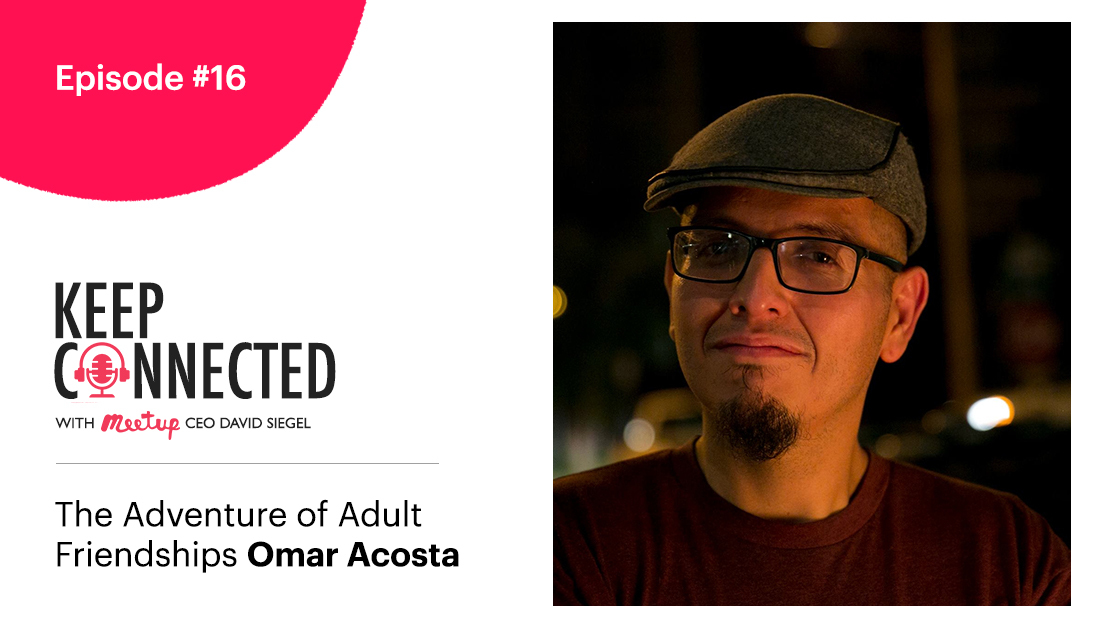


Omar Acosta is a natural when it comes to connecting people. His Dallas-based group, DFW Adventurers, has attracted 6,000 members, hosted 900+ events, and led to five marriages (at least!). Over the years, Omar has brought people out of their comfort zones to embrace local adventures like rock climbing, kayaking, hiking, and—scariest of all—finding new friends. Learn how to take the leap and experience what your city has to offer in this episode of Keep Connected.
Ranked as one of the top 25 CEO podcasts on Feedspot, Keep Connected with Meetup CEO David Siegel is a podcast about the power of community. For more details on other episodes, visit Keep Connected on the Meetup Community Matters blog.
We hope you’ll keep connected with us. Drop us a line at podcast@meetup.com. If you like the podcast, be sure to subscribe and leave us a rating on Apple Podcasts!
Learn more about Keep Connected host David Siegel’s experience as a leader and decision maker in his book, Decide & Conquer. Pre-order your copy today!
The Adventure Of Adult Friendships
In this episode, we’re talking to Omar Acosta, the organizer of the Dallas Fort Worth Explorers Group. They do so much stuff. They have over 900 events, biking excursions, hiking, camping, rock climbing and film discussions. I’m exhausted just thinking about all the stuff that they’ve done. Omar has done it all, seen it all, and will share it all. I hope you enjoy this episode.
—
Welcome, Omar Acosta.
I’m glad to be here.
Thank you so much. I want to tell everyone about Omar. He is the organizer of the Dallas Fort Worth Explorers Meetup Group, founded several years ago. They have close to 5,000 Meetup members, hundreds of events. We’re going to tell you how many events that they’ve had. You’ve impacted so many people’s lives. I’m appreciative that you’re here. Before we get to know you and the group, there’s something in the research that I read that I got to start off with. You made five marriages. Is that true, five marriages came from the Dallas Fort Worth Explorers Group?
Yes. It’s probably a little bit more relationships. Some worked out, some didn’t but I’m pretty sure it’s five. It’s people meeting each other and constantly hanging out. We’re not a dating group. That was one of the best parts about it. They found common interests. I’m waiting for the first Meetup baby though. They got to name their kids after me.
It’s going to be Omar or maybe Meetup could be a great baby name. For all of those reading, consider it, please.
I’ll let them know.
Did people go to Peru for one of the weddings? Tell us what happened.
There were two Meetup members who met through the group. They dated and they got engaged. She’s from Peru. She has family from Peru so their wedding was going to be from Peru. While all that was happening, we were making friends with them. We became friends. It wasn’t just we were seeing them at Meetup events. They were hanging out, doing parties, and taking trips together. When they got engaged and told us that their wedding was in Peru, they were like, “Here’s the invite.” It was pretty much a group of about fifteen people who had all met through Meetup and had become great friends getting a chance to travel internationally, going to Peru. To a country that most of us had never been to and seeing two of our best, dearest and closest friends getting married, and getting to share that experience and moment. It’s one of my fondest memories.
Talk about the community being creative. I would argue if we were a singles group, you wouldn’t even have had five. Sometimes when things are specifically for a singles group, people are reluctant. There’s too much pressure. You have to try to pretend to be a certain person, but when you’re hiking or doing a book club or whatever it is that you’re doing as part of explorers, you can be yourself. Yourself is what ends up building relationships. What do you think of that?
You’re finding a common interest that isn’t just, “I’m here to find a mate.” You’re here because you enjoy hiking, discussing books and craft beers. That’s a little bit more powerful and a better foundation to get to meet anyone regardless if you’re meeting them because you want to date them or you want a friend or you want a hiking partner.
Less pressure results in a lot more success. Let’s get back to you because you’re an interesting person. Tell us a little bit about how you became a Meetup organizer in the first place. Also, in any ways in which being an organizer has changed you from a growth perspective. I’d love to learn about that too.
Like many people, I first joined Meetup because I was new in town. I’m an adult who didn’t know how to make friends. I didn’t have those social connections in Dallas when I moved to it. I had started a new work. I was trying to find people and activities. I was recommended to Meetup by one of my brothers and was like, “There’s Meetup for everything. Join a group and I’m sure you’ll be able to find something.” That’s what I did. I joined a couple of groups and I joined DFW Explorers, which had already been created.
I ended up meeting a couple of people and made good friends with the organizer and the creator of the group. About a year into the DFW Explorers, he had to move to Austin. At that point, I was attending every Meetup event. I had made some pretty good connections. He was like, “You go to every Meetup event, do you want to run it?” I took it upon myself. I was like, “Yes. That’s a new challenge. Let’s see how this goes. Let’s see if I run it into the ground within a month.”
It was probably a lot smaller. How big was it back then when you took over?
It just started. Probably 50 or 100 people at that point.
It’s gone from 100 to 5,000 under your watch. That’s not bad.
I took it up. It helped me out because, at that point, I was like, “I need to figure out what I can do in Dallas as Meetup events.” I was still pretty new to Dallas. One, it made me research and find out more about the city that I’ve grown to love. It made me discover a lot of things that even people who now live in Dallas for five years that I meet, they’ll tell me, “I’ve been living here in Dallas for five years all my life and never knew it was here.”
It’s an amazing thing. People oftentimes feel they have to travel to faraway places in order to do fun things and so many fun things are in your backyard. Part of the pandemic taught us that there’s a park ten-minute drive from where I live. I had never been to it, with this beautiful lake. I went there all the time during the pandemic, even though I’ve lived where I live for years.
During the pandemic, there’s a park here in Garland, which is a subset of Dallas. It’s illegal to drink beers. It’s conveniently located right across from a brewery. During the pandemic, one of the challenges was how do we keep connected. We found out that a good way to stay connected is to do social distance park days at that park. We would bring our lawn chairs, stay 6 feet apart with masks whenever we were close to someone. We would have a happy hour. We would get some beers, get some food, and hang out. That gave us all a bit of sense of normalcy.
Let’s get back to you. You were new to Dallas. You had moved in. Were you going to bars? What were you doing to do something? Were you sitting around watching TV?
I was generally sitting around, watching TV, and playing video games. When they told me about Meetup, I looked up a couple of Meetup events. The bar seemed an easy one to go to and meet people. I try to do that. There were some good ones and bad ones. I joined the DFW Explorers and they were doing a little bit more than just going to bars. They were going out of town day trips, driving out to a distillery or going out on a hike, or trying rock climbing. That got me out of the house, started getting me more into activities and such. That helped me grow. When I took over DFW Explorers, I took on that mindset and made sure that we’re not just going to bars and restaurants, which I love both those activities, but keeping it varied. That was one way that Meetup has affected my life and changed me as a person. It made me step out of my comfort zone and keep a varied lifestyle.
Let’s talk about the comfort zone piece a little bit. People oftentimes want to do the things they feel comfortable doing. They’re comfortable playing video games and maybe going to a bar. They’re not necessarily comfortable kayaking, biking or whatever it is. You’ve spent a lot of your time trying to get people to feel comfortable, moving outside of their comfort zone. You have firsthand experience and there are probably experts in the field, but you’re a bigger expert in the field because you’ve done it with thousands of people. Give us your best suggestions or tips. How do you get people to feel comfortable moving out of their comfort zone?
It’s not easy. A lot of my friends have commented that one of my biggest personal flaws is that I can get frustrated when people don’t want to step out of their comfort zone. I’m that kind of individual who is like, “Whatever we’re doing, let’s do it. It doesn’t matter. Let’s try it out.” It’s taken me a while to understand not everyone works in that mindset for various reasons. You can’t expect everyone to dive into the deep end. What I have found, for me specifically, by doing a variety of events, you can maybe draw someone in that they’re comfortable with.
At that time, natural conversation comes across. We’ll be having a bar night, which is very easy for people to come to attend. It’s a regular happy hour drop-in, drop-out. Somehow the conversation turns to what we did last weekend. We’ll be like, “We did our rock-climbing event. We did hiking.” Especially with physical activities, sadly, a lot of people have the mindset of, “I’m not fit enough to do this. I’m not in shape to do this. I can’t do this.” I completely understand that mindset. I’ve been there. I somehow still struggle with it, but what’s important that I try to let everyone know is that one, we’re not judgmental at all. We’re not going to be like, “You got to be doing better.” All our activities are about having fun and getting out there.
Step out of your comfort zone and try new things.
Two, most of our activities are aimed at beginners to intermediate. For rock climbing, we have a lot of nights where it’s a lot of beginners. Luckily, the rock-climbing gyms are set up for beginners to try their hands at rock climbing. For hiking, I specifically pick trails that might be a little bit more challenging than a cement flat walk. It’s nothing that most people wouldn’t be able to achieve and we’re not walking super-fast. That’s the biggest advice I can give. Let people know that it’s approachable and doable. When organizing that sort of stuff, make sure it’s approachable and doable for those people. The worst thing I would want to do is tell someone, “Don’t worry, you’ll be fine. You can show up to this,” then they show up and they have a miserable time because they couldn’t do anything.
I’m going to summarize here because you said so many solid pieces of advice for organizers and for members on how to get out of their comfort zone. Getting out of your comfort zone is important because that drives personal growth. Personal growth is such a powerful thing. The four things that I’ll highlight from what you said was number one, be non-judgmental. Number two, make it easy to start the activity. Number three, by having social relationships first, it makes it much comfortable to then do the activity later on versus starting with activity without having those relationships first. Number four, setting expectations very clearly for people.
Those are helpful tips and advice. Thank you for that. That is helpful for many Meetup members and organizers. You have, unfortunately, probably experienced some loneliness at different periods in your time. You’ve probably had also seen people who are new to the city or who are more introverted, feel lonely perhaps as well. You probably have an interesting perspective around loneliness and what exists out there. Anything you’re comfortable sharing around that?
I struggled with loneliness, moving to a new city, not knowing anyone. Not having those connections made me feel like, “Another night watching TV. I need to get out there.” Even those first couple of times when I first got out there, I wasn’t making connections. I didn’t feel like I had talked to many people that first night. It took a while for me to make connections and feel comfortable in my own skin.
You persevered. You didn’t just go to one event and be like, “That’s not for me,” and give up. That’s not easy. A lot of people don’t do that.
When it comes to Meetup, one of the first things I do when I meet a new member is to thank them for coming out. I know how hard it can be to make that first step out of the door and be like, “I’m about to go out to a random activity and place to meet random people who have no idea what they’re going to be like.” I know for some people it might be super easy. For some people, it’s not. I would make sure to thank them off the bat. The biggest thing I have learned as being a Meetup organizer and meeting a lot of people who I’m sure were lonely and why they joined Meetup and came to our events specifically, it’s to not be judgmental.
A lot of people aren’t their best selves the first couple of times you meet them. They might be awkward, shy, and might not make the best first impression. I always try to remind myself that I may not have made that best first impression the first time I met some of my now best friends. What had it been like if someone were not giving me the opportunity to get to know me? Obviously, no rapid sexism, racism and misogyny stuff aside. A lot of other being normal people, regardless of who they are. I always treat them like they’re our new friends. I always make sure they’re leaving to let them know that I look forward to seeing them the next time because I generally do. It’s about trying to make those connections and get to know those people outside those first couple of times where it’s like, “I’m random so-and-so from the Meetup.”
Omar, how did you get like that? Are your parents or friends have that personality? Have you always been like that? You’re naturally an optimist and someone who sees the good in people. Is that something you’ve had to work towards?
My mom has always been very social, “Everyone’s my best friend. Let me talk to you.” Growing around her, I took that from her. Also, as corny as it sounds, the golden rule is if that’s how I want to be treated, that’s how I should treat others.
The definition of empathy is the ability to see yourself from another person’s perspective. It sounds like you practice that. It’s one of the reasons why your authenticity has made the group so successful. Let’s talk about the group. You have had 904 events. That’s an insane number.
I’m going to have to keep track and try to figure out what to do for the 1,000th event.
You’ve got to do something special. Let me know I’m going to fly to Dallas Fort Worth and I’m going to be part of that group. You’ve had so many activities. Tell us about 2 or 3 of your favorite activities. Especially those that helped to get people out of their comfort zone. What are some of the activities that you’ve had that people can’t forget about?

Rock climbing because I did rock climbing the same way a lot of our new Meetup members do. Being like, “You can do this as an adult? There’s a place you can go to it here in Dallas? There’s more than one gym that people take this seriously?” That was my first time. Now I’ve been rock climbing for several years. It’s part of my life. I go out there rock climbing. I go on trips. I have rock climbing friends. It’s a huge part of my life. Another huge part of my life is introducing people to rock climbing. We have monthly re-occurring rock climbing events. I’ve been lucky enough to work with some great gyms here in Dallas that gave us discounts per month because I reached out to them and be like, “I want to do a monthly event. I can bring in a couple of people.” The employees know me at this point and they’re great to work with.
What is it about rock climbing that cultivated this passion for you and this ability for others to bond with them? A big part of rock climbing is one person has to support the other and ballet for them. Is it the constant challenge of getting to a different grade level within rock climbing? What is it?
It’s a combination of those aspects. It’s the mental and physical aspects of it because there’s the challenge of trying to figure out how to go up the wall in the best manner. What works for me might not work best for someone else. It’s adaptable. Someone can come in and succeed the first time at the beginner level and get up there. It’s cool watching people saying, “I can’t do this,” and they got up there. It doesn’t have to be the hardest level. It’s them succeeding at what level they’re at. Also, the rock climbing community itself is so encouraging and friendly.
When new members come to the rock climbing gym, they see that not only within our group but with the community at large. At the end of the day, everyone at the gym wants to succeed. Not only for themselves, but they want to see people succeed themselves. You hear random people shout encouragement as strangers going up the wall. They’ll be like, “You got this.” It’s such a great welcoming experience for the new people doing it.
There’s a rock climbing gym near me and you will hear people going, “You can do this. You got this. Go a little to the right, a little to the left.” They ring that bell or whatever at the end.
It’s so gratifying hearing that and hearing someone at the end of the night being like, “This was awesome. I want to come back,” and they do come back. We get people who started rock climbing with our Meetup group. Now they’re our rock climbing friends who have been climbing for a good number of years. It’s a cycle that we keep seeing that because those people keep coming to our rock climbing events and they’re able to sell the experience to the new members to be like, “I started rock climbing with the Meetup group and now I love it. It’s so cool. If you want to come back, we’re here all the time.”
The 1,000th event could be climbing El Capitan.
We have some people who might be close to that level but no worry yet. I got some time.
You’ve clearly built a real community between people. It’s not just like a series of events that people show up and they leave. It’s this depth of relationships that you’ve built. Any best practices that you could share around how you’ve helped to orchestrate? That’s what you are. You’re the orchestrator and facilitator of these real relationships that people have built. What’s some advice that you would give to organizers to engender those relationships?
I always try to remember or tell myself that it’s always someone’s first Meetup event and to think of what my first Meetup experience was. What it was like to enter into a room full of strangers? Some of those strangers might know each other and some of them might not know. You’re not sure where to put your stuff in the conversation and who to talk to. I always make sure that I try to find out who’s coming to our events so I can keep an eye out looking for them. I greet them immediately and introduce myself as the organizer.
Not only that but also try to introduce them to other people in the group. When they come in, I’ll be like, “This is so-and-so. This is her first time.” They can have an end right away. There’s no one, which I always hate to see, sitting or standing on the sidelines not sure when to talk to someone or who to talk to someone. It’s always making sure that people are engaged. Not forcibly trying to talk to people but making sure that people aren’t left out.
What happens when you see someone on the side, not necessarily comfortable? Do you walk over to them? Do you have someone else walk over to them? What do you do?
What works for you might not work best for someone else. Be sure to know how to adapt.
I walk over them because I’m not sure if they’re off to the side because they want to break or they might be introverts and they’re like, “There’s too much social time,” or because they are shy or such. I was trying to make sure that I go talk to them and be like, “How’s it going?” If we’re at a bar I’ll ask them, “How are you liking the bar? Have you had any interesting drinks?” If we’re rock climbing, I’ll ask them, “Have you tried a new route? Do you need me to get you on any particular route?” I try to make sure I’m approaching them to engage them with the activity. Not just I’m talking to you because I have to do it.
We’re talking about the golden rule a bit. I’ve heard two definitions of the golden rule and I’ll share them here. The first is to treat people the way that you want to be treated. I also have heard that an even higher level is treating people the way that they would want to be treated. You and them might be different. You might want to be treated a certain way. If you treat them that way, that may not be the way that they want to be treated. It’s almost understanding how other people would want to be treated and treating them that way. You exemplify that. Any stories related to challenges either at an event or with your group that people could learn from? They’re entertaining. You must have something out there. Tell us a story.
I always talk about it because it’s not my proudest Meetup moment. I often put up Meetup events and oftentimes I forget to do full research on them. I like to fly by my pants and see where the night takes us and such. I had set up a regular evening walk in one of the areas of downtown Dallas. It’s right by a river. It’s called the Trinity River. There’s a paved trail that goes around it. It was going to be a 3 to 5-mile walk back and forth. No big deal. We started taking it at around 7:00 PM. People were in a good mood. When we got around the turnaround time, I was like, “Do you all want to go back or do you all want to keep walking?” Most people are like, “Let’s keep walking. It shouldn’t be that far.”
At that point, we had crossed the river and I didn’t naturally assume that further ahead, there would be another crossing back to the exit. It turns out there wasn’t. We ended up walking for about an hour and a half, close to probably two hours until we were able to find a crossing where we could go back. At this point, it’s gotten dark. For some reason, the trail takes us close to the prison of Dallas. It’s not even the nicest part, but I was thankful that everyone found humor in it. We were a large enough group where we weren’t terribly unsafe because we were a group of about 20 to 30 adults. Nothing was going to happen. I kept people out longer than they expected. Luckily, everyone found humor in it, kept a good spirit, and I didn’t hear anything bad from it.
It’s a good experience. It’s important to be spontaneous because some of the greatest life experiences happened when you’re spontaneous. If you plan a trip, for example, I’m a big trip planner on vacations, and you schedule like, “Day one, we’re going to do this and this. Day two, you’re going to do this.” Versus you say, “We’re going to be a little bit spontaneous.” Sometimes the most fun experiences happen when you’re a little bit spontaneous. At the same time, you also don’t want to be eaten by a bear at 10:00 at night. That’s not a good thing. Let’s talk about an event. There are so many different parts of the event. There’s where everyone is about to join the event. There’s the actual event itself. There’s the post-event meandering around afterwards. Do you generally have a favorite part related to an activity or an event that you get your energy from?
I generally love the middle of the event where you can tell that things are going good. You see people mixing. It makes me sound way like the overlord. When I can step back for a few minutes and watch people enjoying themselves and the activity. Whether it be a happy hour or we’re hiking and I can fall back and forth between our group and seeing what they’re doing, or we’re doing a bar hop and I’m seeing people naturally congregate to the next bar together like people are friends and have known each other forever. That’s often the best fulfilling moment where I can step back and be like, “This is working.”
First of all, I love the concept of the step back. One of the things that we talked about before in this show is mindfulness and being present. Oftentimes, when you’re an organizer or just in life, you’re always in planning mode. You’re either thinking about the past, the future, and you’re planning this and that. That’s not a great way to live. The step back is all about having a quiet time and being present at that moment, looking around and being like, “Look at all these relationships that I built. Look at how happy people are.”
I remembered when I got married someone gave me a great piece of advice for the wedding. They said, “Take two minutes and step back as though you’re watching a show and watch how happy everyone is at that wedding. See how the energy that’s in the room because that could be one of the most powerful times.” I had this five-hour wedding and so many different people came. It’s all a big blur but I remember the moment personally when I step back and watch everyone enjoying. It’s similar to what you said which is, the value of taking a moment to watch that. It’s great that you do that for yourself. I could see why that’s so powerful for you.
It’s great advice. I’ll have to remember it for my next toast.
Speaking of advice. Any last bit of advice that you would give to Meetup organizers that we haven’t talked about yet?
The only other thing I always try to keep in mind personally is that Meetup and organizing is not a job, at least for myself and for a lot of the organizers. We do it because we want to build a sense of community and we truly enjoy it. At least I do. I always try to remind myself that if I feel I’m maybe getting a little bit too stressed out. If I’m like, “I don’t have enough events in my calendar. What are the logistics for this coming event?” I was trying to step back and try to remind myself that I’m doing this for fun. I generally enjoy it. I’m going to keep doing it until it’s no longer fun. If I ever feel like the stress becomes too much, it’s time to step back because that’s going to impact how I organize and how I am at events.
If you’re still having fun after ten years, you were made for this. That is for sure because doing anything for ten years is a rarity, unfortunately, in life. I’m so glad that you do. We’re going to move to the end. The last part is called the rapid-fire section. I’m going to ask you a bunch of questions. We used to call it rapid-fire, now it’s the not so rapid-fire. Oftentimes, I will as questions here and there. Hopefully, you’re okay with the not so rapid-fire. I did a little research, in fact. This is how not so rapid it is. During the Civil War, between every cannon shot, it took between 5 and 10 minutes, so it’s not going to be that laborious, I promise you all, but we’ll try to make it rapid enough fires. Think about the first thing that comes to your mind and we’ll go from there. Here we go. The first time you saw yourself as a leader, Omar. Anything before Meetup that you saw yourself a leader or was it during Meetup?
It was during Meetup. It was a bit more into my organizing career. The first time I led our couch to a 5K running group and training other people who themselves thought they could never run than five minutes into running a 5K through nine weeks of the program. It was the first time I was like, “I’m a leader.” I joke that I don’t have any kids, but seeing those people do their first 5K is the closest thing I got into fatherhood yet. Being like, “I’m so proud of these people.”
You have 4,700 kids. Give them a hug. That’s amazing. First of all, in nine weeks to go from a couch potato to 5K, that could be like a bestselling book. Keep it in the back of your head on how you could get that done. What was your first job, Omar?
I worked at a video store. I was a video store clerk.
What was the big video game that you played back then?
The Final Fantasy games. Role-playing the big nerdy guy with a sword defeating the evil bad guy. I loved playing those games.
If you could access a time machine and you can go to any place in the world at any time, where are you going and when?
I got to go back to the early ’60s and ‘70s in Mexico City to see how my parents met and what they were like when they met. I’m curious about that. I’m always curious about how the past informs the present and the future. I would be curious to meet my parents at that age.
It sounds like a good TV show, movie or fantasy video game.
I’m trying not to interfere, obviously.
It’s one of these continuous questions like, “Would I be friends with my parents if I grew up at the same age as them at that particular time?” It’s hard to tell because you don’t know your parents, how they were when they’re your age because they’re your parents. There are so many psychological and other emotional experiences that you’ve had with them. What’s that something on your bucket list. As an explorer, you’ve explored so many different things, but you must have one thing that you haven’t yet done that you want to do.
More international travel. Ironically, I haven’t been much of a traveler growing up. I’m barely getting into traveling. Going to Peru lit up that part of my brain where I’m like, “I want to do this more.” I want to visit Iceland and Japan. Two very different international countries are on my bucket list.
I am a huge fan of Iceland. It’s probably one of my favorite countries in the world. It’s so different from anywhere else.
Meet people and make them smile. Be surprised by how impactful this could be for the rest of their day.
I also hear that. I have some friends who’ve been lucky enough to go there and it seems amazing.
You feel like you’re on another planet. Omar, you’re going to be remembered for so many things, especially the golden rule in how you treat people. If there is something in particular that you want to be most remembered by, what would it be?
Honestly, bringing people a smile. I like to think that I’m funny and I like to make my friends laugh. I’m usually the one who will often say off-the-cuff things to garner a laugh. As long as I can make people smile, that’s the thing I want to be remembered for the most.
When you make someone smile, the impact that that has on the rest of their day and every other person that they come in contact with is enormous. You can’t underestimate that impact. If you made people smile, then you’re impacting tens of thousands of people potentially. I’m a big fan of smiling as you can probably tell. Omar, thank you so much for everything that you do to make the world a better place, to create smiles in the world, live the golden rule, and step back and make things more meaningful for others. You’re a pleasure to talk to and inspiration. I wanted to thank you.
Thank you for having me on. It was fun.
—
Thanks for reading, everyone. Omar is someone who challenges himself. Now that’s what he’s doing with others, he’s challenging other people because he was that type of person. He knows that if you challenge people in the right way then it could change people’s lives. Everyone should have a little bit more Omar in them. If they did, there’s no doubt in my mind that the world will be a better place. If you enjoy this and you’re not a subscriber, please subscribe. It’s free, do it. Why not? Leave us a review on Apple Podcasts. We would love to hear from you. Remember, let’s keep connected because life is better together.
Important Links:
- Dallas Fort Worth Explorers
- Apple Podcasts – Keep Connected with Meetup CEO David Siegel

Last modified on December 13, 2021