
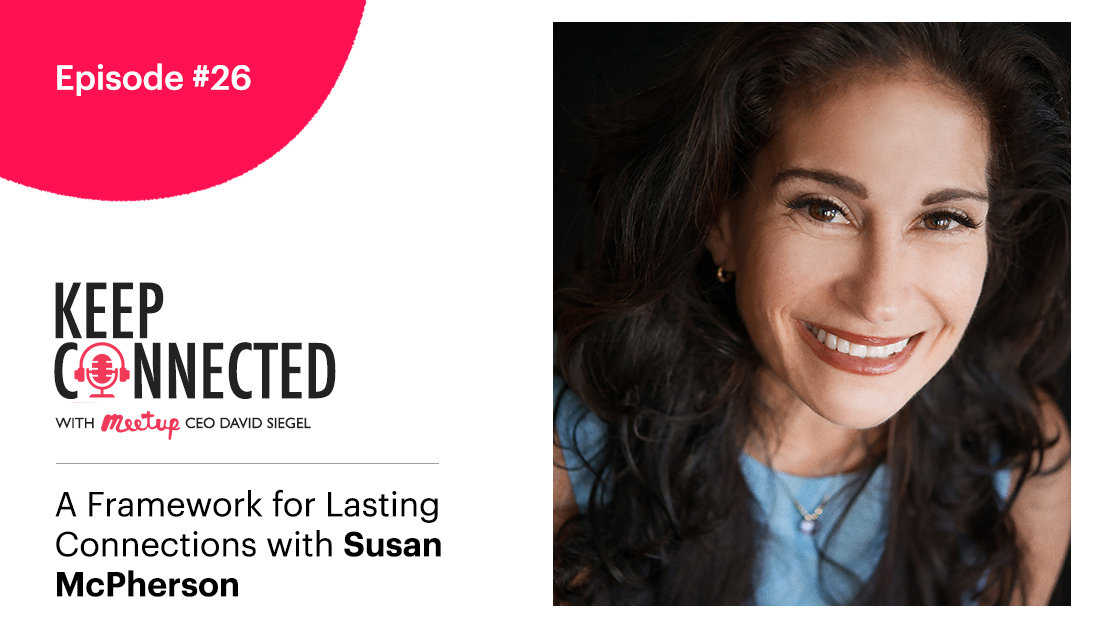
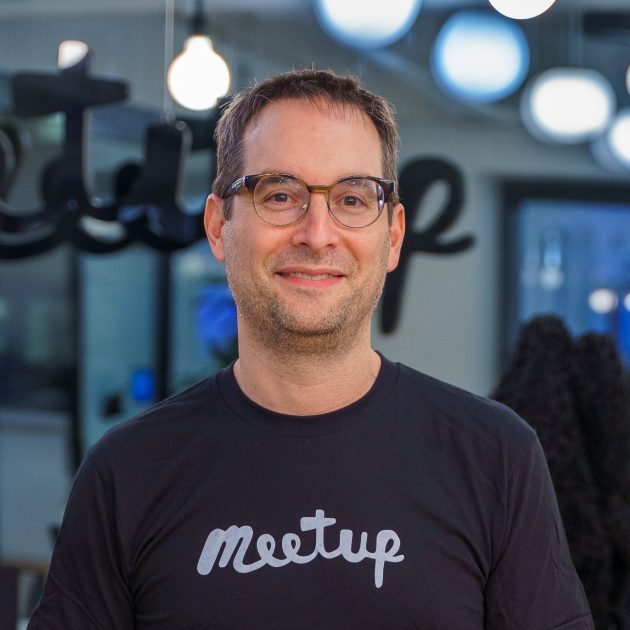


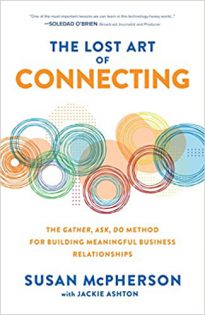
Author and recipient of Forbes’ elite 50 Over 50 distinction, Susan McPherson is making waves in the world by helping people connect and amplify their impact. The message in her book The Lost Art of Connecting is clear: the best way to make lasting relationships is to start with how you can help others instead of the other way around. Learn how you can find your greatest assets and discover why connecting with new people is at the heart of a healthy, happy, and meaningful life.
–
Ranked as one of the top 25 CEO podcasts on Feedspot, Keep Connected with Meetup CEO David Siegel is a podcast about the power of community. For more details on other episodes, visit Keep Connected on the Meetup Community Matters blog.
We hope you’ll keep connected with us. Drop us a line at podcast@meetup.com. If you like the podcast, be sure to subscribe and leave us a rating on Apple Podcasts.
Learn more about Keep Connected host David Siegel’s experience as a leader and decision maker in his book, Decide & Conquer. Pre-order your copy today!
In this episode, we are talking to Susan McPherson, the author of The Lost Art of Connecting. She was listed as the 50 most impactful people over 50 years old. This is someone who transformed her life at 48 years old and pursuing her dreams. Get ready to feel connected. Here we go.
—
Welcome, Susan.
I am so excited to be here, David. It’s wonderful meeting you.
I have high expectations because you are the expert in connecting. I host this show. You’ve written the book The Lost Art of Connecting. We’d better feel pretty connected after this or something is wrong.
It’s a match that was meant to happen all our lives.
A quick background on Susan. She is the author of The Lost Art of Connecting and a connecting and networking guru. She speaks at all these different conferences. You’ve been published in different publications like The New York Times, The Wall Street Journal and Harvard Business Review. I’m super excited to learn from you. I have one question. I’ll start with this. Is the word networking a four-letter word? I know it’s not four letters, but is it a four-letter word? Is it a good or bad word? Talk to me about the word first.
I am indifferent. I know we all have to network in our lives, but I fervently believe there is a fundamental difference between networking and connecting. What I like to think about is flipping networking on its head and leading with how can I be helpful rather than what can I get? If you think of the traditional being in a room and knowing you have to meet a certain number of people and then grab their business cards, etc., what about if we flipped it upside down 180 degrees and thought about who can I be helpful to in this room?
I perceive networking as a pejorative. It’s self-interested. It feels like I am doing something. I’m going to go into that room and do things to help myself. Whereas, what you’re saying is flip it and make the entire experience, whether you want to call it networking, fine. You want to call it connecting, fine. It’s a word, but do it the right way with intent. I often get this question from my students. I teach at Columbia and I talk about networking.
Oftentimes, it’s a very important weight for entrepreneurs to build their businesses. They oftentimes say the same thing, which is, “Susan, if you’re telling me that the job is to help people, I am a college student. I’m a graduate student. Who am I? How can I help this super successful venture capital person?” I have thoughts on it, but I want to know your thoughts because your whole perspective is led by helping.
Before you can lead with help, you’ve got to do a little bit of self-reflection to figure out what your superpowers are. Whether you’re 22 and out of college or didn’t go to college or you’re 70 approaching retirement, we all have superpowers. If you don’t know what they are, ask your friends, neighbors, family or dog. We all have them. Throughout our lives, we have very different ones. They ebb and flow.
The beautiful thing is if you can articulate what your superpowers are, no matter who you are interacting or intersecting with, you have the means to be helpful to that person. Whether it is an introduction to someone else, a restaurant recommendation or a nonprofit they might have a personal affinity or passion for or maybe TikTok, which a lot of people fresh out of college know a heck of a lot better how to use than I do.
There is a famous thing about how Time Magazine listed Jack Welch as the Manager of the Century of the entire 20th century. He built General Electric, as some people know and some people don’t know. He is famous for mentoring people, but he would have young people mentor him. When the internet was coming around, he had all these younger people teach him the internet. I love what you’re saying about TikTok. My daughter spends many hours in TikTok. I don’t have a TikTok account. I should be mentored by someone in their twenties about TikTok.
Interestingly enough, Nick Kristof, the famous columnist from The New York Times running for governor in Oregon. Years ago, he hired a woman named Soraya Darabi, a well-known entrepreneur and venture capitalist herself. She taught him how to use Twitter in 2005 and 2006, which led to so many other wonderful things. She was much younger then, but I like to think that Twitter then is our TikTok now.
You hinted towards your framework, but let’s hit the framework straight on. Gather, ask and do. It’s very simple. People like things of three. Tell us about that framework for connecting, networking, etc.
When I was writing the book, I learned I had to have a framework. It is a requirement if you have a business book. Luckily, I looked back at the last 30 years of how I have been able to build meaningful connections all over the place throughout my professional and personal life. It came down to this gather, ask and do. I would even go so far that gather, ask, do makes even more sense coming to the end of this global pandemic. Essentially, in the gather phase, which is the first phase, you do that self-reflection to think about my superpowers? How can I be of help? Think about who it is that you want to connect with or, importantly, reconnect with that you can be helpful to and vice versa because this is very much about reciprocity.
Lastly, in the gather phase, you think about how you will break that hermetically sealed bubble that most of us live in where we tend to intersect with people who look and sound like us, the same race and cultural heritage as us. To me, that is all part of the gather phase. The ask phase is learning to ask the meaningful questions of others so that we can learn what their hopes and dreams are, what their superpowers are so that then if we listen carefully, we can move to the do phase. The do phase is where I like to be most of the time. That’s when you are responsible, reliable, do the things you say you were going to do and continue the circle. Essentially, that is to gather, ask, do. It’s very simple.
If you can articulate your superpower, you have the means to be helpful no matter who you’re interacting with.
I still want to buy and read the book and everyone else should buy and read the book because there is so much more complexity to that. I’m going to ask you this. I don’t know if you’ve thought about this before, but everyone has pet peeves. I find that the things that one is most passionate about, oftentimes you also have the most significant pet peeves about because you know “the right way” that people can be doing certain things. It’s so frustrating when you see it wrong. The gather, ask, do in each phase and the gather phase.
Tell me what your biggest 1 or 2 pet peeves are in the ask phase. What’s your biggest pet peeve or frustration that people don’t do? Even the do phase, your frustration, people don’t get off the couch and do things. Let’s take the gather phase first. What should people avoid doing? What mistakes do people make on the gather phase that people should be cognizant of?
They are talking themselves out of their superpowers. We all do it. I do it. I wake up 5 out of 7 days a week having imposter syndrome. It’s not healthy for me and not healthy for my company and the people I interact with. The point is to remind yourself. Look in a mirror. You have superpowers. It’s okay to state those and state them aloud. It was in 2007. I went on a retreat with seven friends and the goal of the retreat was to articulate our elevator speech. It was that weekend that I finally got the gumption to state, “Hi, I’m Susan McPherson and I’m a serial connector.” I almost peed in my pants because it sounded so ridiculous. Sixteen years later, I wrote the book on it. That would be a pet peeve. It’s something I’m critical of myself.
The ask phase is asking people meaningful questions and then not listening. I’m as guilty of it with all the distractions we have. I can only believe that it is hard to listen through this pandemic when we’ve been in Zoom chats and our emails and texts are flying in social media. I’m not begrudging anyone, but if we’re going to ask people those meaningful questions, we need to listen. The do phase is not following through. Don’t get me wrong. We are all busy. We all have lives. You don’t have to do it the moment you say you’re going to do it, but write it down, so you don’t forget. If you’re out walking and something pops in your brain, I always think of the word clouds in the Peanuts. Do it then. Text, email or call the person. Do it then or make the connection.
You shared your frustrations, pet peeves and commonalities that people oftentimes experience around the gather, ask, do. I’m greedy. Let’s go through each. For do, you gave the recipe for how to get over the do, which is to simply do it immediately. If you can, do it. I have this philosophy called the five-minute rule. Anything that I can do that takes me five minutes or less, important or non-important, I get it done immediately and that way, I don’t have to stress or worry about it. That works. Let’s talk about listening, which is the biggest challenge that people oftentimes have around the ask phase. What advice would you give people to become more effective listeners or are there people who don’t know how to listen and are never going to become good listeners?

For the book, I was very fortunate to interview Dr. Julian Treasure, who has done five TED Talks on better listening skills. If your readers want to learn how to listen, listen to his talks. He explained to me the whole notion of anticipatory listening, which is something that I had been guilty of. Perhaps in my propensity or desire to get to the do, I’m listening for how I will respond rather than listen. One of the ways that I have dealt with that is I take notes. I take notes when I’m talking to people on the Zoom stuff and Microsoft team meetings. Also, when I’m at an event, I’ll use my handheld device or I’ll carry a small notepad with me, which makes me probably sound extremely archaically old, but that way, I will remember.
It works. It also helps you listen. I also have learned that it’s okay to let the person you are listening to know if you’re in a one-on-one or one-on-two situation that you happen to miss what they said because you might’ve been daydreaming. It’s okay. We’re human and ask the person to repeat themselves. As opposed to sitting there and thinking, “I missed it. I’m too afraid to ask.” To me, it’s a gift to let someone know that you’re trying to be a better listener because in the end, if you can then be able to share that person’s hopes and dreams with others when you’re making introductions, it’s a great gift to give people.
Let’s hit on the gather phase. You talked about the biggest challenge being around imposter syndrome and you’ve experienced that and you’ve seen other people experience it as well. Again, the same question. What can people do to help themselves get over the biggest challenges around imposter syndrome, which keeps them from effectively gathering and learning their superpowers?
I don’t have the magic solution to that. I wish I did. It is doing some soul searching. It is asking your loved ones, the closest people to you. If you, for whatever reason, can’t articulate it, others who know you well will be able to. I wish that was a magic bullet to give you the steps forward, but it also comes with looking inside yourself. Also, not thinking it has to be some massive like, “I’m an expert in astronomy,” unless you are. It also can be a passion you have. It doesn’t have to be a particular subject you studied in school or a professional hurdle you’ve reached at your place of work. It can come down to something like, “You make awesome spaghetti.” Don’t overthink it.
Things feed on themselves, which is you make awesome spaghetti and then you feel a little bit better about yourself. Maybe you make that other thing and then you feel better about yourself and there is this positive domino effect that happens. It sounded like for you, the community was helpful to you and going on this retreat and helping you to feel comfortable saying, “This is what I am. I’m a serial connector.”
It changed my life to articulate that. It did. The comment about peeing in my pants was entirely true. It sounded ridiculous, but I’m introduced as that anywhere I go. It’s a bit of a self-fulfilling prophecy where when you state it. It can happen.
Is it because Susan, you felt like being a serial connector didn’t sound like a good thing or is it because you felt like you were not an expert in that, so you didn’t feel comfortable saying that that’s what your expertise was?
It was a combination of both but also seemed like something I couldn’t prove on paper. I was living it every day. I had been living it for years and everyone who knew me. It was like, “Why wouldn’t I want to say it?” It’s my own insecurities and that’s why I bring up the fact that I don’t overthink it. I over-thought it for too long.
It’s important for young people to understand the good that can come from making connections.
Connecting a group of people is probably my favorite activity. The reason why is because it helps one person you’re connecting with. It helps the other person you connect with and you also help yourself by connecting the two other people because people appreciate that you’re doing it. In a very short period of time, in an email, you could help three different people and help yourself in the process too, which is a nice thing.
It’s important for young people to understand the good that can come from making connections. A lot of people are like, “What’s the point?” I have to look back and be completely honest with you. Every single good thing that has ever happened to me happened because of connections. I can’t be the only one. That is across all populations and people. Most people love to connect with other people. We may be introverted and nervous about doing it, but we’re very comfortable doing so once we do.
Give me some examples of how a connection helped you. I want to hear about some examples of how you’ve helped to connect with other people, too.
First of all, in my company, which was founded years ago, 90% of our business has been inbound. We hired our 15th employee. The proof is in the pudding. The connections I made in my 20s, 30s and 40s have come back because that is crazy that we’ve never had to do any outbound marketing at all. It is all been inbound. Right then and there, that is a proof point to share with hundreds of Meetup folks. I will tell you a story that helped me and I believe it had a lasting impact.
In 2017, I received an email from a friend who asked me to get her friend, who was a filmmaker, into a refugee camp in Greece the next day. To level-set, one of the boards I serve on is the UN High Commission for Refugees. It was so far out of the left field. However, it was 2:30 in the afternoon. I had a call at 3:00 and all I kept thinking was the last thing the world needs is another film about refugees that no one will see. I was pre-judging with preconceived notions without diving in. Secondly, I was thinking, “I’m super busy. I can’t do this.” I was like, “You got twenty minutes, Susan. Make a few calls.”
Lo and behold, I was able to get Brandt the filmmaker into a camp in Lesbos, which is off the coast of Greece. I learned a few days later that he wasn’t a documentary filmmaker. He was a big-budget, Hollywood filmmaker who had done a number of Tom Cruise films. In his visit, he became enamored with the cause of refugees. We were at the height of the Syrian refugee crisis. About a month later, I got a call from another friend who happened to be an advisor to the global NGO CARE.
She said to me, “Susan, do you happen to know any filmmakers who would be willing to go spend two weeks at a refugee camp on the border of Syria to help Syrian youth learn how to make films and tell the story of their exodus from their home country?” I reached out to Brandt and within five minutes, not only did he say yes, he brought eight Hollywood filmmakers with him. They went and spent ten days at the Azraq refugee camp, where they worked with twenty-plus kids to help them create short films about their experience. He went on to fund major donations to CARE, UNHCR and UNICEF.
He went on to make a narrative feature film called Refugee that Angelina Jolie happened to see. Since seeing the film, she has been sharing that film with global leaders because the refugee crisis is not going away. There are 88 million displaced people on this planet. David, I am not taking credit for all of that happening. However, if I might not have made that connection, there is a possibility that a lot of that wouldn’t have ensued. If anybody ever needed a reason to make a connection when they’re thinking, “I am busy,” that should help prove.
You’re an amazing woman. If 5 to 7 days, you start with imposter syndrome, I’m going to have to say a couple of positive things, so it’s only 4 out of 7 days. Number one is the fact that you started your company at 48 is awesome. How often is it that people who are in their 40s, 50s or 60s feel like, “I’m on the backup.” People should reinvent themselves at every age. The fact that you did that at 48 is amazing. I wanted to call out because I want to encourage all of our readers to always be thinking about that. It’s so important.
Second, I’m on the board of a refugee organization called Five One Labs. Shout out to Five One Labs and they help Syrian refugees who are in Kurdistan and help them become entrepreneurs and build entrepreneurship for Syrian refugees. It’s an incredibly important cause. The numbers are terrifying. It’s beautiful that you’re so involved in that. I wanted to thank you, number one. Number two, I have a question to ask from one of the things you said because I was listening.
You mentioned that when you were in your 30s, you built these relationships that you’re leveraging in your 40s and 50s, etc. How do you keep track? Is LinkedIn your thing? I have 30,000 contacts on LinkedIn. I would have people, “Could you introduce me to this person?” I don’t know all 30,000. How do you keep track? Do you have an old-school Rolodex? What do you use?
I did in the ‘90s. I used to do it once a month per call. I had a business cultivation role at a company called PR Newswire in the early ‘90s. Once a month, I would call every single person in my Rolodex, but I wasn’t selling them something. I was saying, “I wanted to find out how you’re doing. Is there something you need?”
Do you use email, paper or LinkedIn?
What I do and I’ve been doing the past years is I ask people the mode of connection they want to use and I note it in their contact because some people prefer texts, email or a phone call. Just like you would ask people before you invited them over for dinner, if there were food issues they had, this is a lovely way to deepen your connection with somebody, “How do you want to be in contact?”
It’s part of listening. I want to double down on one of the things you said when you referenced that you would talk to people and check in on them or send something, but it wouldn’t be asking them for something. The only time that certain people reach out to me personally and I know you are is when they need help on something. That’s not a best practice. It is not the way to go. You’ve got to find other ways in which you could connect people. For example, making a connection to someone, “David, I was thinking about you and I met this interesting person. You and this person should talk.”
I ran a workshop and one of the first questions I asked was how many of you receive an invitation to connect on LinkedIn? You say yes and then within an hour or two, the person is selling you something. All the hands go up and I said to them, “What about if instead, that person did a bit of research about you?” All the research is available online, unlike years ago when I worked at USA Today. I had the Encyclopedia Britannica and the yellow pages to research people before I got in touch with them. You have everything. You can even find out if people have grandchildren by Instagram.
The point is, what if instead they saw something new and interesting that you were doing and said, “Susan, congratulations on the book. I happen to know a local bookstore that I might be able to suggest they pick up your book. By the way, I would love your help with.” They made it a little bit more about you and how they could be helpful to you. That’s what I suggest.
I have quite a few people like you who do reach out to me and say, “Can we get together?” Sometimes I say yes because I’m in a good mood. I’ll get together and they’ll be like, “Tell me again, what does Meetup do? Where do you work again?” I can’t sometimes believe people’s disinclination, laziness or whatever it may be to not to do research before. I have a book coming out. A person out of the blue reached out to me on LinkedIn and said, “I’ve watched this video that you did a couple of years ago. I read this book. In the video, you said this. In the book, you said that because of that, it influenced me in the following questions. Can we talk by phone to get your advice about these following questions because of the fact that you did this?”
I was so blown away by the dramatic amount of research that we talked about again. This person ended up becoming one of the most influential editors, reviewers and confidants for me around the book. As a close relation to this, I have a gentleman named Elliot. It’s because he did so much research beforehand. It’s an amazing example.
What’s the title of your book?
It’s called Decide & Conquer. It’s about decision-making.
If you want to extend your longevity, make meaningful connections a priority in your life.
Let me know how I can be helpful.
Let’s talk about technology. We’ve talked about technology so far a bit, but I want to talk about a little bit more in terms of how technology helps and is a double-edged sword and is a challenge. I know you have a lot of experience around that. Can you share a little bit of wisdom for us around how to use and how not to use technology?
A lot of people think I wrote the book as a response to the pandemic, but I wrote the book because I felt that we had lost our intentionality when it came to connecting because of technology. A friend of mine told me a story that when she would bring her son and daughter to the school bus stop, they were 10 and 12, she would hug them goodbye and send them up onto the big yellow bus. As soon as they took their seats, their heads would pop down to look at their handheld devices. The scary thing is, is every other child on the school bus did the same thing.
I thought to myself, “On my school bus, I don’t have beautiful, wonderful stories, but I would talk to the classmates next to me. I would hear about what they had done the night before and what was coming that day at school.” That got me a little panicked. We would be under a rock if we didn’t see the vitriol of our ability to zap out a tweet or post without thinking about the ramifications or potentially the people we could be hurting or harming. My thing is technology is great. I would be nowhere now without technology.
We have to be thinking about the ramifications and people listening. I still go back years ago when somebody told me that when you send an email out, it’s buying an ad in a Wall Street Journal. Everybody can see it. Don’t ever think it can’t be seen. When we put a text, email, or post on social media, we have to think about it that it could have lasting ramifications. I’m a big believer in using that ten-second rule and thinking twice and being intentional about how we use social media.
Before we wrap up, one of the things that I read that you wrote about is around JOMO, not FOMO. I liked it so much. I don’t want to share it. I want you to share it. What does it mean? Why is it important and what can people learn from it?
I mentioned to you in the early ‘90s, I was in a business cultivation role at PR Newswire. I managed a territory where no one knew who PR Newswire was. I never got the invitations to the events and launches. I also couldn’t get in to meet with anyone because no one had heard of us. I invited the three people I knew in the public relations profession to what we then called a coffee klatsch. We had so much fun. It was so interesting that we decided to do it two weeks later and ask each person to bring two other people. Within six months, we had about 600 people from the industry.
This was long before Meetup, but I guess you could say it was an early Meetup [group]. We didn’t have the means. The internet didn’t exist, but my thought process was instead of having a Fear Of Missing Out, not Joy Of Missing Out, but the Joy Of Meeting Others. I have continued that over the years and I have found one of the best ways to connect is to be the organizer.
That dovetails extraordinarily well with Meetup. The ethos of what you’re doing is you’re helping people create connections around topical information. The one guide point I have is if someone is introverted, they’re terrified about being the organizer. The beautiful thing is you don’t have to do all the inviting. You can invite four people and then ask them to amplify through their communities.
I love that fear can be a good spark, but it’s not great at keeping it sustainable. Joy, however, is great at keeping things sustainable. FOMO can spark something, but maybe it won’t continue. JOMO, the Joy Of Meeting Others can make something sustainable. That’s beautiful.
It’s become extraordinarily more relevant in our social media, Instagram world. It’s also sustained me through the pandemic because we’ve been able to have the joy of meeting others through video. If you want to extend your longevity, making meaningful connections a priority in your life will do just that. All things being equal, but it will enhance your life even more effectively than eating kale and running every day. I used to run, but those days are over. I love kale. After all, I live in Brooklyn. If meaningfully connecting is going to help me extend my healthy life, then I’m going to do it.
I have to take off on that one because it’s so beautiful to hear. The New York Times did a piece years ago about Meetup. They studied women 55 and above, specifically those who had been part of Meetup groups. They found that it increased their health and longevity because they had been part of those communities and helped connect with others. It’s so true. The opposite of that, which is loneliness, can cause untold health issues as well. It’s rapid-fire time. If you could access a time machine, go any time, place, anywhere, where are you going? When are you going there?

I would love to go to 1945, post-World War II and be in Times Square at the end when there was that huge celebratory party.
I’ve never heard that response. I like that. Bucket list. You’ve done a lot and you’re going to do even more. What is something on your bucket list that’s still left for you, Susan?
I want to fall in love. I’ve been single for years and it’s time.
Tell me about a decision that you’ve made that had this massive impact on your life. Talk about that a little bit more. I’m obsessed with decision-making related to the book. Let’s hear about a decision that you made those particularly poignant.
I’m launching my company at age 48. Years later, McPherson Strategies is a successful, profitable, social impact communications firm. That was a huge decision and something I am internally grateful for. It wouldn’t have been successful if I didn’t make those connections in my 20s, 30s and 40s.
The last question, what do you most want to be remembered by? I’m guessing it has something to do with connecting. Is that it or is it something else?
It’s being known for getting the proverbial crap done and having some fun along the way.
You understand that it’s about knowing how to get things done and that’s how you impact others. That’s wonderful. It’s true. There is no doubt that you’re going to be doing that for the next years. Thank you.
David, I had a wonderful time with you.
—
Thanks for reading, everyone. She is the author of The Lost Art of Connecting. I hope you feel more connected to Susan. I know I do. What are some of the learnings for me? Number one, articulate your superpower. Don’t think it. Articulate it, understand it, appreciate it and act on it. Number two, lead with helping. You may be helping yourself the most by helping others first. Number three, her framework around gather, ask, do has so much to unpack there and to learn from. I hope you enjoyed the episode. If you feel more connected to keep connected, then leave us a review. Check out my book Decide and Conquer. You’ll like it. Remember, let’s keep connected because life is better together.
Important Links:
- Susan – Susan McPherson
- The Lost Art of Connecting
- TED Talks – Dr. Julian Treasure
- CARE
- UNHCR
- UNICEF
- Five One Labs
- Decide & Conquer
- McPherson Strategies
About Susan McPherson

Susan McPherson is a serial connector, seasoned communicator and founder and CEO of McPherson Strategies, a communications consultancy focused on the intersection of brands and social impact. She is the author of The Lost Art of Connecting: The Gather, Ask, Do Method for Building Meaningful Relationships.

Last modified on December 22, 2021