
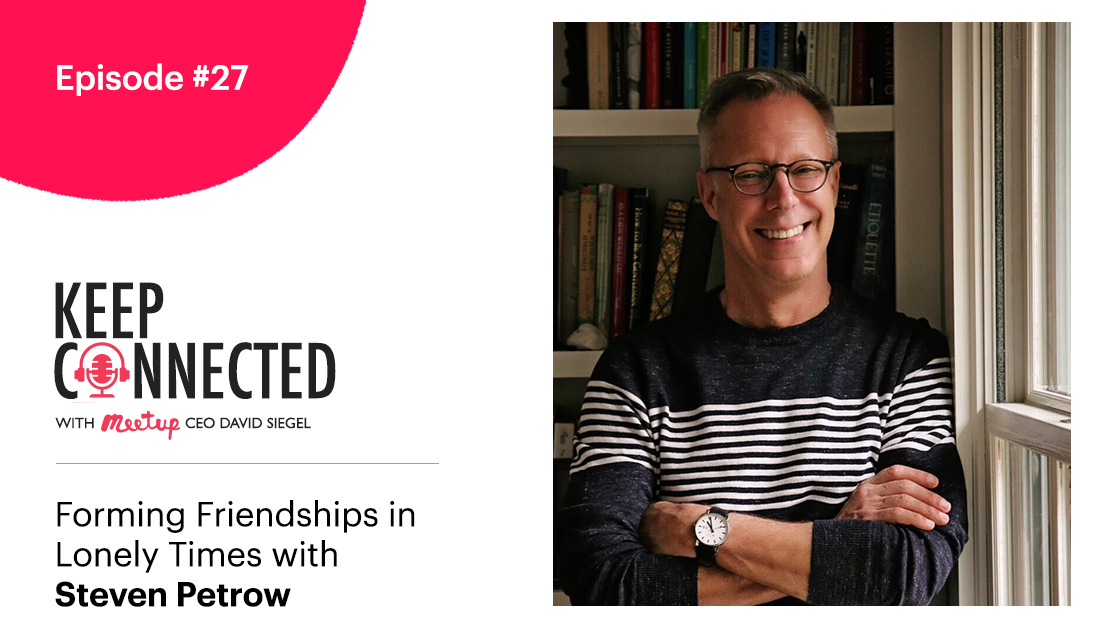
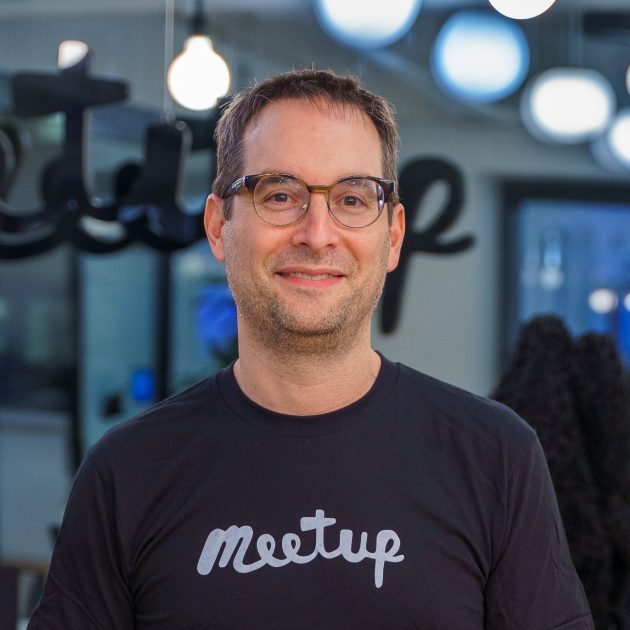


Keep Connected is celebrating its one-year anniversary with a special episode on making friendships! Steven Petrow, Washington Post columnist and author of Stupid Things I Won’t Do When I Get Old, joins the Keep Connected podcast to discuss community building at any age. In this talk on aging gracefully and living well, you’ll learn to fight loneliness, make new friends, and hear the difference between being alone and being lonely. Find out how to spot inauthentic relationships and cultivate authentic ones that will last well into your later years.
Forming Friendships In Lonely Times With Steven Petrow
Before we get into our episode, I have something important to share. Check out my new book, Decide and Conquer, to get to know my story at Meetup. The hardest thing about community leadership is making tough decisions when the stakes are high, and I will tell you they were never higher than when Meetup was owned and sold by WeWork.
In my new book, Decide and Conquer, I will walk you through a counter-intuitive framework for decision-making and the epic journey of Meetup’s surprising survival, good leaders deliberate, and great leaders decide. Pre-order my book by going to DecideAndConquerBook.com or anywhere books are sold. Thank you. In this episode, we are talking to Steven Petrow, an expert in the field of aging, building friendships, and understanding the loneliness epidemic. He’s the author of the book, Stupid Things I Won’t Do When I Get Old. Before we get too old, let’s start the show.
—
Steven Petrow, it has been a while. Welcome.
It’s great to see you, David.
One of the benefits of getting older and aging is that you meet a lot of people. You and I met many years ago, and you have done a lot in years. I’m blown away by how much you have done. It’s quite amazing. You are a columnist at The New York Times, Huffington Post, and The Washington Post. You have written six books, including a Top Seller, Stupid Things I Won’t Do When I Get Old. You have a TED Talk on practicing civility, so I’m not worried about you being not civil with over two million views. You are also the Former President of the Association for LGBTQ Journalists. That’s pretty amazing.
Mind yourself, too. When we met, you were not CEO, and here you are, the CEO of Meetup. It’s a real pleasure to be with you and see all that you have accomplished, too.
Whenever I get to meet people who are as accomplished as you and so many different disciplines, I’m always curious about what most motivates them and also whether what motivates you. Whatever age and time you are, is different than what motivated you years ago. Usually, that is the case. I find a motivational person to help people be motivated. Let’s start with that.
At the time we met, I was an Executive at Everyday Health, as were you. I had worked for major publishing companies for quite some time. I remember often thinking that my value was in my title, salary, and stock options. A social media service back in that day called Klout and how many followers or whatever one had. It’s all external things.
One of the benefits of getting older and aging is that you meet a lot of people.
My mother had always drummed into me. It meant to be in a positive way but the shift that I have noticed is away from those external things and what are often called resume virtues. I don’t like the phrase but I have heard them referred to as eulogy virtues. They are the things that you would like to be remembered or known for. They are not your title, salary or Klout score.
They are more about how do you interact with people? What person are you? What are your values? What do you do? That has been the major shift that I have come to see in my life and moving out of the executive suite. Writing full-time, which was also fulfilling a passion that I had been working towards for quite some time, has also made it very fulfilling in a different way. I feel very lucky to have been making this shift for some time.
I have to ask the question. What do you want to be known by then in terms of your eulogy? What do you want your eulogy virtue to be then?
I hope that people will think that I have been kind. I grew up in New York City but I have lived in the South and California for a long time but I still have that New York edge in me. I remembered years ago, I was trying to get a cab in the city. I had my hand on the handle, and this guy took it away from me, then I pipped checked him out of the way. It was this reflex of a New Yorker pretending to be a ranger but I have been much more focused.
When I’m in a circumstance of taking this pause before I react, I think I have a choice and what is the choice that I want to make. I try to make the kinder or, the better truth. I certainly don’t always but that has been a focus. I see there’s so much unkindness in this world. It’s part of a disease that’s keeping us apart, separate and lonely. Being kind is a remedy for a lot of that or a part of the remedy.
Kindness is something you need to prioritize but because you prioritize, it doesn’t necessarily mean you could achieve it. One of the things you talked about was impulse control. Oftentimes, you could want to be kind but your impulses are a little bit different. I was reading a lot about the prefrontal cortex. The greatest impact the prefrontal cortex has is the ability to control impulses. The benefit to aging is your prefrontal cortex, for many years, in their 20s and even 30s, they say, “Continue to grow.” Hopefully, we are both a little bit stronger in that and can therefore become the kind people that we want to be.
Speaking of kind and thoughtfulness, the article that you wrote about loneliness in the Washington Post is something I want to spend a little bit more time on because Meetup is, in my mind, the world’s cure to loneliness. Millions of people use, not just Meetup but any community that they are in to help with loneliness. You started the article with three very powerful words, as I’m sure you remember. The three words were, “I am lonely.” You then went on to describe that a little bit but if you are open to sharing a little bit about your journey, it would be helpful for others to learn from.
I would be happy to. The genesis for that article was born of a Meetup Live conversation that I had in August 2021 with some of your colleagues. It was about isolation and loneliness. I remember I was shocked when Jeanine told me that 6,000 people had registered. Somebody told me it had been in the top five of the year or something.
I was in California 2 days later, and these 2 women came up to me. They were wearing masks. I’m wearing a mask and sunglasses. They say, “Aren’t you Steven Petrow who did that Meetup Live two days ago?” It was so powerful. That’s struck a chord that so many people were profoundly interested in this topic. I supposed that in some ways, they too would have written or said, “I am lonely.” It’s a cultural illness. Having that experience, listening to the questions, and the conversation is why I decided to write and learn more about it at the same time and to acknowledge that there are times in my life when I am lonely.
In a way, I often write about first-person experiences to try to make it okay for others to say, “If he can say and feel that, maybe I can acknowledge that too if it’s true.” I had a lot of responses from people who were like, “It was courageous of you to say that because we often have these colors with being lonely that there is something wrong with you. You are weak, needy, and all of these negative associations.”
That stuff was bringing to it. It’s not necessarily true. I have found that by making that acknowledgment and statement, that is almost the most sure-fire way to begin to dissolve it too because someone else will say, “I feel that way, too.” You start having a connection, and then it begins to evaporate. Not that it’s a cure-all forever but this is how we dance with each other. It wound up being a very powerful experience on your platform, and then writing about it.
The majority of people who feel it, according to the data, that can’t acknowledge it is a lot harder to do about something that you can’t acknowledge. It’s a lot harder to have conversations, be vulnerable, and have behavior change. That’s why I thought those words were so powerful, and you’ve got the response that you did. I certainly encourage you to keep writing more because you added some suggestions in the article to help with loneliness. I thought they were poignant. Would you be open to sharing a couple of suggestions regarding either friendship or loneliness that you had referenced for our audience?
One of the things I have learned in researching the post article was not only does loneliness impact our mental health but it has some serious negative impacts on our physical health like heart disease and other illnesses. It’s not something we should say it’s in your head. We should try to find ways to make it better. I talked to several experts as I do for my columns.
I was struck by the range of things. Meditation was one of them, and there are many wonderful meditation services out there. In part, the theory behind that is if you can learn to be more in touch with yourself, thoughts, and fears, you are going to be able then to take that connection from the inside, outside, and be more here.
I have had an on and off again meditation practice. When I am practicing, it is very true. I’m sometimes reluctant to do it. Sometimes we are all reluctant to do things that we know make us feel better but that is one of them. I went through a bad time several years ago. I went through a breakup, and my parents died. It was all in the same 4 or 5 months.
It was suggested to me that I start to keep a gratitude journal because we can also get into this cycle, the circle of, “Whoa is onto me. I’m the only one facing these problems.” We all go through challenges but I found that writing down 3 or 4 things at the end of every day that I was grateful for made me focus on them.
Focus on trying to make the kinder or the better truth.
It wasn’t these pie in the sky thing. Sometimes it was like, “I’m grateful for this piece of chocolate, my next-door neighbor and my dog.” They were very concrete things, but then you start to realize we have these impacts in our life and we need to open ourselves up to them a little bit more. It builds on itself. There is a lot of science behind practicing gratitude. The last one that comes to mind is about authentic connection. I’m sure this is true for you. We have lived with a lot of people in them and some of those relationships are not necessarily authentic, and they don’t feed us.
There is a real connection with authentic relationships. I became quite mindful of myself about trying to distinguish which were the more impactful relationships, which weren’t, and how could I make that all better? In part, that’s about making yourself vulnerable, putting yourself and your feelings into a relationship. It’s reciprocal to your partner. Your friend needs to do the same. That is very powerful in bridging divides, bridging distance, and helping us get out of our silos of loneliness.
I love to know your definition of an authentic relationship. I could come up with one but what would you use as the line between an authentic relationship and one that’s perhaps inauthentic? I can tell you my answer too if you would like.
First, we are probably looking at a spectrum. It’s not a binary like that because we can be a little bit in and out. This is not a one-sentence definition, which it sounds like you might have, David. I have found that having some skin in the mix and an element of vulnerability in your relationships opens you up and allows for that real connection. That can happen in all kinds of ways. It’s not limited to the officer at home or anything like that.
There are some researchers, and they have talked about how art can be one of those catalysts for helping us to express ourselves. For several years, I have been a volunteer in a writing program at Memorial Sloan Kettering Cancer Hospital. I’m a cancer survivor, and they pair us up with patients. We use writing as an informal way to do therapy but to communicate. I have seen that those are some of my most authentic relationships. I believe some of the folks that I have worked with have thought that way. I quoted one woman in that article.
I didn’t know that you are a cancer survivor, and thank God, everything has been fine for some time. I wouldn’t be surprised if you are focused on authenticity, even thinking about the eulogy virtue question and kindness. Friendship is most likely impacted by the health experience that you have had in the past. I’m happy to know that things are fine.
My one-line definition was if the primary purpose of your relationship is for selfish purposes, then it’s an authentic relationship. If the primary purpose of your relationship is not for self-aggrandizement, then it’s a more authentic relationship. I don’t know if that’s valid or invalid, and there are probably multiple definitions but it was what had come to my mind.
I like that a lot. There’s a good bit of truth in that.

I speak for everyone else because I thought this was also so great. One of the things I still wanted to ask you is about the difference between what you wrote, which is aloneness or being alone and loneliness. Often in a big city like New York City or San Francisco, you could be not alone but incredibly lonely. People mistake the two. Do you have anything that you would like to share or did I ruin it by saying it?
We often conflate the two, and I have to say I have, in the past, conflated the two but I will give some personal examples. I will start with a little bit of a definition. To be alone, there’s a quantitative answer to that. I am sitting in my house by myself, so I’m alone but I’m not feeling lonely. I’m talking to you, and I feel this connection but if you were looking at me, you would say, “He’s alone.”
Lonely is much more a state of mind, and many of us have witnessed this. You can be in a room full of people and feel lonely. That’s very different and painful. I talked about the end of my marriage, and here we were, two people living in the same house. I was not alone but I certainly felt one of the worst kinds of loneliness that I have had in my adult life. That’s how I understood they are different.
Let’s go to the opposite. Perhaps, it’s not the exact opposite. Nothing is binary between loneliness and friendship. You have also written quite a lot about friendship. You have shared different things that you do to help to maintain relationships, grow and build friendships. Would you be open to sharing a few things that you do that me and others could perhaps learn from? As we focus on growing friendships, that is one but not the only path towards helping with loneliness. You’ve got a lot of friendships. You know a lot of people authentically.
That’s not the point. If people look at my social media followers, especially my “Facebook friends,” I have 4,970. I know 500 of them, maybe. I use it as a platform for my work. Those are not real friendships. What I have learned is in that year that I was talking about that was challenging for me, I remember I have this great friend in Washington DC. His name is Bob Widdick, and he had a practice that I didn’t know about. He would randomly call people and use the phone. Who uses the phone? Our faces are in shock here, and he would call.
Was it like a telegraph machine?
I don’t know. It’s like a fax. People are irritated. Why is Bob calling me? Bob would say, “I’m just calling to touch base and see how you are.” We would have a conversation of maybe I would be fine or I wouldn’t be so fine. The act that Bob was using some antiquated form of technology to reach out so that we could have a real conversation in real-time meant a lot.
It helped me to see that I was being seen and heard. I saw the impact on me, and then I copied him. Thank you very much, Bob. Sometimes, people would be in great shape, and sometimes, it was what they needed. What researchers have found out also is that when you give of yourself to others, when you are kind and extend yourself, there’s a hit that you get back to, and it’s a reinforcement of that behavior.
Unkindness is a disease that keeps people apart, separate, and lonely. And being kind is the remedy for a lot of that.
There’s this smart and empathetic sociologist at Stanford. His name is Jamil Zaki, and he’s written about the viral nature of kindness. It’s the other virus that’s lived along with this pandemic and how we accrue benefits when we share that. If I were to do something nice for you, David, you are then more likely to do something nice for someone else as a result. Not necessarily the same thing but that’s how that good virus replicates.
That is a good virus, also known as the butterfly effect. The beauty of it is you don’t know what domino impact you are having on others when you are kind. You did something kind with your book. Your book focused on stupid things I won’t do when I get old, the aging of people, how one should approach aging oneself, and things to focus on and also, to start doing more and less of.
It’s a broad question but you have become an expert in the area. The good news is that 100% of the people reading are all aging as we speak, so it’s relevant for everyone. What are the 3, 5 or any number you want a piece of advice you would give on what things to start doing more of, stop doing that we might be doing? What could help us around aging?
When I started this book, which was many years ago, I was not a very kind person because I was watching my parents, who were then in their 70s, make what in my mind were stupid mistakes, and I was writing them down. Here’s the journalist and the firstborn son keeping this journal of everything I’m not going to do but it was an indictment of them.
I was judgy and snarky in what I was writing. That became a column for The New York Times with a little bit better tone because as they aged, my empathy grew for them. I saw and felt much more keenly the struggles that they were going through. By the time I finished the book, they had both passed, and a little time went by.
I was a very different person, especially in how I viewed them and of us who moved through the various life cycles. Some of the takeaways are, we tend to equate getting older or aging with illness and how to mix them up as though they are the same thing. They are not the same thing. Your aging is a stage of life. It’s like pregnancy but one hopes longer than 38, 39 or 40 weeks. There shouldn’t be a pejorative to illness. That’s challenging and can be painful in many ways.
I’m trying to break those two notions apart. Also, a major theme of the book had self-awareness about the everyday decisions we make that contribute to the narrowing of our lives as we get older. This is a great parable about the boiling frog, which I talk about in the book. Many people know this story in some form but for my life is there’s a frog and a pot of water. Someone turns up the heat, and very slowly it gets hot, then to boiling but the frog doesn’t recognize the danger until it’s too late.
There are many ways that we may forego using a device that will help us with our mobility or we will start eating dinner at 4:30. There’s nothing wrong with the special but it shrinks our time away. It shrinks our energy and exercise. These are all small things that we don’t pick up on, but then you are in the boiling water, and you have created this mindset where you are old, it’s bad, and you are limited.
This awareness in the decisions that we make can be very helpful. I have seen it talking about the book that strikes people. I will give you an example that there was a long time when I thought I was going to keep adding to this list, and it’s never going to impact me. That’s a form of denial. After I turned 60 years, I felt that I needed to start to be a little bit more mindful and implement some of them. I’m talking to you from my office and on the very top shelf of the books are the books I have written. I was on the desk, and another foot was on the chair. I couldn’t reach the book I wanted.
I saw myself hopping up to try to grab that book. I said, “Steven, this is one of those stupid things. You have a step ladder in this house. You had talked and written so much about your dad, who did not want to use a walker when he needed a walker, and then he fell. He needed the wheelchair but he didn’t want to use that. Get down and get that step ladder.” I did. It was hard, though. It seems easy to get into the step ladder but it required this shift. It’s a realization that I’m not 30 anymore, and there are different consequences for certain actions.
We are similar in so many ways but the way that we are might be the most opposite is if you are 64, I’m the exact opposite of that, which is 46. It’s such an important topic. The reality is of ageism that exists in our culture is so deeply saddening to me. When you look at Asian cultures, in particular, where there’s a great deal of appreciation for the elderly and people who intergenerational relationships and respect, and you look at oftentimes what exists in Western cultures. Not always but in many Western cultures, particularly in the US even more, stereotypically in Europe or Latin America, for that matter, it’s painful. Even in the workplace, you see behaviors that are incredibly unacceptable and perceptions of people that are painful. Do you have thoughts on it? Do you have recommendations of how to be a little bit more thoughtful around ages and intergenerational relationships?
I’m going to tell you a story that is funny, and it goes back to our time at Everyday Health. When I was President of NLGJA, which was the Gay and Lesbian Journalists Association, I cohosted a benefit with Diane Sawyer, who was the ABC News anchor at that time. Before we went on stage, she said to me, “Anchors don’t get older. They only get blonder.” That was her advice to me. At Everyday Health, I was out of a company that maybe had 300 people.
I was certainly in the top 3 to 4 in terms of age, so I became very sensitive to this. Our CEO, Ben Wolin, was twenty years younger than me. In my curiosity, this was probably about the same. I started this whole thing of coloring my hair, highlighting, and so on, which became this complete disaster before a video shoot at Everyday Health, who’s with you at Meetup, was filming.
What happened with the disaster? Was it started coming off the hair coloring?
What happened was the guy went down here he said, “I will take a little bit of gray out of your hair.” All of a sudden, I was a honey blonde. He said, “Your eyebrows match your hair.” I’m like. “They looked like bananas.” I went up to this color-correction specialist in Manhattan and spent an inordinate amount of money for this woman to hand paint my hair back to some fake version of what it was. That’s when I knew that I needed to do some work on accepting who I am. That was a shift but that also told me that I had begun to accept and internalize a lot about ages.
That is a very common predicament, and that also hurts us. It leads to other kinds of diseases, and it can shorten our lives as much as up to seven and a half years, which is equivalent to being a smoker. In the book, I try to talk about how to become more aware of those things. I have this birthday card that I’ve got on this past birthday from very good friends of mine. It’s two cows. Did you know that as you get older, your hearing and eyesight begin to fail? One of them is trying to hear, and then you open it. The print is so tiny that I can’t even read it. I checked my glasses off to read it. “What do you think of your musical birthday card?”
Having an element of vulnerability in your relationships opens you up and allows for a real connection to happen in all kinds of ways.
The card is open, and we hear nothing because it’s not a musical birthday card. I’m deaf and blind but this is meant to be funny. On one level, it is funny but on another level, it’s not. It pushes those stereotypes, and we start to accept them. This is also part of limiting our world. I’m not going to be able to hear, see and use all of these devices. That’s a long way back to your question about intergenerational friendships.
They are important because they keep us connected, and that’s what you do at Meetup. That’s what I’m trying to promote in a lot of the work that I do. How do we stay connected? How do we not become intimidated by TikTok, Twitter or whatever the platform is and embrace it in the ways that we can use it? You don’t need to become a programmer but don’t run from it. Try to find ways and ask someone to help you. I often ask my nieces for help. I used to be much more embarrassed but they appreciate it. There is something in these relationships for both sides.
I’m so much there. I was talking to an executive at Meetup, and I asked her, “What are you going to do during a winter break?” She said, “I’m going to spend many hours with my kids where they going to teach me how to use TikTok effectively.” She’s very focused on technology and some of our tech leaders. She said, “I don’t know how to optimize the use of TikTok.”
I said, “My daughter uses TikTok a few hours a day.” I should do the same thing because there’s no reason not to become more facile with TikTok. There are close to one billion users. I should be as facile as I can be with that and other platforms. You are doing so many great things. I wanted to call out in particular, you are focused on sharing personal vignettes that are “embarrassing” a little bit about oneself, whether it’s checking the person for a taxi or the hair coloring situation.
I have done some writing in my life, and consistently, the thing that people oftentimes call out is, “David, I love when you write about your failures.” Everyone loves hearing about challenges and failures. It’s so normalizing for people that you could be an author of six books, be the president of the association like you are, and be a CEO like I am.
Perfection is so far away from where both of us and many people are. With sharing those challenges, do you do it because it’s personally therapeutic for yourself? Do you do it because you know how much it helps other people or it’s great writing as well? It’s a style of yours that is powerful. Share a little more about that.
It’s A and B and probably a little bit of C, which I will talk about but that was how I found my voice as a writer. I have moved into it fairly slowly because I had been a traditional journalist, and I never wrote about myself, my feelings, and so on. It was all reporting. We don’t have feelings, and we are completely objective about everything. I say that with a wink, only that we are human beings, so we are subjective about some things, and we hope to keep it out of our work.
One of the first columns I wrote was about the fears I had after I finished cancer treatment. It was fears of recurrence. I talked publicly about what it felt like to have those fears in me. One of the strategies that I learned to reduce them was to become a volunteer at Sloan Kettering and talk to others about their fears. We were making that connection, not necessarily the same fears but shared fears that diminish them. It’s like if you have a dropper full of blue ink and you put it into a glass of water, it’s going to spread.
That little glass is going to get pretty blue but if you put it into a much larger body or two bodies, it’s much more dispersed and much less powerful. I found that by talking about challenges in my life, I could disperse them for myself but I could connect with others and find resonance that way. Sometimes, they are embarrassing. I wrote some of this book before I was divorced but now that I’m divorced, I’m going out with strangers. They hear about this book. They go read it and know an awful lot about me before they even laid eyes on me.
What a coincidence. I was talking to a relative, and uncharacteristically, they are sharing with me that they oftentimes have difficulty sharing things about themselves. They were also sharing that they don’t feel that they have as many close friends. That’s why they don’t share things with people because they are not close to them. It’s a catch-22. The more that you are willing and able to share with people, the greater number of close connections that one has.
It’s a chicken and egg but for all of our readers, you said much better than I’m saying now. The ability to share is directly proportional to the ability to build deeper connections and friendships. Clearly, you get that. The last part of the segment is a couple of rapid-fire questions. I’m going to hit you with those rapid-fire questions, and we are going to rapid-fire away. When was the first time you saw yourself as a leader?
I was elected President of the NLGJA and I was 40 then or thereabouts.
You never saw yourself as a leader before 40.
I didn’t see myself as a leader. I don’t think I thought in those terms but when they give you a title, that external validation and you are doing budgets, you are a leader.
If you could access a time machine, go anywhere in the world at any time in the world, where and when are you going?
I am going back to the 1920s. The Roaring ‘20s, Fitzgerald and so on. I’m going to have a rousing time before it all comes crashing down.
What’s one thing on your bucket list?
I was going to go to Sicily in 2020, and that didn’t happen. That was on top of my bucket list, so I will put that up there.
We always end with the final question, which is, what do you want to most be remembered by? You answered it already. That’s why I asked it because it’s around kindness. That’s a beautiful thing to remember. Feel free to elaborate on that if you would like.
Loneliness has some serious impact on not just our mental health but also our physical health.
The only elaboration I will make it in your direction because we didn’t know each other well when we worked together but I always thought you were one of the kindest people I knew and most giving. I still feel that with you. I know that people who are reading will be able to say that. Your face is completely lit up during this talk, which is wonderful. Even if you have a mask on, your eyes are still happy, and they are giving out this energy. I’m absorbing that from you and I say, “Thank you, David Siegel.”
You made my day. I was downstairs, a little tired after a run that I did, and my wife said, “Have a good show.” I said, “I will.” That’s very kind of you to say, so thank you and it’s mutual.
Thank you.
—
Thanks for reading. One thing that struck me was he was on Meetup Live, 6,000 people listened to him, and then he ended up bumping into people on the streets that stopped him with this mask and said, “Are you the Steven Petrow from Meetup Live?” I love hearing those kinds of stories. There are so many takeaways.
Five items stood out for me. 1) Focus on eulogy virtues. 2) The ripple effect of kindness. 3) Authentic connections and what is an authentic connection. 4) Intergenerational relationship. 5) That loneliness is most about a state of mind. What an incredibly exceptional person. I knew Steven from before. I’ve got to know him even more now, and I look forward to getting into more in the future. Hopefully, you enjoyed this episode. If you did, please subscribe and leave a review. Check out my new book, Decide and Conquer. Let’s keep connected because life is better together.
Important Links:
- WeWork
- Meetup
- Meetup Live
- Decide and Conquer
- Steven Petrow
- The New York Times
- Huffington Post
- The Washington Post
- Stupid Things I Won’t Do When I Get Old
- TED Talk – 3 Ways to Practice Civility
- Washington Post – “I’m Not Alone In Feeling Lonely. There Are Ways To Fight Loneliness” article.
- Memorial Sloan Kettering Cancer Hospital
- Jamil Zaki – Kindness Contagion
- Ben Wolin
About Steven Petrow

A former president of NLGJA: The Association of LGBTQ Journalists, Steven is the recipient of numerous awards and grants, including those from the National Endowment for the Humanities, the Smithsonian Institution, the Ucross Foundation, the Virginia Center for the Creative Arts, and the National Press Foundation. In 2017, he became the named sponsor of the Steven Petrow LGBTQ Fellowship at the VCCA, a prize that is awarded annually. Steven lives in Hillsborough, N.C., with his cocker spaniel, Binx Bolling.
Please follow Steven on Twitter at @StevenPetrow and “Like” him on Facebook
Stupid Things I Won’t Do When I Get Old

Last modified on January 5, 2022