
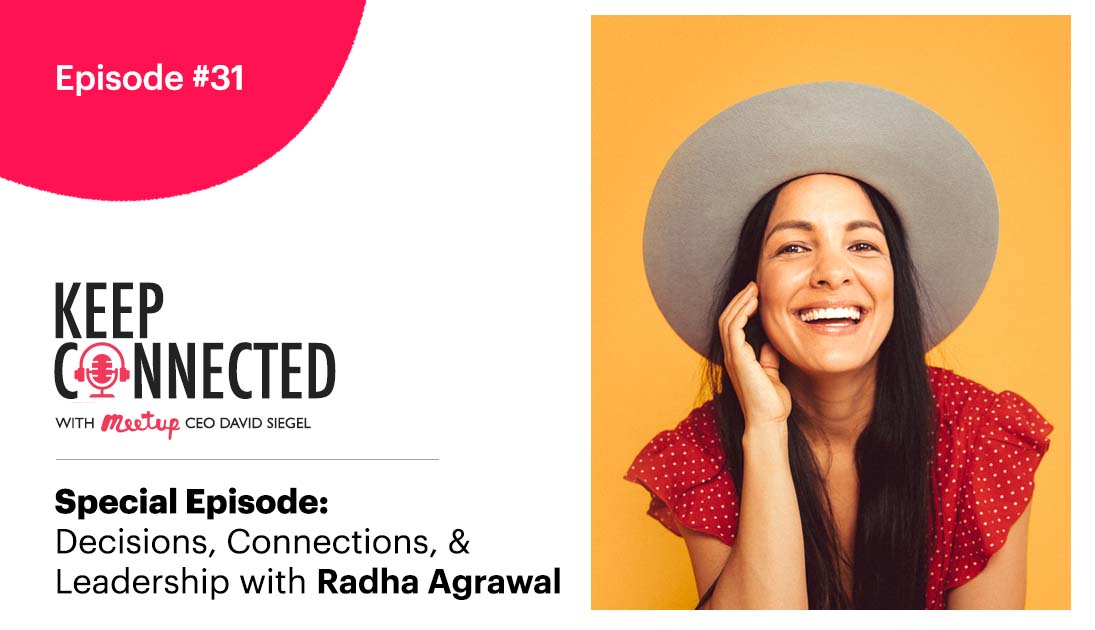



We’re switching things up on Keep Connected! In this special episode, host becomes guest and guest becomes host when author, CEO, and founder of Daybreaker, Radha Agrawal interviews Meetup CEO and Keep Connected host David Siegel. This episode delves into topics from David’s new book, Decide & Conquer, a guide for decision-making that’s sure to help new and seasoned leaders alike. Don’t miss this chance to hear from the leader of Meetup on how to run a company, how to make smart decisions, and how to build a culture of community, even during a pandemic.
Ranked as one of the top 25 CEO podcasts on Feedspot, Keep Connected with Meetup CEO David Siegel is a podcast about the power of community. For more details on other episodes, visit Keep Connected on the Meetup Community Matters blog.
We hope you’ll keep connected with us. Drop us a line at podcast@meetup.com. If you like the podcast, be sure to subscribe and leave us a rating on Apple Podcasts. Learn more about Keep Connected host David Siegel’s experience as a leader and decision-maker in his book, Decide & Conquer. Pre-order your copy today!
—
Special Episode: Decisions, Connections, & Leadership
Before we get into the episode, I have something important to share. Check out my book, Decide & Conquer, to get to know my story at Meetup. The hardest thing about community leadership is making tough decisions when the stakes are high. They were never higher than when Meetup was owned and sold by WeWork. In my book, I’ll walk you through a counter-intuitive framework for decision-making and the epic journey of Meetup’s surprising survival. Good leaders deliberate. Great leaders decide. Pre-order my book by going to DecideAndConquerBook.com or anywhere books are sold. Thank you.
—
We have a special guest. It’s me. The host becomes a guest. Radha, take it away.
My name is Radha Agrawal, the Founder and CEO of Daybreaker, the global dance community and movement and author of Belong. I am taking over David Siegel’s spot as the show host, interviewing him on his book, what it means to be a leader at Meetup and all of his incredible trials and tribulations to get to the leader that he is now. Let’s get into it.
—
What an honor. It’s great to be here. David, it’s good to have you on your own show.
I’m excited to be here. I haven’t been a guest ever.
To kick us off, why are we swapping?
I loved having you as a guest. I have three children. No one could ever say who your favorite child is. With 30 episodes or so far, I can’t say who is my favorite guest but you were definitely one of the top guests. I had an amazing time talking to that when someone said, “Sometimes it’s fun to do a little bit of a flip, have a guest host, and you as the host becomes a guest so that people can get to know you a little bit longer, a little bit more.” I thought Radha is the perfect host for this. That’s what we’re doing. We get to know me and you a little more, talk about some community stuff and Meetup, and go from there.
Since both of us are so deeply steeped in the world of community, why are community and connections so important to you?
I grew up, and I still am, an observance Orthodox Jew. Because of that, we went to synagogue all the time. We have 10, 15 or 20 guests over on Friday nights and Saturdays. We’d hang out in a collective community with 200 or 300 people every single Saturday. It became a very big part of my life. There also have been times during life transitions that I have had less community whether it’s starting college or moving after college. I saw such a contrast between the life that I grew up with and at times not having that community, that you tend to appreciate things more. That’s when you know the opportunity to become CEO of Meetup, I was like, “Whatever it is, yes. I want to do it.”
As a half-Indian, half-Japanese woman, I’m very familiar with the concept of gathering with your community members and how imprinting that is early on. That was such an ending part of your early childhood as well. How do you go from, “I love the community,” to, “I want to be the CEO of Meetup?” How does one make that leap?
I had always wanted to become a CEO from a pretty early age. I had first worked in business in human resources. I was a Human Resources Manager, which is not a common path to go from an HR Manager to CEO. However, HR managers tend to focus on things like recruiting top people, how do you motivate people? How do you manage people effectively? How do you create amazing work environments? How do you create a great culture? All those things that HR managers focus on.
I realized when I was an HR Manager at a company called DoubleClick many years ago, I would advise on all these things that were important to organizations getting the most out of people, but ultimately the decision-maker was the general manager or the CEO. I said, “I believe in trying to help people to become their best selves at work and in general.” HR could do a liaisoning role in that but if you are overseeing a company then you can help to build a culture and processes that make people love what they do and happier in their lives.
Processes and infrastructure are great enablers to growth.
It was at that moment that I decided I needed to go to business school because I didn’t understand enough. I went to business school and then there was a series of roles. I had a series of mentors who are also CEOs of companies. I did the typical, went to be a manager, director, president of a company at a pretty early age. I became a CEO at 40 years old of Investopedia. That was my first CEO job and then it got sold. Adam Neumann came, knocked on the door and said, “Would you like to become the potential CEO or the first outside CEO of Meetup?” Twenty-seven interviews over a four-month period later, I became the CEO. It’s easy peasy. Anyone can do it.
What a circuitous and thoughtful journey that you’ve taken to become CEO of Meetup. What attracted you to Meetup in the first place? What aspects do you like about Meetup that attracted you to the role?
I had always been going to Meetup events. I had not been a Meetup organizer, though I am a Meetup organizer now and I love it. I have another event for my group. We have about 200 people in the group. The thing that attracted me most was Meetup’s role when it comes to the loneliness epidemic that exists in this world. You hear the studies, 46% of people regularly feel lonely, Millennials, Gen-Zers. It’s like 62% of people feel lonely.
I have 70 students in my class. I talked to them at times when they are comfortable sharing about challenges that they have and the negative results of loneliness and depression that could come from it and all the other challenges. Meetup is the cure for the loneliness epidemic. To be able to work for a company that has 57 million members where we’re helping people to become less lonely, kids would say I got the best job in the world. I’m crazy lucky to have it.
As a community architect myself, when I think of 56 million people whose lives you’re serving and supporting, my whole heart bursts wide open. As you are sharing about the whole WeWork experience and you shared about this so thoughtfully and beautifully written in your book, I’m not one for salacious storytelling but can you explain the difference between your staff management and WeWork? Why did Meetup succeed while WeWork stumbled? I’m curious to know your take on that. You share that very deeply in your book and I loved that but for the readers to get a little taste, it would be great to know.
WeWork was incredibly focused on growth for growth’s sake. The goal was growth. The challenge with growth for growth’s sake, as opposed to growth for mission sake, meaning that if a mission of a company let’s say is secure the longest epidemic and growing conflicts with that, it doesn’t for Meetup, but if we go too fast, that will be a problem. If the entire mission of a company is essentially growth and you are not able to support that growth in any way then what happens is you create negative and challenging experiences for people as part of that growth.
For WeWork’s case, the challenges were internal. They went from 1,000 employees to 10,000 employees practically overnight. What that meant is people have 5 or 6 managers in the course of a year. There were six different people doing the exact same position and they didn’t even know it or talk to each other. There was just so much chaos that rain through the organization that it added tremendous amounts of stress because there were these growth goals because the business valuation was $47 billion that they had to hit that made success nearly impossible.
A lot of that does stem from the leader from Adam Neumann who genuinely wanted and still wants to make the world a better place. He does care, and a lot of people don’t appreciate that. They hear stories about money or other things. He does want to make the world a better place. He just wasn’t equipped to be able to effectively do so because he didn’t understand that processes and infrastructure are the great enablers to growth. I’m sure you’ll appreciate this, the concept of sometimes fast is slow and slow is fast is an important thing to understand.
In terms of personal growth that we all go through, if you try to do too many leaps too fast, you could have crashing back down very quickly. If you try to make some kind of leap in your life, a habit that you want to take on and then you work on that, then it becomes sustainable. You work on the next thing, it becomes sustainable. In WeWork’s case, there was so much growth that the crash was almost inevitable and the crash ended up obviously coming down.
At Meetup, we try to grow in a slow, steady place where we are able to ultimately help our organizers and members along the path versus potentially to blow things up later. It’s something that I feel pretty good about, which is before WeWork, Meetup was losing close to $20 million a year then the pandemic happened, WeWork sold Meetup and we’ve been more profitable the last few years than any time in our history. It’s not a lot but enough that we’re sustainable and will last forever. Any additional profit, we try to plow back into creating better experiences. To me, the goal is not just one-time successes or unsustainable activity but everything is about to me, creating sustainability through creating the right processes and infrastructure.
I can’t get into the full thing. You talked about slow and steady growth, leadership in both of us as CEOs of our own movements and communities and grow for growth’s sake versus growth for mission’s sake. As a leader and CEO, how do you know what the fine line is between growth and mission? Our fiduciary responsibility to our shareholders is to grow the business. When you say slow and steady growth, what does that look like? How do you plan for that as a leader? For those reading who are also in leadership roles, what is your advice for them because hockey stick growth clearly does not work? How do you manage thoughtful growth where your investors and community members are happy as well?

The first thing to recognize is that they are not mutually exclusive, which you have said. One of the things I oftentimes talk about is that revenue and profit give oxygen to our mission. Meaning, the more that you are able to have a successful business, the more that you’re able to ultimately achieve a company’s mission. Back to your question which is, “How do you know if you’re growing too fast? Can you understand?” There are two answers to that.
First is people oftentimes ask the question, “How do you know if you have product-market fit? How do you know when an entrepreneur starts a business whether that product is a real interest to the market or not?” There are quantitative answers and more qualitative answers. I tend to look at the more qualitative, but quantitatively you could look at NPS, which is Net Promoter Score, which has been shown by numerous studies as one of the best questions to ask about how good a product or service is, which essentially the question of, “Would you recommend this to a friend?”
If you start seeing your NPS or Net Promoter Scores going down as you grow, then that’s telling you something. It’s telling you the quality of the product and experience is not the same as it used to be. You need to dig into that and understand it. That’s a quantitative metric. Qualitatively, however, to me is more important. Qualitatively, what kind of feedback are you getting? You know it when you see it.
There’s a famous statement by a Supreme Court justice around in the 1970s of, “What’s the definition of pornography?” The answer by a Supreme Court justice, “You know it when you see it.” My point to that is that when a CEO or a leader starts seeing their customers getting more frustrated, start seeing that the infrastructure and the processes that have worked in the past are not working today, they know it. The key is to say, “Let’s step back here and figure out what we’re doing wrong before we start growing even faster and then just keep making the same exact mistakes over and over again but for a much larger audience.”
I feel like it’s evolved compared to so many of the shareholder-led and shareholder-run public companies that exist out there. It’s comforting to know that you both think of things qualitatively and quantitatively.
Another example besides WeWork is what’s going on with Peloton. Peloton announced 3,000 job cuts. It’s an amazing product. John Foley is someone I know personally. He’s an incredible individual. He decided to step down but what he said is that pandemic is not a strategy. The pandemic that we’re all under is a situation that presents opportunities and challenges but ultimately it’s not a sustainable strategy. When you’re a leader, you know that the situation you are in either good or bad is usually not going to continue forever. For Meetup, we knew that we are going to get back together in person. We are 68% in person now and it keeps growing every single month.
Pandemic is not a strategy. It is only a situation that presents opportunities and challenges, but ultimately it’s not a sustainable strategy.
Daybreaker had times where it wasn’t in-person, there are times where it is in-person, and now you are going to this amazing tour and hitting 8 or 9 different cities as part of the Daybreaker movement with 500,000 people. You knew that it was going to come back amazingly. People are desperate for Meetup and Daybreaker but ultimately the situation that weather Peloton was in, which was for the good or other organizations like ours that have been posed challenges, it’s not what the future is and understanding that is important.
You talk about a decision framework that you came up with, which I connect with. There are so many concepts in here that are both tried and true but also, feel new. How do you decide when to be confident about your leadership decision? When do you know when to be more long-term focus? You talked about be kind, be confident in long-term focus, be honest. When do you apply different decisions to your everyday leadership?
Thank you for listening to a whole bunch of them and for pre-reading the book also because you gave us some great help and feedback on it. I appreciate it. The number one component to effective decision-making before we get into the different kinds of values that I focus on in the framework is surrounding yourself with people who will disagree with you. One of the biggest risks that leaders can do in making a decision is to have too many yes people around them. The key is finding people who think differently than you and creating an environment where disagreement is championed because the more disagreement that you have, the better and smarter decisions you are going to make.
For example, one of the things that we do at Meetup is before meetings, before an offsite, for example, we will have someone put their point of view on a document. Everyone needs to read that document, add areas where they agree and disagree with that point of view then the entire conversation is about, “Where do we disagree? Let’s not talk about where we agree.” That’s a waste of time. That’s not what all the areas we’re disagreeing. I tell people, “Don’t show up to this meeting if you didn’t add anything to the document where you didn’t disagree about something because then the whole goal is to have some disagreement there.”

What I also like about that is it allows people who are more introverted, who sometimes don’t feel as comfortable talking up in a meeting but may have the smartest things to say. Oftentimes introverts, by the way, truly do. Those individuals can be on equal footing. It could be more thoughtful in their responses if something is documented. My first answer to a decision process is to make sure that there’s this where in fact, oftentimes what we will do at Meetup is someone will say something and I’ll say, “I agree with you but I’m going to disagree just because disagreement is so important. We don’t want to make any critical decisions unless there’s enough debate that happens first.” That’s an overriding factor in anything that one could do around decision-making.
First of all, it is courageous to be asking for your team members to disagree with you in a world that is polarized and we know it is a take-down world. If you choose to go a direction that is against someone’s feedback, you also risk them taking you down or speaking negatively about you to press or media or whatever it may be. You have to strike the right balance between building the container for this tenant disagreement happened in a way that feels safe for everyone. That’s your leadership and action. That’s hard to do.
If someone acts defensively, for example, when they’re having someone disagree with them, that’s just the death now because then you don’t facilitate a culture of disagreement. You don’t help people to understand that the best thing they could do is to disagree. I talked about this in Decide & Conquer quite a bit. I’m a big believer in listening and selectively following.
You want to listen to all people’s points of view but just because you are listening to someone’s point of view, doesn’t mean you have to follow their point of view. You want to listen to everyone and get everyone’s feedback but also you can’t feel the burden that just because you got feedback from someone and if the person’s a board member, the person’s a manager person is important, it doesn’t mean you follow what they say. You have to use your gut to figure out what the right decision is but ultimately listen to all but selectively follow.
We live again in a world where we are often listening to two persons’ complaints in a 1,000 person office environment. It is comforting to know that the concept of selective following continues to exist in leadership because we do live in a society that listens to the few voices on the negative side of the spectrum rather than the collective voice of the group in general. I appreciate this part of it. How would you describe yourself as a leader? What is David Siegel like as a leader? What would your team members say about you?
As a leader, I am the same exact way as I am as a person and as a friend. There’s no difference between my professional behavior style and how I act personally. It’s very intentional. First of all, I don’t even know if I could fake it so I don’t bother. I don’t even try which gets me in trouble at times but it makes life more interesting perhaps, although not necessarily for everyone but I try my best. The second thing, asking about someone’s leadership style to some extent is almost asking like, “What’s your personal style? What’s important to you generally?” That’s what’s important to me from a leadership standpoint.
Generally, I would say two things. One of the reasons why I enjoyed our conversation so much is because they are the two things. You have got the Jewish person and the half-Indian-Japanese person but were still siblings from another mother. My two things are living a life of joy and meaning. Those two are intrinsically related for me.
The more that I can spend my days creating joy and meaning for myself, my family, everyone who I touched, all those around me, podcast listeners, readers or listeners of the book then that’s a good day. Any day that I’m spending whatever, lying in bed sometimes you need that to recharge. I don’t need that much. Other people do and that’s okay. If they need it then they should take it.
Any day that I spend in cold frigid weather, binge-watching Netflix, that’s not as good a day, unless I need that, which is okay in order to do the things that I want to be spending my time doing, which is helping joy and driving meaning. For me whether it was because of the way I was brought up or because some friends of mine had passed away when I was at an early age or whatever reason, living as meaningful personal life and a work life as possible is what it’s about. That’s what I try to do for everyone that we can. Fortunately, at Meetup, it’s easy because what we provide is meaningful.
You are busy. You are the CEO. Why now? Why does this book need to exist? What was your inspiration for this book?
Surround yourself with people who disagree with you. The more disagreement you have, the better and smarter decisions you’re going to make.
One thing that’s particularly meaningful to me is education and teaching. For many years now, I’ve been a professor at first, Pace University and then Columbia University for the last years. I’m teaching entrepreneurship and strategic planning to graduate school students. That’s deeply meaningful. The reason why I enjoy it so much is because it helps people to figure out what they want to be doing helps them in their jobs, helps them in their lives but you have 70 students. That’s a big class but it’s 70 people that I’m able to deeply impact. Ideally from an influence and helping standpoint, I want to go super deep with people and my family, for example.
That’s the deepest way I want to help and support them and then be able to help my 70 students and teach but also a book. Whether it’s an audiobook, what it’s able to do is it’s able to help potentially millions of people. I don’t know if the book is going to help millions of people but it’ll help however many people read or listen to the book. My number one drivers were joy and meaning. A book fits perfectly into that subset of helping to drive meaning for myself and for others. Also in terms of joy, truthfully writing the book was a joyful exercise. I know that sounds crazy because it’s stressful but it wasn’t for me. In two months, I vomited out all these crazy experiences that happened at WeWork and built a framework around decision-making.
Editors hopefully cleaned it up. HarperCollins was a great publisher. The same anchors in life. Joy and meaning the book fits perfectly into it. The last thing I’ll say to this specific question is that I’ve read a lot of books, thousands of books probably. I have hundreds of business books. Oftentimes, books fall into two categories. They’re either the instructive, textbooky five different points there’s said over and over again, more boring in nature and it’s repeating the same thing or they’re these kinds of stories that are fun but they don’t necessarily teach you.
I want to write a book that was represented this rollercoaster story of career, WeWork, running Meetup during the pandemic but helping to teach people through some crazy stories and storytelling lessons around decision-making. That was the goal. When you’re able to be a little bit more entertaining, people retain things better as well.
It is an entertaining book and journey. You talked about the pandemic and Meetup having record numbers or revenue. You made it out of the pandemic with flying colors. What do you think you did in the pandemic that resulted in this experience?
Number one is we took a step back and did a couple of things. The first thing we did is when the pandemic first hit, we said, “What is the goal of Meetup? Is the goal of Meetup, in real life, getting together in person? Is the goal of Meetup to help to build connections between people, the 30 million connections a year that we drive between people? The answer is obvious. It’s about the connections, not IRL.
We got all the engineers in the room together. Within a week, we launched an MVP, a Minimum Viable Product, which basically means a product with lots of problems where we could make it easy for people to get together remotely through Zoom or through 100 other types of video conferencing platforms. They can stay connected in a time with the pandemic when people need connections more than ever.

We said, “Our mission is not about IRL. It’s about that.” We pivoted and allowed it. In the last years of the pandemic, there have been over 5 million online events, tens of millions of people have gone to online events. Online events are still 30% plus and will continue to be a big part of Meetup because it allows people from different global locations to go to one group and there’s a ton of positives to it. The one thing that we did was that.
The second thing we overemphasized is I talked about process and infrastructure. When a company like Meetup has been there around for many, in fact, June 2022 is our twenty-year anniversary. You will be invited to the big celebration. Maybe we’ll do some Daybreaker dancing right in the beginning. That would be totally awesome. You accumulate all this what’s called technical debt, which is essentially for non-techies, they are millions of lines of code that accumulate one project of another project of the thousands projects where you don’t necessarily take the time to eliminate a code that you built but you keep just adding on bandaid after bandaid. To make one little change that could take a week, it takes like four months. That’s not sustainable.
We re-platformed most of Meetup to make it much easier for us to make changes, eliminate challenges within the technology. We looked at this as an opportunity to say, “Let’s build better infrastructure and process during this time because people are not going to as many in-person events.” It gives us that ability to do so. We’re not going to be growing as much because of that. The third thing that we did is we said, “Let’s focus on how we can do our job and helping our organizers and our members better.”
We hired an amazing Head of Content, Mary Garcia, along with Jeanine Mioton, and a whole bunch of other people who work in the organization who built a blog out called Community Matters that 1.5 million are getting. We built a podcast, Keep Connected, that 50,000 to 100,000 people have already been listening to podcast episodes. We created something called Meetup Live, which allows people to learn about best practices around organizing and community. There are over 100,000 members of that group. It went from nothing to the largest group in Meetup. We did all those things to support our organizers and members. That’s helped us so far.
How do you decide on price points for membership, for example? As a leader of a community who wants to obviously create connections, how do you leverage, “We want to make all these connections. We also need to keep a business afloat?” How did you decide on the membership that’s the revenue model? What is your decision-making framework for how you decide to price your product or service?
Two of the things I talk about in the book are around decision-making, the importance of being bold and also being speedy. What that oftentimes means and it comes to decisions is, you will roll something out. It may not be great and you’re not going to learn from it and then you are going to pivot. The key is that you don’t spend too much time trying to figure out what you should do then roll something out and then also learn it’s a problem but you have spent six months trying to roll the thing out. In the first place, you can’t know anything until it’s on market. It is the bottom line.
Scott Heiferman, our Founder, made a pivotal decision years ago around Meetup pricing. It was a hard lesson that he learned that I’m going to share with all of you because it comes down to pricing. That could help Meetup organizers and members understand our pricing model. Originally, becoming a Meetup organizer was free for all individuals. The result of that was within a year or two of Meetup’s founding, he had thousands of people that are stepping up and becoming organizers. That was a great way to grow fast. WeWork in. It was just growth.
The problem with that was that many organizers weren’t necessarily doing a quality job in organizing because they didn’t have any skin in the game. They weren’t necessarily paying anything for us. we had all these groups that were created that were empty groups. There were groups but there were no events happening. People would join these groups, get excited about joining a group and then nothing would happen. He made an important decision on pricing to get to your specific question.
He said, “We’re going to start charging.” He started with $10 a month to become a Meetup organizer. I kid you not, overnight, the number of organizers declined by 90%. $10 is not an insignificant amount of money but it’s not an enormous amount of money either. It took three years for the company to get back to the same number organized.
What was a genius about Scott’s move is he realized that if the company kept growing with poor experiences for its members and organizers then that growth was inevitably going to lead to a crash. Instead what he said is, “We’re going to take the pain and charge our organizers so that they know that psychologically, when you’re paying for something, you’re going to put more time into it. It’s just the way that our minds tend to work.”
Whenever we do an event, it ends up less people show up than a paid ticketed event.
Companies must have a set of core values they truly live by, not just hanging on the wall that no one looks at. These values must be embedded within all the elements of their culture.
Oftentimes organizers will say to us, “How can I get more people to come to my event?” To show up, the answer is, “Charge $5. Charge $2. Charge a tiny amount of money,” but psychologically people don’t necessarily think about the sunk cost fallacy. They think, “I paid the money. Now I need to go,” then people go.
Hopefully, that’s helpful in understanding our model, which is organizers pay a relatively nominal amount but we also equip organizers with tools so that they could charge dues to their members and they could offset that fee. They could have their groups be sponsored and that could offset the fee. There’s a whole host of things that we’ll find organizers to offset those types of fees. We also have a decent amount of our company’s growth has been in businesses that build out communities and support community growth whether it’s Google, IBM or AWS.
What this says to me between Scott and your leadership is long-term leadership vision. I have so much respect for that. It’s cool.
The world is oftentimes against leaders having a long-term perspective. It is the reality. When you’re a public company and you’re held to hitting quarterly financial projections, it’s a great driver for people to end up becoming more short-term focused than they should be. Unfortunately, there are financial incentives for more short-term thinking. Meetup is not a public company so we have a lot more flexibility for that reason.
Getting back to you as a human, what is the difference between being nice and kind? You talked about that in your book. How does this influence trap door decisions?
One of the mistakes that I have personally had made when I was early in my leadership journey and I think a lot of leaders tend to do this is you want to be liked. I am the kind of person that does want to be liked. A good way to be liked is to be nice. It’s not to criticize people. First of all, never would you criticize but not criticize people’s actions, not to necessarily upset people.
I learned that there’s a big difference between being nice and being kind. Sometimes the kindest thing you could do is to say to someone, “This job that you’re in may not be what you’re meant to be doing. You should probably start looking for another opportunity.” That’s not nice. You are asking the person to leave the company but it could be the kindest thing that you do.

If you think about good friends that are truly kind to each other, tell a person, “Where it’s at?” We’ll say to someone like, “What are you doing?” or we’ll call people out on their BS. That’s what’s being kind is. We should always strive to be kind, not just “be nicer,” which doesn’t necessarily help people to the greatest extent. When you’re making a decision, distinguish between, “Am I trying to be nice and help someone in this short-term right now, or am I being kind and helping this person, am I being kind of helping the company make the ultimately right decision for the future?”
On the other side of that as a leader who understands the difference between nice and kind. When you’re selecting and choosing the team members that you hire, obviously having come from an HR background, which I think is epic as a CEO and every CEO should go through HR training by the way, how do you decide as a leader, the culture fit of team members that you’re hiring?
It’s extremely important for companies to have a set of core values that they truly live by. Not core values that are on a wall that no one looks at but core values that are embedded within all the elements of a company’s culture, that are embedded into the recruiting process. When you recruit, you look for these core values. When you do performance manager and you give people reviews, you review people relative to those values.
We have a 360-degree feedback process, which is getting feedback where people have the opportunity to learn from their manager, peers and subordinates in 360 degrees. All the questions are relative to these core values that we have. Promotions happen to have as a relative core value. It needs to be embedded into the processes and infrastructure like I talked about for those values to be ultimately sustainable.
We have rewards regarding some of our core values. You ask, “What are Meetup’s core values?” Here we go. The first is trust and transparency and essentially be as transparent as possible in running an organization because that builds trust. The second is to embrace change, not just accept change, not letting change happen to you begrudgingly but embracing change as an opportunity for yourself and for others. That’s number two.
Number three is to elevate people, understand that people are how everything happens and elevating people makes for great organizations. Number four is lead with integrity. Everything that we do needs to pass the test from an integrity standpoint. Number five is step up, which is don’t just think about your job as a little microcosm, “This is my job. I can’t go left. I can’t go right. I just got to do my job.”
Your job is to find any opportunities to take your amazing talents, step up and do things that aren’t necessarily in your job description but you want to become part of your job description. We have a step up award that we give out every month to someone who’s nominated for it. We give a financial thank you to the person who is that step up award. That’s the fifth.
The sixth is to focus on impact. In order to have the greatest possible impact, you need to have focus. You can’t be doing 1 million different things and expect someone to succeed. Focus drives impact. Those are the six. We embed those throughout the company. Those values end up highly influencing the decision processes that we make.
I connect with all of them. They’re thoughtful. At Daybreaker, before we even launched our first event, we also wrote down five core values that continued to be our North Star for all of our decisions. Ours is our wellness. It’s all about being well and healthy, wellness holistic health and wellness comradery, which is about one-to-one and one-to-many. The community can often feel pretty large in often vague camaraderie felt a little bit more one-to-one connected. Self-expression is all about allowing your body to move and finding the courage to express yourself. Mindfulness is about the presence and being here now. Mischief, which is living life with a wink and not taking life seriously. Those values are the lens that we look at, all of our partners, talents and every aspect of the value chain as well but yours resonate also for internal culture.
Ours, we wrote more for external culture. This feels like core values for internal culture, which I want to implement as well. These exact ones are awesome. Jumping back in. There’s so much about the book that I feel like resonates and you need to use those. Writing a book is interesting because you get to sort of really reflect on all the things that you’ve worked on and then began distilling them down to frameworks, into repeatable retweetable bite-sized things that people can then take with them.
Since it’s your week zero, your first few days, your next 60 or 90 days and I loved the way you broke down each of these very important formative parts of your leadership experience, can you give us a bit more color about the difference in each of these day 0 to day 30 and day 60 and why you break it down in that way?
Starting with day zero is most leaders don’t understand that on day one, you’re already under a complete and total microscope. Everyone looks at every little move that you do. You are going to be overwhelmed as soon as you started an organization. Your success in your first 30 days, 60 days, 1 year is going to be actually incredibly dependent and influenced by the work that you do prior to starting. Do not accept a job on a Friday and then start it on Monday and expect that you are going to hit it out of the park. You could end up struggling in any role.
Try to get information as much information as you can about the company, your role and what you’re doing prior to starting. That allows you to then hit it more out of the park and do a better job in listening and asking the right questions, which is the best thing that a leader can do on day one by doing the homework beforehand.
What I did and what I encourage all leaders to do in terms of “day zero” is when I accepted my first official day was a week prior to even being announced and meeting all employees. I spent the entire week with numerous people in the executive team, with people that we work with, the Founder, Scott. I went to a whole bunch of Meetup events also and talk to me to organizers and members. I asked a whole lot of questions. I ascertained that there were 6, 7, 8 themes that were going on at Meetup that we need to spend time right when we started and learning more about. If I didn’t take 40 to 60 to 80 hours before starting to do all that homework, it would have been a lot more difficult on day one.
To have the greatest possible impact, you need to have focus. You can’t be doing a million different things and expect someone to succeed. Focus drives impact.
On day one, what happened is we identify these 6 to 8 things. An example of one theme was we’re doing too many different things, what should we stop doing? That was a theme that I had heard. What we did is we created a workstream with people volunteering to join one of these big questions and themes. They met every single day for two weeks. We had to prioritize over other work that they were doing and then they told me, the CEO, what we should ultimately do and what we should stop doing.
Two weeks later, we had the organization galvanized and making suggested changes. I said, “That makes sense.” It was a lot easier to then make change happen very quickly because it came from the people but ultimately, had I not done all that preparation and all those meetings beforehand, we wouldn’t have known the right questions to ask. One of the most important things that I think a leader can do is simply ask the right question. Spending your time and figuring out the right question to be asking will end up driving what you’re answering and what you’re answering will end up driving what actually actions you’ve taken, you prioritize. That’s a little bit about day zero in the book.
That shows such dedication. That speaks volumes of you as a human being and as a leader as well. How do you know what the right questions are to ask?
The answer is you don’t but being thoughtful about what questions you’re asking are very important. If you put so much pressure on yourself, that the question you’re asking is the “perfect question” to be asking, it’s not going to necessarily be healthy. One step is first saying, “I may not ask all the perfect questions but I’m going to be thoughtful about each question and determine whether or not it’s the right question.”
However, the right questions are ones oftentimes more controversial in nature. If it’s a softball, if it’s a question like, “How do we grow faster?” Everyone’s thought about that question before. If it’s, however, “What do we need to deprioritize and stop doing because we’ve been doing it forever and it isn’t working?” That’s a more controversial question. That unfortunately could make some people feel a little bit less comfortable.
That may not be a nice question to ask because people might not like to hear the answers because people are working on some of those things that may need to be deprioritized but that is the reason why it’s so important to ask it because people oftentimes run away from things that could be more controversial in nature in order that everyone be as happy and content as possible, which oftentimes results in everyone doing a million different things. None of which is the right focus.
If your questions are not going to create any type of disagreement then it’s not the right question. If your question is potentially not going to cause some actions to be taken that make you feel uncomfortable then it may not be the right question. If people can get away with broad and general answers to the question and it’s also not the right question because great questions are ones that require specificity of answer that doesn’t let people get away with a broad statement because the specificity of the answer will drive a specific action. What you want are actions and not broad statements.
It also sounds like what you’re saying is you have pressured the questions you ask but you also recognize that at the very beginning, day zero, it’s okay to be messy in terms of not having the exact right question. You’re not going to beat yourself up for not being perfect. Those honing or iterating on your questions from a lens of courage, confidence and just wanting to go in and be curious about how to make things better, that’s also an important place to start because of the pressure that you put on yourself as a first-time leader or even as a seasoned leader to ask the right questions can be very stressful. To remember that it’s all a playful experience that you talk about joy and meaning, I can only see you jumping into these Meetup groups asking questions, curiously banding around and calling up different executives and just being so enthusiastic which breeds excitement on the other side.
Messiness is important in the beginning, being comfortable with being uncomfortable. I talked about healthy tension a lot, being comfortable with tension. Tension is healthy but when you are in tension, it means that everyone’s in agreement. What the heck does that do? Being comfortable with things being a little bit messy because through the messiness, knowing that you’re going to get order, you’ll give space to give people the ability to think more broadly and then you could create order but oftentimes people start with too much order in the beginning. It is debilitating and it keeps broad thinking from happening. Sometimes you need much broader creative solutions and a little messiness to get there, a little mischief.

The other takeaway that I got from just these series of questions is the idea that you are inviting participation from the team who have been there from the very beginning and that you’re getting them to give you the answers. That hand reaching out, “Tell me what you know,” versus, “I know what to do. I’m going to tell you what to do,” which many leaders do to their teams. I also think that that’s the recipe for a successful both business and community internally. Those are the two. The messiness and the participatory invitation from your team members.
I remember on my first day, I had the president of WeWork standing right next to me, introducing me. I’m sweaty, nervous and everything else. I play my pump-up song beforehand. I got myself ready. Someone raised their hand and said, “David, what’s the company’s strategy? What’s the strategy going to be?” I’m like, “I have absolutely no idea what the strategy is. What I do know is that there are some values that are important to me. I’m going to share with you some values that are important to me. We’re going to figure out the strategy together and you’re going to be a big part of figuring that out but I’m not going to tell you anything about that.”
Was everyone smiling, excited and grateful? I’m sure. That’s exactly the way a leader should step onto a stage when they first come in. I respect your committee tasks. You’re focused on the community and listening.
To answer your question, I think people, to varying degrees, feel comfortable with ambiguity. Many people don’t like ambiguity for lots of good reasons. People have greater levels oftentimes of anxiety in more ambiguous situations. Sometimes people want to hear, “This is it. This is the answer.” It helps them. I don’t think people did feel many people. Some people did. Some have gratitude or excitement. There is more nervousness about change. That’s the most normal thing in the world for people to be nervous about change and for it to be a source of concern.
It’s important to acknowledge it but it’s important not to then listen but selectively follow but not to necessarily make it more comfortable for people to say, “Here’s the answer,” but to say, “We’re going to be in a period of ambiguity for a time. I know that that’s hard for you, to acknowledge it, to be as empathetic as possible and try to put a plan together of how the ambiguity is going to end.” In the beginning, that was probably more nervousness than anything else, honestly.
Messiness is part of the journey. For both employees and leaders to know on those sides what to expect, that’s also comforting. In the rest of your book, you talk about the next 60 and 90 days, all the things leading to new territory, facing the unknown unknowns. There are so much juice and good stuff in this book. I’m not just blowing smoke. What do you hope readers will take away from this?
Here’s my one takeaway, which is that I think all too often, when you think about some people have more of an external locus of control and they believe that things happen to them. Other people have more of an internal locus of control and they believe that things in their life they can control and sometimes it’s too great to a degree. The reality is there are internal and external of things that you can control and you can’t control. However, when it comes to work too often, people will think, “I can’t influence that. I can’t change that. This is above my pay grade. This is outside my sphere of influence.”
The one thing that I want people to take away from the book is that every single person whether you are right out of college, in college, manager level, senior-level, CEO or whatever it is, you have a lot more influence on your future than you realize. You can make decisions within your company, outside of your company, in your personal life and your professional life that can change the course of your life and that can make things better. If you’re stuck, you could get unstuck.
The biggest takeaway for me for the book is to say, “I can make decisions. Here’s a framework for making decisions. I can get out of bad situations personally or professionally. I can influence things even if I don’t have the ultimate authority to make that final decision.” To me, that’s the biggest win. If people do that, hopefully, they live happier, more meaningful and joyful lives. That’s the goal of the book.
As a final couple of questions, do you think that this leadership framework can be applied in your home life with your own family, with your friends and in your romantic relationships? How can you take some of the principles that you talk about in your book and apply it when things are so much more tender, where kids might not listen to you as a leader of your household? How do you manage those challenges both as a parent and a leader?
My three teenage kids listen to everything I say. They definitely don’t, by the way. I’ll take one principle and I’ll apply it to personal life and answer everything that could apply to personal life, which is be surprised only about being surprised. What that means is the job of people, generally, both personally and professionally is to avoid surprising others. How many times are people in a relationship and they think everything’s going amazingly well then suddenly they break up and it’s like, “What? Where’d that come from?”
There’s a failure there. How do you avoid surprising people that you love? How do you avoid surprising people that you care about? How do you avoid surprising people at work? How do I, as a leader, avoid surprising my board of directors, our investors? How do I avoid surprising people who work for me? In my personal life, how do I avoid surprising other people? The answer is to be comfortable talking about uncomfortable topics, things that are kind, that may not be nice and to understand that any time that you’ve surprised someone, you failed and you’ve made a mistake.
That’s incredibly relevant for people’s personal lives because so often people end up making a decision in one’s personal life and be surprised that had that conversation prior to it, have they talked about what was frustrating them when it was a 1 out of 10 of frustration or 3 out of 10 or frustration and then it waited until it became a 10 out of 10 and frustration, a lot of good could have happened from that. That to me is a principle around not to surprise others that apply to personal and professional. A lot of them do but that one particularly resonates for me.
Last question because this is something that is so near and dear to both of our hearts. This leave the readers with this counsel in mind. Why is loneliness dangerous? What can readers continue to be reminding themselves every day over and over again to not be in seats of loneliness? Why is it dangerous? What can anyone do? Both of us being in the world of belonging and community, this is a question I always get. I’m curious to know your answer to that.
It’s more dangerous now than it was a generation ago. My “generation” before my parents’ generation because of the double-edged sword of technology. Technology is an enabler towards amazing things like Daybreaker and Meetup but it’s also a disenabler towards in-person connecting, community, going out and doing things.
My biggest fear around loneliness is the ability to be able to be fully entertained and “busy” while feeling completely lonely at the same time. In the past, without technology, the only way to not feel lonely temporarily was to go out and try to do the same things and be with other people. Now, you could spend ten straight hours playing video games or on your phone looking at social media and be busy or watching TV, but you could also be the loneliest person out there.
That’s one of the biggest dangers. In Meetup, we say we use technology to get people off of technology. We use good to try to do more good. That’s why it’s such a risk. I fear for the meta world and the metaverse when we may or may not need to be in front of people directly all the time to be able to build that community. In reality, that’s where all great things, love and personal growth happens and in-person.
It’s very scary. The number of people, especially after the pandemic, during the pandemic, that depression is unfortunately at an all-time level high in every country around the world. Suicides are at all-time highs in the US. Also, in Japan in particular and around the world. That is a result of loneliness. Our goal is to help people live joyful, meaningful lives. Loneliness is, to me, the opposite of being able to do so.
What a way to end cap this beautiful conversation. It’s for all of us to be reminded that right belonging is the root of all possibility and abundance, belonging and community. Investing in Meetup communities, loving leadership and thoughtful leadership truly are such a gateway out of loneliness. The best leaders in the world as well think of not just their employees as tools to grow their business but the lens of how can they make their lives better.
How can they make them feel a sense of belonging inside and outside the office? You are cleared of all of that. I’m excited to be on the other side of a mic with you. What an honor it is to have time together to unpack your leadership and your amazing book, Decide & Conquer. I can’t wait to share it with my team and continue spreading the gospel of Meetups. I look forward to seeing you on the dance floor as well.
Thank you for having me on my show. I appreciate it.
—
Thanks for reading. While we covered a lot of ground, we learned about the importance of long-term leadership, that leadership can be messy at times. It’s important to surround ourselves with humans who don’t agree with us all the time, and that being nice is different from being kind. Please subscribe and get your copy of Decide & Conquer in Amazon or your local bookstore. Let’s keep connected because life is better together.
Important Links:
- WeWork
- DecideAndConquerBook.com
- Daybreaker
- Belong
- Community Matters
- Keep Connected – Podcast
- Meetup Live
- Decide & Conquer

Last modified on March 8, 2022