
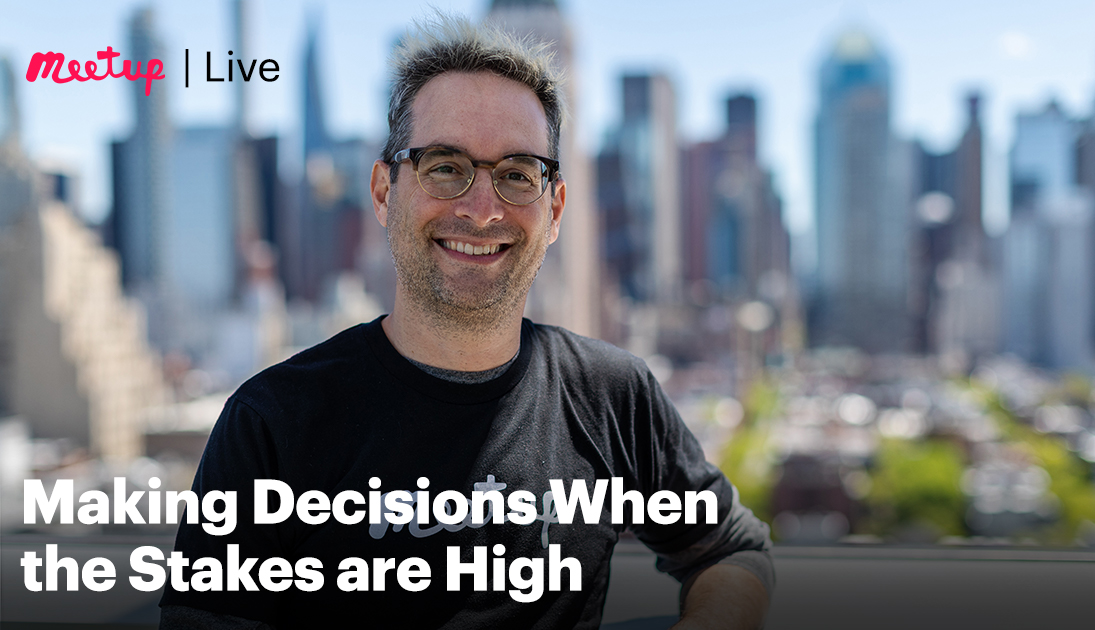



Make smart decisions, even when the stakes are high. Watch Meetup Live with Meetup’s CEO, David Siegel, for a discussion on why platitudes like “nice guys finish last” and “you can’t control your luck” are not only false but are dangerous when making important decisions.
In this event, you’ll hear about the counter-intuitive decision-making framework David drew upon while navigating the sale of Meetup from WeWork during a global pandemic. Learn to apply these decision-making rules of thumb during times of crisis and calm explained in David’s book, Decide & Conquer.
Main Takeaways:
- When you’re making a decision, what optionality means is that you are creating a significant number of new options for yourself. Because you just decided to join a Meetup group, or you decided to move to a new city, or whatever those options are, they create other possibilities for you. The reason why that’s so important in decision-making. People who are successful oftentimes talk about getting lucky, but the reality is that you can create your luck by making choices that open up more options later on.
- Understanding Biases:
- Recency bias: recency bias is where you prioritize what just happened most recently. You over-emphasize the exact experience that just happened rather than emphasizing and thinking about all the different data points, and all the information you’ve had. For example, if you just had a job that you don’t like you’re now gonna look for the exact opposite in a new job.
- Confirmation bias: Confirmation bias is the concept that you only look for information that confirms something that you already know. You surround yourself with “yes” people or people saying things that are similar to what you say, and what you believe.
- Status quo bias: status quo bias is the bias for people to focus on the day-to-day and the status quo, even if it’s a terrible situation, because of fear of the unknown and fear of change.
- Sunk cost fallacy: Let’s say you just spent 3 years in a relationship, 3 years on a job, 3 years building a house, whatever the thing happens to be, and those years are gone, that time is gone. If I go to a restaurant and spend $100 on a delicious meal, I don’t have to eat all the meals just because I just spent all this money. That money is gone, my goal is to enjoy myself is to have a good time, it’s not necessary to compensate for the fact that I spent all this money.
Top Q&A & Resources:
- How are we able to help overcome our biases?
- There are a couple of biases out there, it depends on which one. For recency bias, I think acknowledging the bias in the first place, and then writing down as many different inputs, so I’m not just going to think about the one relationship, I’m going to think about the last 3 or 4 relationships and don’t over-emphasize this last data point. If it’s status quo bias sometimes it best way to overcome that is to realize that by not doing something you’re actually hurting yourself just as much as by doing it.
- How do you identify the criteria for your decisions?
- Think through what’s important to you, think about what your life mission is, your goals, and ground importance as relative to your goals, too. Oftentimes we say, what we want to do but we’re not grounded in what our actual goals are. Ask yourself why you want to do a certain thing and then ask why again.
Resources:
- Decide & Conquer book

Last modified on May 31, 2022