



Meetup organizers, we hear you and we’re here to help. We know that organizer and event-related costs have an impact on your ability to build community. In this installment of Meetup Live’s Monetizing Meetup series, we’re discussing ways to use event fees to offset costs.
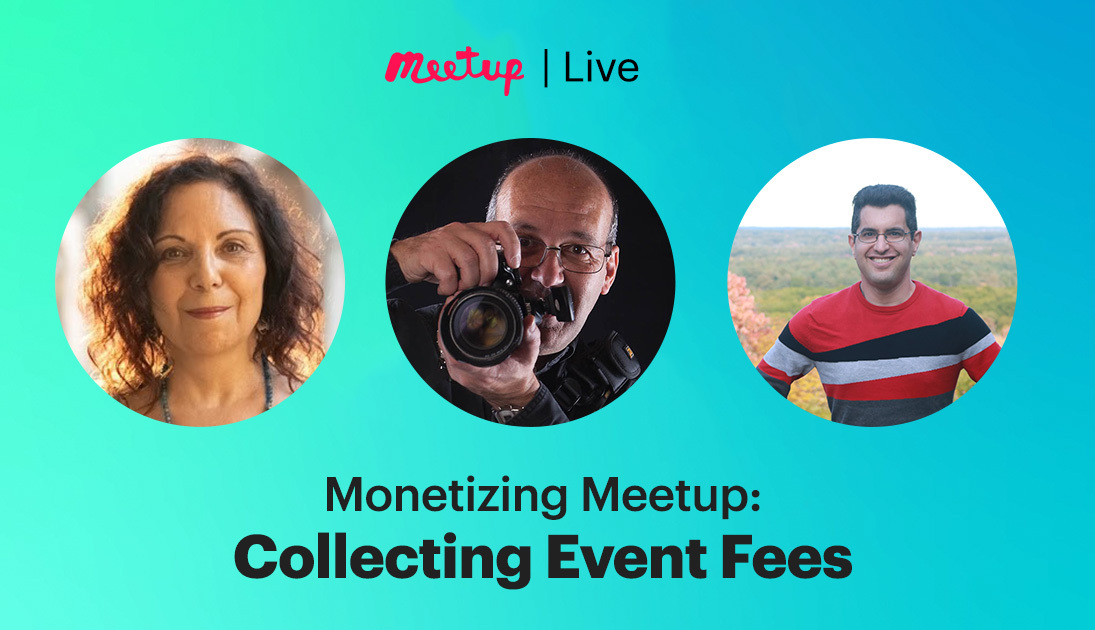
Watch this Meetup Live recording to hear event fee best practices from three experienced organizers, Deborah Paiva, Maxwell Morrongiello, and Mike Giovinazzo. Learn how to assess the right amount for your next event and communicate about event fees with your group members.
Main Takeaways:
How do you show the value to your members that your events are worth paying for?
- Deborah: When I started charging I made sure that I also did some free events in between. The free events were chats, or meeting somewhere for dinner, where I knew my members were already paying for something else.
- Maxwell: The goal of my events is to make social connections and to connect people together which is the real value. I think it is important to have events that are fun but remember the end of the day, your members would not have a sense of social connection if you didn’t host the event.
- Mike: For the photoshoots I provide, what they’re getting is very obvious but for my other events, I charge to maintain the maximum attendance. If I tell a restaurant that 30 people will be coming and only 10 show up, that’s not a good look. So I charge $10 for events at restaurants to ensure people will show up and that money goes to some finger foods on the table. You can also get creative, I had an event at a store that specialized in theatrical lighting. They had room for 10 people in their store, and I didn’t want to show up with less than 10 people. So I charged $10 per person and used the money to buy a $100 gift certificate from the store. When people showed up, they had the chance to win the $100 gift certificate from the store.
What do the earnings from the fees go to?
- Deborah: I have to say I first charged event fees with my Florida groups and I did it because I was keeping track of the money I was paying to Meetup for my Meetup fees, and I noticed I was in the hole for over $300. At that point, I realized, that’s not good business. So I started charging $5 here, $8 there, depending on the event I was doing. I very quickly started to not only cover my Meetup fees but also my Zoom fees because I was doing some online events during Covid.
- Mike: I usually have some venue or some costs with my events that I need to pay for. I use the money to pay for fun events that would otherwise be very expensive if it wasn’t split among the group. If I’m hosting a photo shoot that costs me $150, I can divide that by the 5 attendees and that’s only $30 each to participate.
- Maxwell: First Paypal takes a percentage of our fees as a processing charge. We are organized as a non-profit under a fiscal sponsor, called NOPI inc, which is short for Non-Profit incubator. They do a lot of the administrative work for us, opening a bank account, filling our DBA, and granting us tax exemption. After PayPal takes its fees, NOPI takes a 10% overhead fee. We have certain costs for supplies for the events we run such as name tags, or karaoke software. We also believe it is important to support our organizers who put a lot of effort into volunteering to run our events and may reimburse them any expenses needs to run the event.
what advice do you have for organizations that are considering charging event fees?
- Mike: One, let people know where the money’s going. Be transparent so you don’t have any pushback. The second thing that I found very useful is a very flexible refund policy.
- Maxwell: So I think first off you have to figure out what your purpose is for charging event fees. Is it to offset your costs? Is it to maximize profit? What is the reason you’re doing it? And I think that will provide context on how much to charge. Think about if you believe you should be compensated for your time hosting your events. If you believe you should consider that when determining your fees.
- Deborah: I think it’s really important to remember the things that other people have told you when they’ve come to your events. The experiences they’ve had, the people that have told you your events saved them and found them meaningful connection, that’s what we have to listen to. We are providing this connection that they really need so it’s okay to charge and be compensated for that especially to cover the expenses.
Top Q&A Questions and Resources:
- If you’re starting now, would you start off as a free event and then move into charging, or would you charge the first time?
- Mike: I need to break even with my events, so I can’t afford to give anybody a freebie. If there’s a new member who’s not sure if they want to join, I let them come to an event and watch, but they can’t participate.
- Maxwell: I did try to start a few other groups, and it’s really hard to charge when you first start out with a limited amount of membership since there is less demand. Take some time to build up to the point where you can charge. It can be tricky, so I think it can help to get a free following first, then build from there.
- Deborah: I would start out with something free, it doesn’t have to be exorbitant. I would start out with some free events to build your following and to get credibility because people need to trust you before they’re going to start paying for your events.
Resources:
- Deborah
- Deborah’s website
- Deborah’s book
- Women 50+ for Friendship & Fun – MA & RI
- Maxwell
- Mike

Last modified on April 4, 2023