The Odyssey-Part 4


Details
INVITE LINK
https://us02web.zoom.us/j/81085586371?pwd=1gR9Fao4gWGCSTNCdzfbjxnrHA1xCc.1
IN SEARCH OF THE TROJAN WAR EPISODE 1-THE AGE OF HEROES
https://www.youtube.com/watch?v=ya-OWg7BL6s&list=PL2vJ5Cg-wlPxcTvzl0fTKQOuZk4pe4RuA
IN SEARCH OF THE TROJAN WAR EPISODE 2-THE LEGEND UNDER SIEGE
https://www.youtube.com/watch?v=rcp5Cal-N_Q&list=PL2vJ5Cg-wlPxcTvzl0fTKQOuZk4pe4RuA&index=2
IN SEARCH OF THE TROJAN WAR EPISODE 3-THE SINGER OF TALES
https://www.youtube.com/watch?v=w0zskP6x9Dg&list=PL2vJ5Cg-wlPxcTvzl0fTKQOuZk4pe4RuA&index=3
This episode is critical to watch since it directly talks about the importance of oral history and the role of the storyteller/"bard".
# Nolan’s Trojan Horse
Aug. 2, 2026
By Ezra Klein
### Christopher Nolan Stared Into Elon Musk’s Soul
“The Odyssey” is the political movie of the decade.
I’ll admit I’m a little late weighing in on “The Odyssey.” Chalk it up to having young kids. I don’t make it to the movies much. But what a trick its director, Christopher Nolan, has pulled off. Elon Musk did not understand what this movie was. But this movie understands what Musk is. It understands who we are becoming and who we have become, and it points a way out.
Tricks are central to “The Odyssey.” In myth, Odysseus is a trickster. He is described, in the first line of the story, as the man of many ways or of many wiles or of many turns. He is, depending on the translator, an ingenious man, a cunning man, a complicated man. He is a man of appetites and contradictions, a man who wants nothing more than to go home but keeps choosing to stay abroad, a man who yearns for his wife but cannot stop bedding goddesses. Odysseus is never one thing; he is always many things.
Matt Damon is no trickster. I thought he was going to be the problem with Nolan’s “Odyssey.” Amid the right-wing outcry over the casting of Lupita Nyong’o and Elliot Page, it was Damon’s casting as Odysseus that I couldn’t reconcile with “The Odyssey.” Damon often seems to me like a man of a single way, a man who wakes up early and keeps to a clean diet and rarely has more than one glass of wine before bed. That’s not Odysseus.
But Nolan wasn’t looking for a trickster. His Odysseus is something else. That, you can say, was Nolan’s first trick.
I want to stop here and say a bit about tricksters, because I have spent the past few years quietly obsessed with the archetype. The trickster is Loki in Norse mythology, Eshu in Yoruban stories, Coyote or Raven in Native American tales, Maui in Polynesia and Hermes and Odysseus among the ancient Greeks.
The function of the trickster, writes Lewis Hyde in his wonderful book “Trickster Makes This World,” is “to uncover and disrupt the very things that a culture depends on.” The trickster dances across customs and taboos, says what may not be said, does what should not be done. The trickster injects disorder into order, renders visible what is ordinarily hidden. The trickster causes the damage that makes growth possible. But a happy ending is never guaranteed. The trickster can be regenerative or ruinous. Coyote brings fire; Raven brings the sun; Loki brings Ragnarok.
Hyde’s argument is that tricksters are both necessary and dangerous. They represent a tension every society must grapple with. A culture that cannot meet disruption with creativity cannot survive change. A culture that cannot protect its core values will be consumed by corruption. Too much order leads to paralysis; too much chaos invites collapse.
Sign up for the Opinion Today newsletter Get expert analysis of the news and a guide to the big ideas shaping the world every weekday morning. Get it sent to your inbox.
We are living in an age of chaos. We have been living in an age of tricksters. Musk, President Trump, Tucker Carlson, Andrew Tate, Nick Fuentes — the grammar of the modern right is tricksy. What is serious, and what is not? What is a provocation, and what is a promise? Why did they say that, and how did they get away with it? I am not saying these men are only tricksters. They are not the culture makers Hyde prefers to focus on. But I am saying that the dominant personalities of the age have gathered power by bulldozing customs and taboos, by saying what may not be said, by doing what should not be done.
Hyde said that Americans love a trickster “because he embodies things that are actually true about America but cannot be openly declared.” That might have been true in 1998, when Hyde published his book. And I can see the argument that American institutions and mores ossified in the years since — that our society had become too rulebound and bureaucratized, that too much had become unsayable, that there was too little openness to transgression and invention.
##
But today there is little that may no longer be said. The ideas and morals upon which the best of our culture was built have been disrupted and desecrated. The question now is whether that disruption can be met with creativity and renewal.
This is the central question of Nolan’s “Odyssey.” This “Odyssey” ostensibly hinges on Zeus’ law: Treat the beggar and the stranger as you would want to be treated. But as a horde of classicists have pointed out, that is not the law of Zeus, which is narrower: It demands hospitality toward the guest or the stranger, recognizing that anyone could be a god in disguise. It is not an ethic of compassion or even reciprocity.
And here we find Nolan’s central trick: Nolan has smuggled the core of Judeo-Christian ethics into “The Odyssey.” Zeus’ law, in Nolan’s “Odyssey,” echoes Leviticus 19:34: “The foreigner residing among you must be treated as your native-born. Love them as yourself, for you were foreigners in Egypt.” It echoes Rabbi Hillel, who said: “What is hateful to you, do not do to your fellow. That is the whole Torah; the rest is commentary.” It echoes Matthew 7:12, when Jesus says, “In everything, do to others what you would have them do to you, for this sums up the law and the prophets.”
Such an ethic is demanding. Few of us live up to it. But the problem with adherents of the modern right is not just that they don’t live up to it; the issue is that they detest it. To treat the foreigner residing among us as well as we treat our native-born is derided as suicidal empathy. The Trump administration glorifies cruelty toward the immigrant, the stranger, the weak and the poor. It takes money from Medicaid to cut taxes for the rich. It threatens the destruction of whole civilizations.
The modern right is built on the logic of tribute and dominance. “We live in a world, in the real world, Jake, that is governed by strength, that is governed by force, that is governed by power,” Stephen Miller, a top White House adviser, told CNN’s Jake Tapper. “These are the iron laws of the world since the beginning of time.”
But weren’t those iron laws replaced by the Golden Rule? When Odysseus concocts the trick of the Trojan horse, taking advantage of Troy’s veneration of the same gods he worships to sack the city and make its streets run red with blood, is he a hero or a villain? Is it a trick or a crime? To Homer, he was a hero. To Nolan, he is a soul in need of redemption. Between Homer’s time and ours came a revolution in civilizational values, an upending of what civilization even means. Which side of that divide are we on?
The modern right believes that Western civilization has lost the appetite for strength and dominance and hierarchy that built it. There is a reason a theorist like Bronze Age Pervert has become required reading for young Trumpists. There is a reason right-wing intellectuals like Curtis Yarvin and Michael Anton have mused about the need for an American Caesar. There is a reason the Trump administration is obsessed with Roman-style architecture. It is not an accident that they keep circling this era, both intellectually and aesthetically.
A recent exchange Musk had on X reveals how far this thinking has gone. A user told Musk it was time to “wise up” and abandon classical liberalism, because “universal suffrage leads to universal suffering.” His reply: “I have wised up.”
Helen of Troy, in Nolan’s “Odyssey,” is just an excuse for a war launched to dominate routes of trade. It’s a telling choice during an administration that is crashing into the global order in pursuit of more dominance over trade flows.
In the cry of protest by the Canadian prime minister, Mark Carney, against this regime, he also reached back to Greece to describe what he saw happening: “The strong can do what they can, and the weak must suffer what they must. And this aphorism of Thucydides is presented as inevitable, as the natural logic of international relations reasserting itself.”
When Nolan’s Odysseus recalls the sacking of Troy, he blanches at the memory of 10 years of rage pouring into a city in a single night. It was hard for me not to think, then, of the pent-up rage that Hamas poured into Israel on Oct. 7, 2023, and that Israel has poured into Gaza a hundredfold in the years since. The Israeli prime minister, Benjamin Netanyahu, now describes Israel’s future as “Athens and super-Sparta.”
Yuval Noah Harari, the Israeli-born historian who wrote “Sapiens,” sees the diminishment this foretells clearly. “A lot of the thinking, and also the practice, about what it means to have freedom of thought, what it means to be a powerless minority, was done by Jewish thinkers,” he told me. He added:
> For 2,000 years, Jews all over the world saw studying and learning as the highest spiritual activity. After 2,000 years, you ask them: What have you learned? You have studied for 2,000 years. What have you learned?
> And then people like Netanyahu tell you: Oh, we have learned that you need to be a Roman, that you need to be strong, that you need to build legions, that you need to destroy cities. This is the only thing that matters in life.
> It’s a legitimate value system. Rome had its usefulness. But if after 2,000 years, the Jews simply become the Romans, what was the point? Why did you waste 2,000 years, then? You could have just become Roman back then.
This is Nolan’s finest trick: to make one of our oldest moral rules sound new again. To turn the best of Judeo-Christianity into the law of Zeus, so we can see why it might matter and what it might still have to say to us.
What Odysseus sees, eventually, is that his violations of the moral order have brought ruin to all around him. Agamemnon, the king who launched the war against Troy, is dead, his throat slit by his wife, who never forgave him for sacrificing their daughter for fair winds. Troy is destroyed. Ithaca, Odysseus’ home, is overrun by suitors who seek his wife and land and think nothing of murdering his son in their pursuit. Odysseus and his men were not fighting the barbarians; they were the barbarians. And their actions led to more barbarity.
So, too, has the political movement that rose promising to make Western civilization great again betrayed its inheritance. The world now looks at America and sees us as the barbarians: the country obliterating the global order, the country that takes what it wants and demands tribute from those who cannot resist.
And what the political opposition has to do now is recognize what Nolan recognized: That it is an affirmation of our civilizational values to say that cruelty is a weakness. That only compassion and reciprocity build a durable and decent society. That order is necessary but order without ethics and restraint is perversion or authoritarianism. That there is both beauty and wisdom in the injunction to avoid inflicting on others what we would not see turned against us and in remembering that we were strangers in the land of Egypt, too.
At the end of his book, Hyde considers when the trickster’s tale ends in ruin and when it ends in regeneration. His answer is that devastation comes when you cannot rejoin the worlds. Loki is bound beneath the earth, with poison dripped on him for eternity, and the end of the world is the result. Hermes becomes a connector between our world and the underworld, allowing Persephone, and spring, to return each year. In other words, it is only when severed worlds can be bonded that cultures can rediscover their strength.
I do not want to make this too didactic, so I will just end here: Justice in America has come, repeatedly, when those seeking progress realize that the language of the Torah, of the New Testament and of the Declaration of Independence can be wielded on behalf of a new world. It has been some time since religion, liberalism and patriotism had a comfortable relationship in this country.
But the shape of the modern right has created space to do that work again. Regeneration is hard. It requires seeing old values in new ways. It requires recognizing that a moral inheritance that has collapsed into cliché holds power in an age when it has been debased and forgotten. But it can be done. It needs to be done.
Nolan’s Odysseus is not a trickster. He is a man living in the ruins brought about by tricksters. So, too, are we. This movie, and the reaction to it, is a sign that the age of the trickster is ending.
Now we need those who would remake this world.
# The Moral Message of the New ‘Odyssey’
Readers respond to Ezra Klein’s column about the meanings of Christopher Nolan’s movie.
Aug. 15, 2026
To the Editor:
Re “Nolan’s Trojan Horse,” by Ezra Klein (column, Aug. 5):
In his analysis of Christopher Nolan’s film “The Odyssey,” Mr. Klein brilliantly extracts the director’s message for today’s audience from Homer’s ancient poem. Mr. Nolan’s “finest trick,” he writes, is “to make one of our oldest moral rules sound new again” by turning “the best of Judeo-Christianity into the law of Zeus, so we can see why it might matter and what it might still have to say to us.”
Mr. Klein is right to say that Mr. Nolan “smuggled” the message in without most viewers even noticing. Most of the film’s audience, including Elon Musk and even the renowned “Odyssey” translator Emily Wilson, who reviewed the film harshly in The London Review of Books, misses what Mr. Klein sees: “Odysseus and his men were not fighting the barbarians; they were the barbarians.”
By observing both the film and the world order (and American democracy) crumbling around us, Mr. Klein reminds us that we cannot make Western civilization (or America) great again by betraying its own fundamental values. Strength, rules and order are necessary, but without compassion and empathy, we risk becoming the very thing we abhor.
Adam Michels
San Francisco
To the Editor:
Bravo to Ezra Klein for taking a stand. How ironic that it took Christopher Nolan’s “Odyssey” to bring forth this crystal-clear statement of Judeo-Christian values.
We are living in an age of debased tricksterism. Could one imagine an ancient saga in which an utterly corrupt ruler seeks to create a fund through which the wicked suitors who stormed the palace of democracy would be rewarded, while he and his sons are allowed to go free despite all their many crimes? Homer couldn’t have depicted it better.
But Mr. Nolan sees through this tricksterism and brings his knight in shining armor, none other than Matt Damon, to call its bluff.
Mr. Klein invokes the Torah, Rabbi Hillel and the New Testament to make the point. The Golden Rule of human decency, treating others as you would be treated, is a beacon that can carry you all the way home and even make America once again a promised land.
Sign up for the Opinion Today newsletter Get expert analysis of the news and a guide to the big ideas shaping the world every weekday morning. Get it sent to your inbox.
(Rabbi) Arthur Green
Newton, Mass.
The writer was the founding dean of the Hebrew College Rabbinical School.
To the Editor:
Ezra Klein credits the director Christopher Nolan with smuggling Judeo-Christian ethics into his film version of “The Odyssey” in the guise of Zeus’ law. But Mr. Nolan has said otherwise.
##
In a recent interview with the Chinese podcaster Zhong Shu, he traces the film’s moral core to xenia, the Homeric hospitality ethic, and denies any deliberate Christianizing. He is right to do so.
Zeus Xenios, an aspect of Zeus that demands hospitality to strangers, is not a Christian add-on. It existed long before Christianity existed. And the reciprocity principle Mr. Klein credits to Judeo-Christian sources — like the Old Testament book of Leviticus, the New Testament Gospel of Matthew and the first-century B.C.E. Rabbi Hillel — turns up in the work of Confucius five centuries earlier, and again in Buddhist, Hindu and Islamic texts.
Mr. Klein isn’t wrong that the Golden Rule matters, or that the modern right has discarded it. But crediting Mr. Nolan with “smuggling” it in from Judeo-Christian tradition is its own sleight of hand, enlisting a director’s film for an argument the director says he never made.
David Phillips
Amsterdam
To the Editor:
Whenever I teach “The Odyssey” in my world literature class, my college students often begin nodding as I explain the requirements of xenia. The protocol of inviting strangers in and feeding them is common back home, they say — meaning back in Egypt or Iran or India or Nepal.
I experienced this rule of guest friendship myself as a young Canadian teacher in Bhutan in the 1990s. I’d stumble into a village, lost on my way home, and a family would bring me in, sit me in their best room, cook me a meal and give me a gift as I was leaving. So I don’t think that Christopher Nolan’s take on xenia in his film is particularly Christian.
The belief that a guest might be a god in disguise was just one reason to treat strangers with kindness. Xenia was, in fact,reciprocal. The guest’s duty, upon leaving, was to offer the same hospitality to the host, as well as to other strangers in the future.
There’s a scene in “The Iliad” in which a Greek and a Trojan refuse to fight each other when they realize their grandfathers had been bound by the law of guest friendship; they exchange armor instead.
Xenia could not stop the war once it had started, but this tiny instance reminds us of how it might have been averted.
Jamie Zeppa
Toronto
To the Editor:
As the author of “Trickster Makes This World,” I was pleased that Ezra Klein found it useful in his recent essay. Behind Mr. Klein’s essay lies a question I’m often asked: Is Donald Trump a trickster?
Indeed, the mythological tricksters are amoral opportunists, shameless thieves and liars, so there’s a case to be made. But I have reservations.
First, trickster tales are funny, and Mr. Trump has no sense of humor. He can’t take a joke. His wit is dehumanizing, fueled by insult and mockery. A trickster’s wit, by contrast, is all too human. It tells us not to be so self-important.
Take the classic tale in which the day-old baby Hermes steals the cattle of Apollo but, when Apollo insists that Zeus punish the thief, the little god’s denials are so witty, Zeus begins to laugh, and by the end of the story the antagonists are friends.
Second, there’s the issue of who’s in charge. In none of the old tales is a trickster the chief or king. He’s too mischievous, strewing feces around the palace or stealing fruit from the royal gardens. He’s a sneak, an outsider, never the boss.
Hermes is one of the last born of the Greek gods. He must be. Only after the cosmos has been put in order can he show up to bend or break its rules. He’s a parasite on structure, not its author.
Any kingdom foolish enough to put a trickster on the throne is in serious danger.
Lewis Hyde
Cambridge, Mass.
To the Editor:
There is another aspect to add to Ezra Klein’s column in relation to trickster figures. While tricksters gleefully throw shade and cast dirt over societies that have become lopsided or gone awry, they also unwittingly pose an important question: How do we actually deal with our own dirt?
We are now seeing how President Trump’s chaotic and cruel culture deals with its dirt — not at all. If we want the past 10 years to be an interregnum and not a permanent disaster — for the horror and grief to become compost for something new — we need to find new and creative ways to deal with the dirt that has enabled the trickster dynamic to come alive again. Doing that, as the writer Lewis Hyde concluded, is how “trickster makes this world.”
Sherry Salman
Clinton Corners, N.Y.
The writer is the founding president of the Jungian Psychoanalytic Association.
# Christopher Nolan’s ‘The Odyssey’ Is in Theaters This Summer. Columbia University ‘Lit Hum’ Professors Have Thoughts.
July 08, 2026 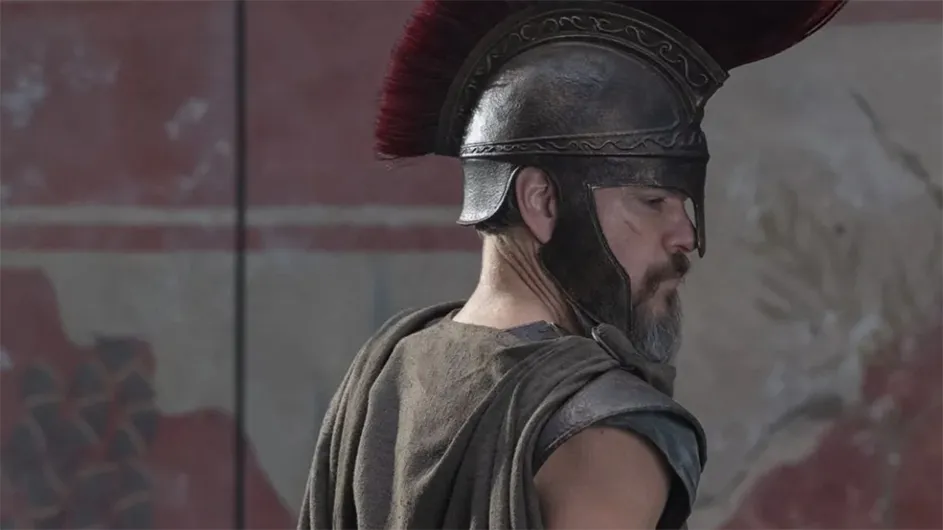
In anticipation of Christopher Nolan’s film version of The Odyssey, opening in theaters on July 17, Columbia News checked in with a few humanities professors who teach The Odyssey in the Columbia Core class, Literature Humanities,or “Lit Hum.” The prospect of seeing the movie, starring Matt Damon as Odysseus and Anne Hathaway as Penelope, elicited wildly different reactions.
“I’m sorry to disappoint you,” said Edward Mendelson, Lionel Trilling Professor in the Humanities, “but I never look at film or TV adaptions of books I love. It’s too depressing.”
On a more positive note, Denise Cruz, professor of English and comparative literature, reported that “I’m a Christopher Nolan fan, so I’m delighted.” Cruz is not a Lit Hum teacher, but she did organize the Senior Reread this past spring semester, in which graduating students were invited to return to the beginning of their time at Columbia, specifically to Lit Hum, and reflect on a number of key works that they read as freshmen in that class, including the first 11 lines of Emily Wilson’s much-lauded translation of The Odyssey:
“Tell me about a complicated man.
Muse, tell me how he wandered and was lost
when he had wrecked the holy town of Troy,
and where he went, and who he met, the pain
he suffered on the sea, and how he worked
to save his life and bring his men back home.
He failed, and for their own mistakes, they died.
They ate the Sun God’s cattle, and the god
kept them from home. Now goddess, child of Zeus,
tell the old story for our modern times.
Find the beginning.”
(The Odyssey, Homer, trans. Emily Wilson, 1-11)
“I read the book aloud to my son during the pandemic, and the process of rereading or revisiting it with him was fascinating,” said Cruz. “Regarding the Nolan film, I think that many of his films center on the power of memory and narrative, how one’s past might shape the decisions one makes in the present or the future, the tension between an individual and a community. In this context, how do individuals and collectives make ethical choices?”
Read on for more faculty reactions.
##
## Will you see the movie version of The Odyssey?
Clémence Boulouque, Carl and Bernice Witten Associate Professor of Jewish and Israel Studies: Absolutely. Ever since I heard last year that Christopher Nolan was adapting The Odyssey, it has been at the top of my list for this summer. I already have July 17 circled in my calendar.
Julie Crawford, Mark Van Doren Professor of Humanities: But of course! In fact, three students from my 2004 (!) Lit Hum class are taking me this summer! In 2004, I took the entire class to see Troy, starring a young Brad Pitt.
Nicholas Dames, Theodore Kahan Professor of Humanities and Paul Brooke Program Chair for Literature Humanities: Despite my skepticism, I probably won’t be able to resist. I’m sure it’ll at least be pretty.
Matthew Hart, chair, Department of English and Comparative Literature and professor of English and comparative literature: Yes, it looks like a proper summer blockbuster. Who doesn’t like big-screen swords, sandals, and sorcery?
Zoë Henry, assistant professor of English and comparative literature: Yes. I’m curious, and I think casting Zendaya as Athena is a genius move. Ditto to casting Lupita Nyong’o as Helen of Troy! But in terms of the larger project, my expectations are low.
## How do you think the film might affect your view of the poem, if at all?
Clémence Boulouque: I don’t think it will fundamentally change my view of the text. I’ve seen other adaptations before, including the very good The Return two years ago. After reading the epic so many times, I don’t expect a film to replace my understanding of it. But it will surely enrich my perspective by inviting me to reflect on Nolan’s interpretation and the particular choices he makes in bringing the story to the screen.
Julie Crawford: I have such a strong visual sense of the book—and years of readings (mine, the expert lecturers, my students)—that I’m simply happy to add to the portfolio.
> Who doesn’t like big-screen swords, sandals, and sorcery?
> Matthew Hart, department chair and professor of English and comparative literature
Nicholas Dames: The temptation of almost every retelling of the poem is to reduce it to its most action-packed moments. But the real traction of the poem is the way all those famous adventures are set within so many quiet, tense, and hugely complex moments of human (and human-divine) interaction. It’s so often a poem of two people gauging each other warily, with so much weight of implication! I doubt that the film can, or even wants to, capture that. Having said that, there is one film version of The Odyssey, if a really unorthodox one, that avoids this trap: Godard’s Le Mépris (Contempt).
Matthew Hart: I’m always interested in popular takes on ancient literature. There are few better ways to understand the afterlife of ancient epics than to study their adaptation for stage and screen. But adaptations tend to tell us more about the people and cultures doing the adapting—or about the media into which an artwork is being adapted—than they do about ancient societies, ancient peoples, or ancient poems. I’ve watched many adaptations of The Odyssey over the years, but, ultimately, it’s a poem and not a movie—my view of the book is based on my reading of Homer’s verse.
Zoë Henry: From what I’ve read, Nolan seems to have drawn inspiration from Emily Wilson’s translation of The Odyssey, which I teach in Literature Humanities. I’m not sure it will change my view of the book, but it might bring up interesting questions around translation (both as a literary project and as a film adaptation).
## Would you advise students to see the film?
Clémence Boulouque: Absolutely—preferably after they’ve read the book. I’ll encourage them to think critically about the adaptation: What choices did Nolan make? What works well? What do they disagree with? Why?
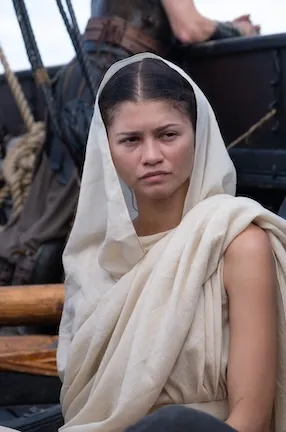
The actress Zendaya as Athena in “The Odyssey.” Universal Pictures.I also plan to use the film as a pedagogical tool. I always incorporate what I call “contemporary echoes” into my classes to show students that the classics remain a source of inspiration and continue to shape our culture. If a filmmaker like Christopher Nolan wants to revisit The Odyssey, and studios are willing to invest in such an ambitious project, it’s worth asking why this story still speaks to us.
More broadly, I enjoy showing students how the reception of a text evolves over time. Seeing what Nolan makes of The Odyssey will be fascinating—not only in light of his own body of work, but also as a reflection of how our own era understands Homer’s epic. Madeline Miller’s Circe is another example of the ongoing rewriting of classical texts, focusing on so-called minor characters. I like encouraging students to think about why each generation returns to these stories in different ways.
Julie Crawford: Of course!
Nicholas Dames: Why not? The act of comparison is a hugely useful intellectual tool. Seeing what’s been done to the poem, what’s been added or elided, is a way of seeing, by contrast, what the poem is.
Matthew Hart: Sure! But I generally advise students to go to a movie theater, especially something spectacular like Nolan’s Odyssey, which looks like it’ll repay watching it on a big screen, with stereo sound and the excitement of a crowd.
Zoë Henry: To each their own. But if they do see it, I would hope that they read the book first!
## What are some lessons/takeaways from the poem that have affected your own life?
Clémence Boulouque: One of the questions that has stayed with me is what it means to return home. When Odysseus finally reaches Ithaca, he doesn’t immediately recognize the place he spent 20 years longing for. It raises profound questions: Do places ever live up to our memories or expectations of them? Can we truly go home again, or does home change because we have changed, which is especially the case of Odysseus, who suffers from what we would now call PTSD after the Trojan wars.
> Read the book first!
> Zoë Henry, assistant professor of English and comparative literature
There is a traditional contrast between two figures who have shaped Western culture: Abraham, in Genesis, who is defined by leaving home in response to a divine call, and Odysseus, who is defined by the long journey back home. Ithaca is his promised land. Which of those two philosophies of life do I (or anyone) feel closer to is a very meaningful question.
I’m also deeply disturbed by the ending of The Odyssey. The slaughter of the suitors is often treated as a triumphant return, yet the hanging of the 12 enslaved maidservants—women who had no agency and were themselves victims of sexual exploitation—is very troubling. Equally striking is how little attention readers seem to have paid to their fate. The epic appears to end happily, but it leaves unresolved the question of reconciliation. How do the families of the slain suitors move forward? What does justice look like after such violence? Those unanswered questions continue to resonate with me.
Julie Crawford: I think everyone wrestles with Proteus.
Nicholas Dames: Every time I return to the poem, I find myself confronting one of its paradoxes: First, that nothing is ever really over, that the past lingers in so many ways; second, that everything is always ending, drowning into time’s ocean.
Matthew Hart: It’s not an easy text from which to derive moral lessons. At its center, there’s a very moving love story between Odysseus and Penelope, the resolution of which depends on the idea that these two complicated individuals are perfect for one another, even if they are far from perfect as people. And there’s something very touching about Telemachus’s drive to be loved and taken seriously by a father he knows as a legend, rather than as a person.
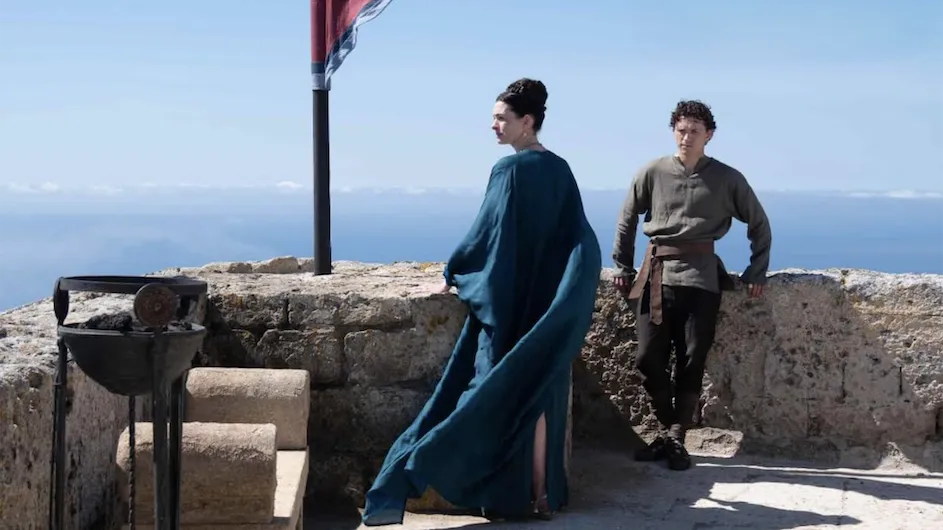
Anne Hathaway as Penelope and Tom Holland as Telemachus in “The Odyssey.” Universal Pictures.But it’s also a poem full of terrible and inexplicable cruelties; Homer depicts a world in which neither gods nor men are prepared to take responsibility for their actions, a world in which small people are murdered for small sins and great men get away with almost anything. Even the reconciliation of Odysseus with his family—the emotional heart of the book in most adaptations—requires the brutal massacre of the suitors. And while we might not mourn those guys (the worst house guests in the world), we must surely cry for the enslaved women who are made to clean up the bodies, only to be slaughtered by Telemachus because they have polluted the household by sleeping with the enemy.
Zoë Henry: There is no such thing as an uncomplicated man. (This is a riff on the first line of Wilson’s translation.)
## How do you approach such a classic text (and others) in terms of your students?
Clémence Boulouque: I want students to approach the text with both curiosity and irreverence. We don’t read the classics in order to worship them; we read them because they continue to challenge us, and in challenging us, they illuminate aspects of ourselves we wouldn’t otherwise be confronted with.
Julie Crawford: The only way is by reading—one book at a time, with some good questions heading in.
Zoë Henry: I try to keep an open mind. The associations that I bring to the text, and my own sense of what is significant, may be different from theirs—but that’s also a starting point for teasing out the text’s connection to the present. I like to stay as close to the sentences as possible, cozying up in the spaces between words, to appreciate the poetic cadence of the epic, and to slow down the process of interpretation.
## Do you see The Odyssey as a living, breathing text that is still relevant today?
Clémence Boulouque: Absolutely. That’s precisely why I like bringing contemporary adaptations into the classroom. They remind students that the classics are living works that continue to inspire artists, filmmakers, and writers. Christopher Nolan’s adaptation is only the latest example, but the Coen brothers in O Brother Where Art Thou? took up the epic. The continued reinvention of The Odyssey—whether in film, literature, or popular culture—shows that Homer’s questions remain our questions: What is home? What does it mean to return? What do we owe one another after war?
Julie Crawford: Hollywood just spent $250 million making a movie about a story people of all nations and languages have been reading for nearly 3,000 years. My 16-year-old daughter, who read Gareth Hinds’s amazing graphic novel of the story when she was 6 years old, can hardly wait to see the movie.
Zoë Henry: Definitely. Its women characters, in particular, are some of the most compelling on the Lit Hum syllabus. The Odyssey also raises important questions around nationhood, belonging, colonialism, and the challenge of homemaking.
## How many times have you read The Odyssey?
Clémence Boulouque: Probably around 10 times. I first read it in French in high school, fragments of it in Greek classes, and I always look forward to returning to it each year when I teach it. Every time I open the poem with students is like reading it anew.
Julie Crawford: I have taught Literature Humanities probably 20 times? But I also read the story myself as a teen, and read it aloud to both of my children.
> I can’t wait to see what they do with ... the Cyclopes (of course).
> Julie Crawford, Mark Van Doren Professor of Humanities
Nicholas Dames: Since one of my children is named after one of the poem’s characters—I’ll let their identity remain shrouded, in the way Odysseus himself prefers—it’s fair to say that it’s been one of the texts closest to me since I was young. So at this point, I’ve lost count of the full rereadings, partial rereadings, times I’ve consulted a passage, or times I’ve tried to check a quote, and ended up feeling compelled to reread a scene.
Matthew Hart: I think I had read it twice before arriving at Columbia and starting to teach Lit Hum—always in translations, though; I’m no Greek scholar. I’ve now taught Lit Hum about 12 times, and tend to reread each text every couple of years, so I’ve probably read it right through eight or nine times by now, albeit in three or four different translations. I’ll also reread key sections every year as I refresh my seminar notes and teach the class.
Zoë Henry: Five times.
## Do you have a favorite passage/s?
Clémence Boulouque: My favorite passage is Odysseus’s encounter with Achilles in the underworld. Achilles, the greatest warrior of The Iliad, famously says that he would rather be a living servant than rule over all the dead. It’s an extraordinary reversal of the heroic ideals celebrated in The Iliad. The Odyssey turns a critical eye on the values of its own society, asking what is truly worth sacrificing one’s life for, and asking us to question our own beliefs. That passage never fails to move me.
Julie Crawford: Two: Menelaus wrestling Proteus (Book 4), and Odysseus’s first simile. (He is compared to an octopus.)

The actress Lupita Nyong’o as Helen of Troy in “The Odyssey.” Universal Pictures.Nicholas Dames: There are so many! Helen’s and Menelaus’s barbed marital disagreement in front of Telemachus; Eumaeus’s wary hospitality offered to the disguised stranger who happens to be Odysseus; Penelope’s countless subtleties. But finally, for me, it’s from Book 16, when Odysseus reveals himself to an incredulous, disbelieving Telemachus. He says the truest words about parenthood ever strung together. I like the way Robert Fagles renders it: “No other Odysseus will ever return to you.”
Matthew Hart: I’m a sucker for Robert Fitzgerald’s translation of Achilleus’s speech from Book 11, when Odysseus meets his shade in the underworld: “Let me hear no smooth talk / of death from you, Odysseus, light of councils. / Better, I say, to break sod as a farm hand / for some poor country man, on iron rations, / than lord it over all the exhausted dead.” More people ought to talk to Odysseus this way.
## Anything you want to add?
Julie Crawford: I can’t wait to see what they do with: Demodocus (the singer), the enslaved characters (particularly the servant women who are executed near the end of the poem), the Cyclopes (of course), the bed (!), Scylla and Charybdis, Helen, and Hades, particularly the bowl of blood.