

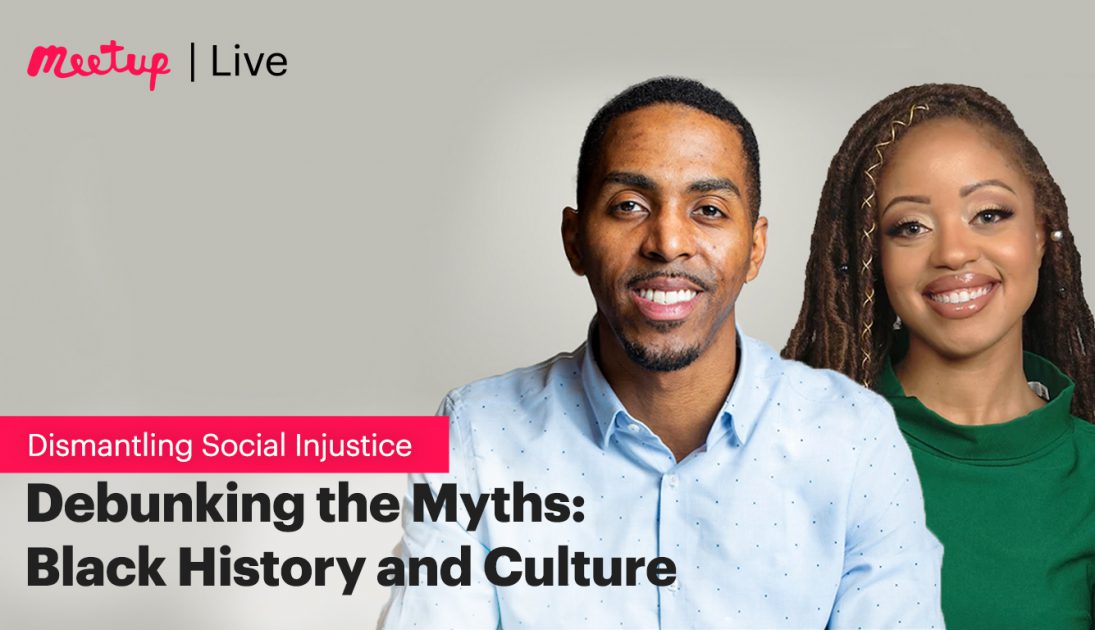


There are different versions of Black history in the United States depending on who you ask, which books you read, or even which classes you take. Myths and misconceptions surrounding Black history and culture run rampant in daily discourse. In this installment of Meetup’s Dismantling Social Injustice Series, we’ll learn where these harmful mistaken ideas came from and learn how to stop perpetuating them.
Watch the recording for a history lesson with Johnny Bailey, Founder and Director of the ShineHard Family, and Dr. Janice Gassam Asare, Founder of BWG Business Solutions, LLC, to learn the origin of some of the most common myths and misconceptions on topics ranging from Reconstruction, Jim Crow, wealth, and more.
Main Takeaways about Black history:
- Johnny Bailey: Slavery as a practice is said to be older than the first human records which date back to like 300 BC. However, chattel slavery in the Western world is, in fact, a product of capitalism. An astronomical amount of wealth was created from an inherited on the backs of free labor from this economic system.
- Janice Gassam Asare: I heard a quote that I thought was very profound, which is “if you don’t see race, how will you see racism?” I think it’s an understanding that the goal is not to be colorblind but rather not to make decisions based on a person’s skin color.
- Janice Gassam Asare: People can pass on the pain and harm and trauma that they experience from generation to generation to generation. A lot of people say, “no one is a slave anymore and slavery is over.” I think another misconception that people have is that in 1863 when Abraham Lincoln signed the Emancipation Proclamation, that’s when black people became free, but that wasn’t actually the case.
- Johnny Bailey: Black Lives Matter was created to bring awareness to police brutality in local communities. We are experiencing different treatment because we are Black. We are being killed or being shot at more frequently, because we are black, and so, saying that black on black crime versus black lives Matter it’s just not comparable.
Top Q&A Questions & Resources:
- Is there a connection between the reparations confusion and the seemingly widespread myth that one person’s benefit comes at another person’s detriment?
- Johnny Bailey: I don’t think that reparations would necessarily take away from someone else, there are multiple ways to approach how we would compensate or reimburse the descendants.
- Janice Gassam Asare: [We’re] thinking about it from the perspective of the fact that helping the most marginalized folks will help everyone.
- What are the quick steps to close this prosperity gap in the short and long term?
- Johnny: it’s not a quick fix, and there’s no one solution. But at ShineHard we have an eight-step methodology.
Some of the key modules that we talked about are history and heritage. I think it’s just simple financial wellness. And then, I would just say, entrepreneurship is a major key. If you don’t come from a wealthy family a wealthy family must come from you.
- Johnny: it’s not a quick fix, and there’s no one solution. But at ShineHard we have an eight-step methodology.
- Resources:
- Connect with Dr. Janice Gassam Asare on LinkedIn Her website: https://www.drjanicegassam.com/
- Connect with Johnny Bailey on LinkedIn or Instagram @1johnnybailey
- Johnny’s organization: https://www.shinehardfamily.org/
- Book: Post Traumatic Slave Syndrome by Joy DeGruy
- Article: “Closing the racial wealth gap requires heavy, progressive taxation of wealth”

Last modified on June 23, 2021