


Can you believe it’s been a year since we went into lockdown? The past 12 months have been filled with uncertainty, but one thing is for sure: stress levels are soaring. Let’s take the time to learn how to channel our stress, negative energy, and longing for the past into something more useful.
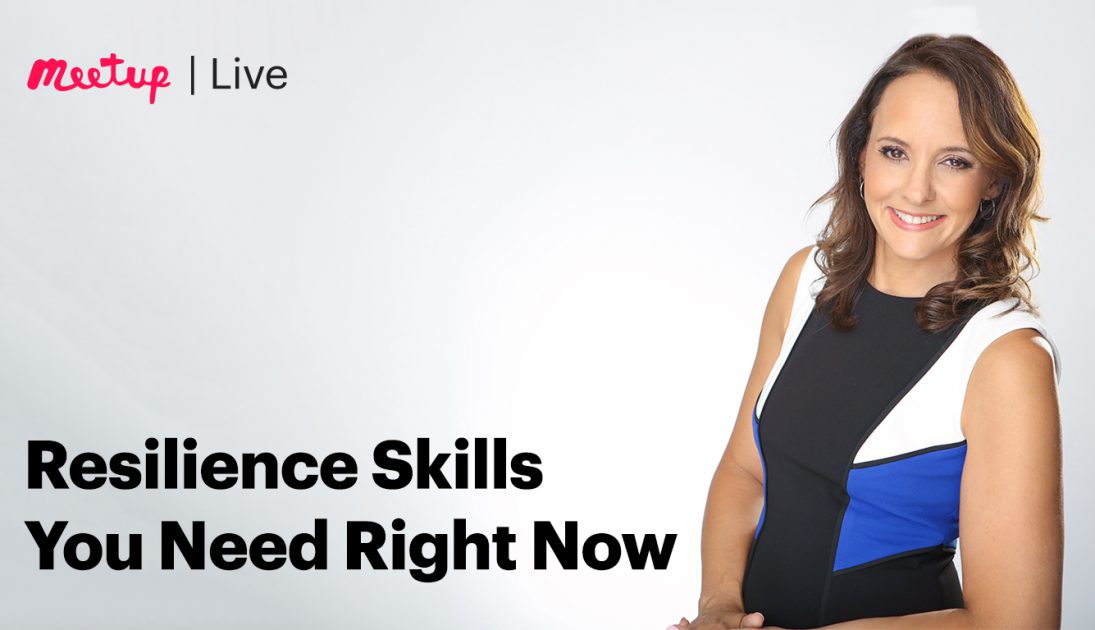
Dr. G (Deborah Gilboa, MD), board-certified family physician and resilience expert joined Meetup Live to help you re-direct that stress to get stronger. She explained the science behind the brain’s reactions to change and shared strategies for building resilience. Check out this recap in order to handle more and struggle a whole lot less.
Main Takeaways on redirecting your stress:
- We have a myth in our society that I want to challenge, and the myth is that stress is toxic. Stress is not poison.
Stress is to resilience and mental health as exercise is to body health.
If I want my body to be more fit, I’ve got to work it, right? If I want to be able to handle stress without feeling so winded, it’s actually stress that will get me there. - Stress can absolutely be damaging if you use it wrong or too much, but you cannot build without it.
- Identify your “yellow flags”: What are the behaviors or feelings that mean we are having trouble?
- I’ll give you an example myself. When I’m dealing with too many things, or there’s too much stress piling up, one of the ways I know it is, I start forgetting things. Appointments, usually.
- I define resilience as the ability to navigate change because remember all change can be stressful, and come through it the kind of person you want to be.
- Resilience Ingredients:
- Build connections: Widening the number of people that you feel connected to, not just listed on your social media friends list. Also, deepening on the connections that you have, talking to the people that you know and getting to know them a little bit better, and allowing them to know you a little bit better.
- Set boundaries: Figuring out what you will do and what you won’t do is really useful in building resilience, because setting boundaries allows you to say, “I will expend extra effort here” and, “that over there isn’t worth my effort. It’s not reasonable, it doesn’t line up with my priorities are my values.”
- Open to change: Opening to change, understanding that the path you had in mind isn’t the only possibility.
- Manage discomfort: Keep in mind that uncomfortable, and unsafe aren’t the same thing. If you can list more ways that you manage your discomfort in positive or neutral ways, the more you will be able to get through that discomfort phase.
- Set goals: You never actually get towards the future that you want if you haven’t identified it. So being able to say, “this is what I want” is a really crucial skill.
- Identify Options: Most of us that might have great ideas, need to edit a few times to get to our best final draft when we’re identifying options. One of the ways we can build that skill so that we have more than one choice to choose from when we want to engage is by every time we have a choice, forcing ourselves to list three possibilities.
- Take actions: People talk about cortisol, the stress hormone as being a fight or flight hormone, but it’s actually a fight, flight, or freeze hormone. And freezing is the most likely thing that we will do. You can take action for practice.
Ex. When somebody says, “what movie should we watch?” If nobody’s jumping in, pick one. Risk being wrong. Risk them saying, “this wasn’t a great movie” because you’ve practiced building your resilience by taking action - Persevere: And lastly, try again, not try again doing the exact same thing, but persevere towards your goal. You set a goal and you meant it.
Recommended exercise to lower stress and find coping mechanisms:
- On a piece of paper I want you to make three columns.
- In the first column, you’re going to write down every single thing you do when you don’t like how you feel to try and change how you feel.
- ex. Drinking too much or being irritable or yelling at your kids or sleeping or forgetting things and also the things you’re really proud of, I create poetry or art or I dance around to music right exercise or I play Candy Crush.
- Then you cross off everything that’s damaging to you or someone else.
- You copy that list over to the middle column. Those are your positive and neutral coping mechanisms to stress.
- And then you put an “H” by the ones you can do when you’re at home. And you circle the ones you can do when you’re at work, or you have your kids put an “S” by the ones they can do when they’re in school, and you copy it over to that third list for the place that you’re having the most trouble with your discomfort.
There you have a list of positive and neutral coping mechanisms you can use to be resilient and stick to your priorities and navigate change. And I hope you keep growing that list.
Top Q&A Questions:
- Can you give us more examples for stress being helpful?
- It is not possible to dodge and dive and avoid all stressors, especially if you want anything. We have to develop our ability to navigate the world.
Here’s a really specific example: If something that you want requires talking to someone new, that’s stressful for pretty much everyone to varying degrees. The more you learn to manage your discomfort around talking to someone new, the more likely you are to be able to do it without feeling that depleted by it, so that you can have more experiences that are what you’re looking for.
- It is not possible to dodge and dive and avoid all stressors, especially if you want anything. We have to develop our ability to navigate the world.
- How do we manage stress imposed by some people who are more powerful than ourselves?
- That is the situation that so many people live with where you might say, “oh sure it’s nice to say set a boundary, but this is a situation in which I’m really stuck.”
If you can’t change the stressor, and it’s damaging, all you can control is your reaction to the stressor. I agree that you can’t always change your situation, which is actually why I believe that learning how to be more resilient is more valuable than just telling people, “well, you should avoid stress.”
- That is the situation that so many people live with where you might say, “oh sure it’s nice to say set a boundary, but this is a situation in which I’m really stuck.”
- Any advice on saying “no” more often?
- You will be really aided by knowing that that decision aligns with your priorities, with what you need. So, in that situation what I want to say to you is, remember what you’re saying yes to when you’re saying no to that person. Use it to manage your discomfort of their disappointment or their frustration.
You can say no. And when they say, “but I really wanted you to,” you can show empathy for their frustration or disappointment, without changing your mind.
- You will be really aided by knowing that that decision aligns with your priorities, with what you need. So, in that situation what I want to say to you is, remember what you’re saying yes to when you’re saying no to that person. Use it to manage your discomfort of their disappointment or their frustration.
- How do you build more open connections?
- The easiest way to make new connections with people is to find people who care about something you also care about. You’ll have one area of connection for sure whether that’s that you all like to play kickball, or you all like to play online poker, or you all care about a particular cause and you’re volunteering with that cause, put yourself out there for something that you genuinely enjoy, and even if you didn’t really meet anybody you connected with it would be fun to do for an hour.
As far as deepening the connections that you have, reach out with one note of gratitude. Write a card to someone or send a text to someone telling them something with no strings attached. Someone you admire about them, or something you appreciate about them. And then, in a couple of days, you’ll be amazed at how awesome they will feel, whether they say anything or not. And then in a couple of days, ask them one meaningful question. Just one thing you’d like to know more about them. Those two actions. Open up dialogue and relationships, even when people are busy with kids and partners.
- The easiest way to make new connections with people is to find people who care about something you also care about. You’ll have one area of connection for sure whether that’s that you all like to play kickball, or you all like to play online poker, or you all care about a particular cause and you’re volunteering with that cause, put yourself out there for something that you genuinely enjoy, and even if you didn’t really meet anybody you connected with it would be fun to do for an hour.
Additional Resources:
- If you’re interested in learning more from Dr. G, you can sign up for her workshop Change a Behavior in You. Meetup members can get $100 off with the code DRGRESILIENCE.
- Find Dr. G on social media:

Last modified on June 23, 2021