
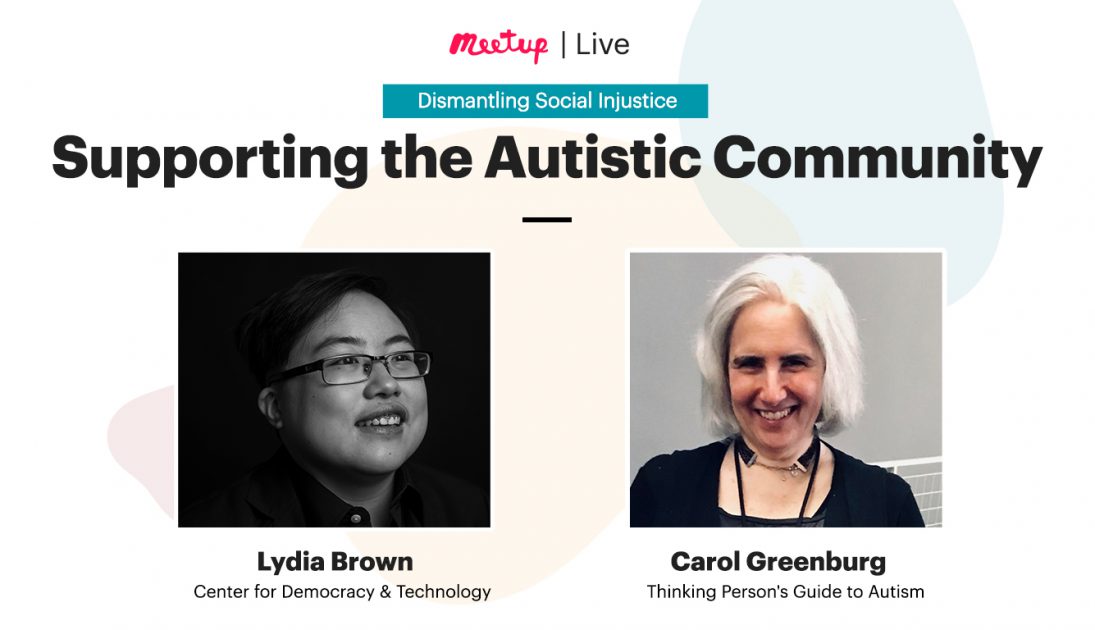


In honor of Autism Acceptance Month, this special edition of Meetup Live sheds light on some of the issues facing the autistic community. In this installment of the Dismantling Social Injustice series, learn about ways that we can all be more inclusive.
Lydia Brown, (they/them) of Center for Democracy & Technology, and Carol Greenburg, (she/her) of the Thinking Person’s Guide to Autism, discussed neurodiversity and the autism rights movement. They discussed the limits of autism research, testing, and legislation, as well as the impact of remote learning for autistic children. They also shared ways that we can take action to support the autistic community.
Main Takeaways about Supporting the Autistic Community:
- Lydia: Ableism is so entrenched in our society that laws that are supposed to protect us are not sufficient to address or eliminate the problems that disabled people face.
- Carol: There’s no way to predict when an autistic is going to suddenly acquire a skill. Autistic people often have a punctuated learning style, where we have spikes in learning. It’s upsetting when someone pities autistic people, claiming that we’ll never do something. Who knows what could or couldn’t happen, given the right circumstances and respect as full human beings and full citizens.
- Lydia: Autism is a developmental disability. It affects everything about a person’s life. It affects the way in which we communicate, experience our senses, and the way we interact with others. It affects our thinking, our language, and our emotions. There isn’t one definition of what autism looks like for everyone—we are not identical to each other.
- Carol: Educational needs are not being met for autistic children. It’d be great if school systems supported inclusionary education, where all children have access to an education that is appropriate for them. Autistic children end up overwhelmed in large classes, where their sensory needs are ignored and they’re often not comfortable enough to feel baseline safe. The less privilege we have, the less likely we are to have access to an appropriate education.
- Lydia: The neurodiversity movement believes that our brains are not bad, broken, or wrong, and that all people deserve to be supported. That support should be on our own terms and respect our agency, autonomy, and humanity.
Top Q&A:
What is “masking”?
- Lydia: Masking means when a disabled person attempts to hide being disabled. This can include mimicry of nondisabled people’s ways of moving, speaking, or socializing, for instance.
- Carol: Masking is trying very hard to appear as non-autistic as possible in order to blend in for some perceived benefit. It happens most frequently in group settings and at work. Sometimes employment depends on being able to mask.
How can people support the autistic community?
- Carol: Listen to us and take us seriously. When we say what we need, that’s what we need. If you don’t understand, then ask us questions and assume that you are capable of understanding our answers and continuing the conversation in whatever way suits the autistic person best.
- Lydia: Presume competence. Assume that we know about our own preferences, needs, and desires, even if sometimes we’ll make bad decisions or be irresponsible (just like non-disabled people). Communication is always a two way street: what one person is expressing and what the other is understanding. This is especially true in the hardest, most uncomfortable, or confusing situations, and especially when a disabled person is in distress, experiencing difficulty, or is overwhelmed. They should not be treated as a problem or something to control or manage. This is the most important time to presume competence and enable the dignity of risk.

Last modified on June 23, 2021