


Are you ready to tackle your 2023 goals? Your brain may have other plans! In this Meetup Live event, we’re talking about the role brain science plays in forming healthy habits. Learn how to program your brain to make your resolutions a reality.
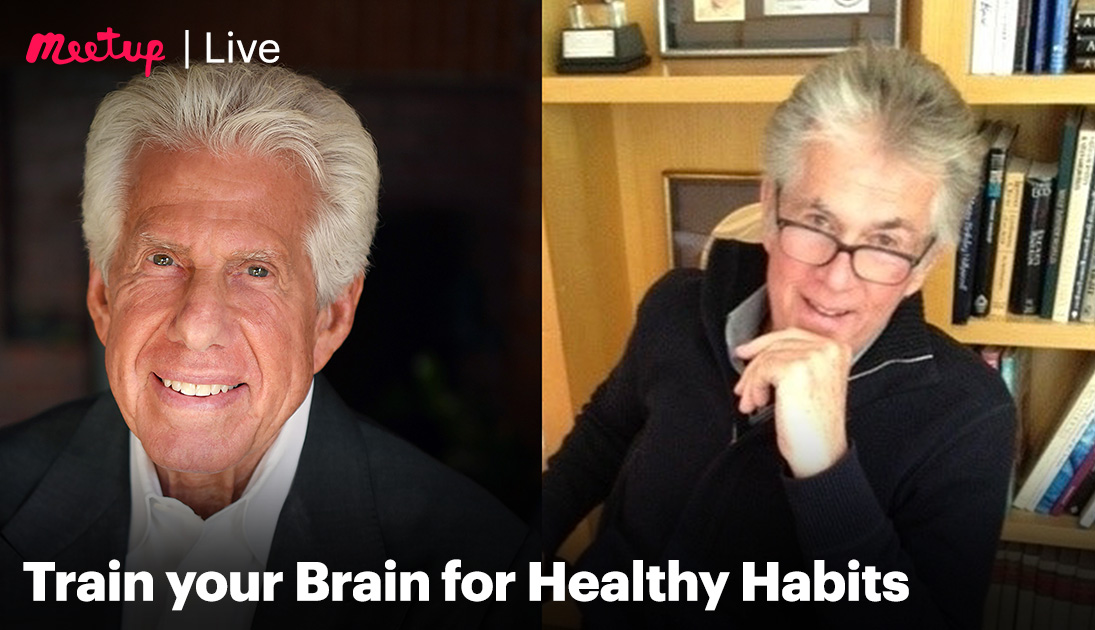
Watch this Meetup Live recording with Dr. Connell Cowan and Dr. David Kipper, authors of Override. Get a crash course in psychology so you can understand your vulnerabilities, break out of self-defeating patterns, and make meaningful changes with a science-based approach. Learn to set the conditions for maximizing your self-control so you can form healthy habits and meet your New Year’s goals.
Main Takeaways:
Behind Dr. Connell Cowan and Dr. David Kipper’s book Override
- As psychologists and as internists, we’ve shared many kinds of dilemmas with patients that we’ve worked with. For both of us, the resistance to change became a central concern, because people have a hard time doing the things that are really healthy for them. This made us want to study and try to understand why it’s so hard for us to change.
- We all inherit a brain chemical imbalance in two different neurotransmitters, dopamine and serotonin. The body depends on both of these in order to have some equilibrium. People that are shy in dopamine tend to have certain personality types and behaviors that are very predictable. These people are outgoing, curious, risk-takers, and have issues with impulse control. These specific behaviors can lead them to some behavioral trouble. On the other side of the equation is the serotonin-deficient. These people tend to be much more insular, they can have OCD behavior. We are all hybrids, none of us are pure dopamine or serotonin deficient, and most of us have a predominant imbalance that directs those behaviors when we’re stressed. We labeled these two groups; the dopamine imbalanced are the swords, and the serotonin imbalanced are shields.
- Shields: likely to struggle with anxiety, worries can manifest themselves as hypochondriacal worry, so you worry about your physical being.
- Swords: have tendencies to do things that can get them into trouble, such as addictions
- To determine if you are a Sword or a Sheild, take the quiz online here
Changing habits
- If you’re looking for a total change in a habit, it takes about 100 days of doing something different. So it takes a little over three months to really establish a new habit, but that old habit doesn’t really go away. The old habit is stored away but can always come back, the new habit is a replacement for the old habit.
- A simple strategy to defeat a bad habit that we can all access is a pause button in our brain. We tend to not pay attention to it, but as soon as you see yourself falling into a bad habit, hit the pause button and take a couple of seconds to think about what you’re about to do. You’re about to enter into a habitual behavior that you can actually understand where it is coming from.
Top Q&A Questions and Resources:
- Do your brain’s dopamine and serotonin levels change as you age?
- No, because these are inherited and we could get into a conversation about our microbiome, which is a very important part of this conversation but our microbiome is predetermined by our genetics, and that microbiome wants to say the same. We abuse it, and we reshuffle it, but its job is to remain the same. So the answer to that question simply is no.
- When you suppress habits could that lead to a higher chance of being stressed or depressed?
- When I said suppress a habit, it really becomes dormant which doesn’t create any heightened stress. The habit kind of goes to sleep and exists in a dormant stage, if you slip and get back into the habit, it’s like waking it up. When it’s really suppressed, meaning it’s replaced with a healthier habit that you’re employing every day, it’s not causing you stress.
Resources:
- Read Override to learn more about forming healthy habits
- Follow Kensington Publishing

Last modified on October 17, 2023