

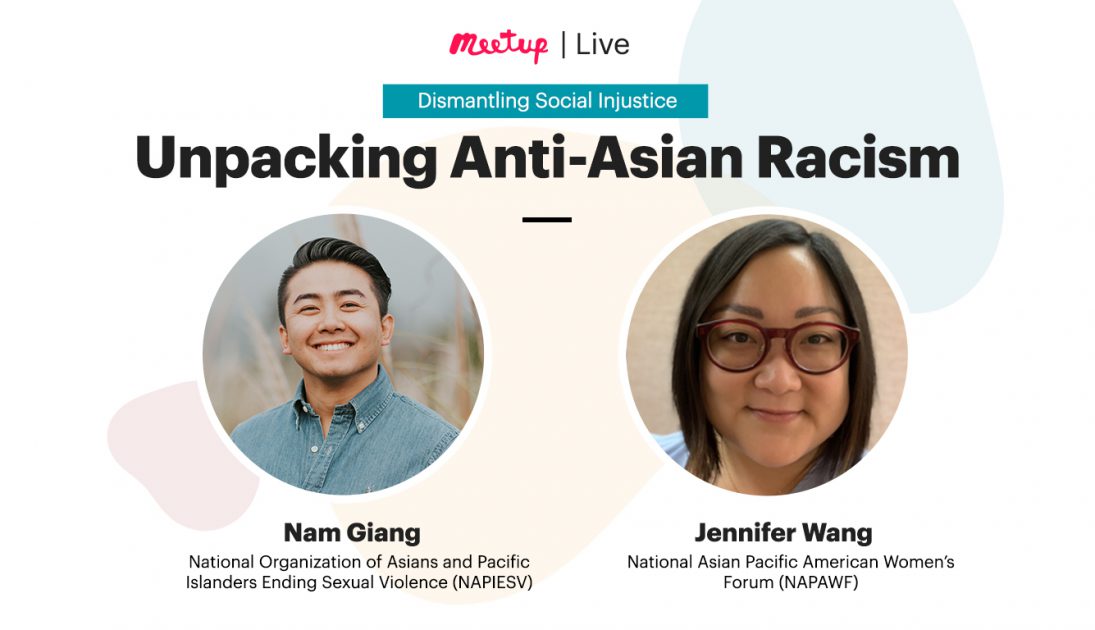



In the past year, anti-Asian attacks in the United States have spiked 150%. This startling surge in violence reminds us that the fight for racial justice is far from over. Watch this recording to learn about the history of anti-Asian racism in the United States, and what steps you can take to fight it.
Nam Giang of the National Organization of Asians and Pacific Islanders Ending Sexual Violence (NAPIESV) and Jennifer Wang of the National Asian Pacific American Women’s Forum (NAPAWF), joined Meetup Live for a discussion on the history of anti-Asian racism in America. Breaking down topics like the model minority myth, gender expectations and the hypersexualization of Asian women, and other harmful stereotypes that persist in the United States, they also discussed steps we can take to support the AAPI community, as members and allies.
Main Takeaways on Anti-Asian Racism:
- Jennifer: Racism, racialized misogyny, and anti-immigrant sentiment are deeply intertwined with our nation’s history, dating back to its founding.
- Nam: The violence that we see has been happening consistently, and an increase in harmful political rhetoric emboldens more people to cause harm against the Asian American community.
- Jennifer: 80% of AAPI women report that racism has impacted their lives. It’s not just happening to a couple of people. These are widespread, sweeping, lived experiences.
- Nam: Even though there are high numbers [of reported attacks], it’s still low based on underreporting. Oftentimes there’s a distrust in law enforcement and reporting incidences of Anti-Asian racism and violence, alongside victim-blaming that further inhibits reporting. With gender expectations and hypersexualization, Asian women are viewed as docile, timid, and obedient. When Asian women face violence and they don’t fit the stereotype and speak out, they face more violence.
- Jennifer: The “model minority” is a strategic myth that people in power use to draw a wedge between AAPI people and other communities of color. It’s a lie that all Asian American people are wealthy, highly educated, good at math, etc. If you believe the stereotypes, then you might think that Asian people in the U.S. don’t need social services or our businesses don’t need loans to get through the pandemic. If you believe the myth, it makes it easy to ignore the needs of AAPI people.
- Nam: In appropriation and sexualization, it’s important that we recognize those things as harmful, pervasive, and overlooked. We need to call it out, and not accept it or let it go as a joke. Those words have an impact and can translate into real-life violence. Challenge stereotypes and learn the diversity that occurs in our communities.
Top Q&A:
- Where can we find some reliable and objective data about the violence against Asians?
- Jennifer: We have data about anti-Asian violence on our site at NAPAWF, and Stop AAPI Hate is a great resource as well. There’s a huge push for the federal and state government to collect data, which we hope will be disaggregated to acknowledge diversity in ethnicity, race, and gender. However, the data is incomplete. The more trust we can build in our communities to report to entities they trust, the better data we’ll have.
- Nam: The Center for the Study of Hate and Extremism reported a giant spike in hate crimes against Asian Americans when overall hate crimes went down.
- How can we hold elected officials accountable when we’ve seen accountability and responsibility fall through the cracks?
- Nam: It’s important to continually put pressure on our elected officials and uphold our democracy. We should push and show up at the table until we’re recognized. Hold elected officials accountable if they’re using harmful rhetoric and urge for policymaking that accounts for the diversity of the AAPI community. Representation absolutely matters—we’re always encouraging more AAPI people to run for office.
- I know so many Asians that are racist against Asians and are ignorant about Asian history. Why does this happen, and where does that come from?
- Jennifer: We all have work to do in dismantling white supremacy and internalizing it less. Instances of anti-Asian violence can be forms of colorism or nationalism. In this country, we need to unlearn the scarcity mindset that drives a lot of people to drive wedges between communities of color. There have been powerful instances of cross-racial solidarity in the last year. Change is possible and it starts with dialogue and real, courageous conversations with people.

Last modified on April 27, 2021