How does the world feel about the U.S? Is the world order & economics changing


Details
This is what Google's AI says:
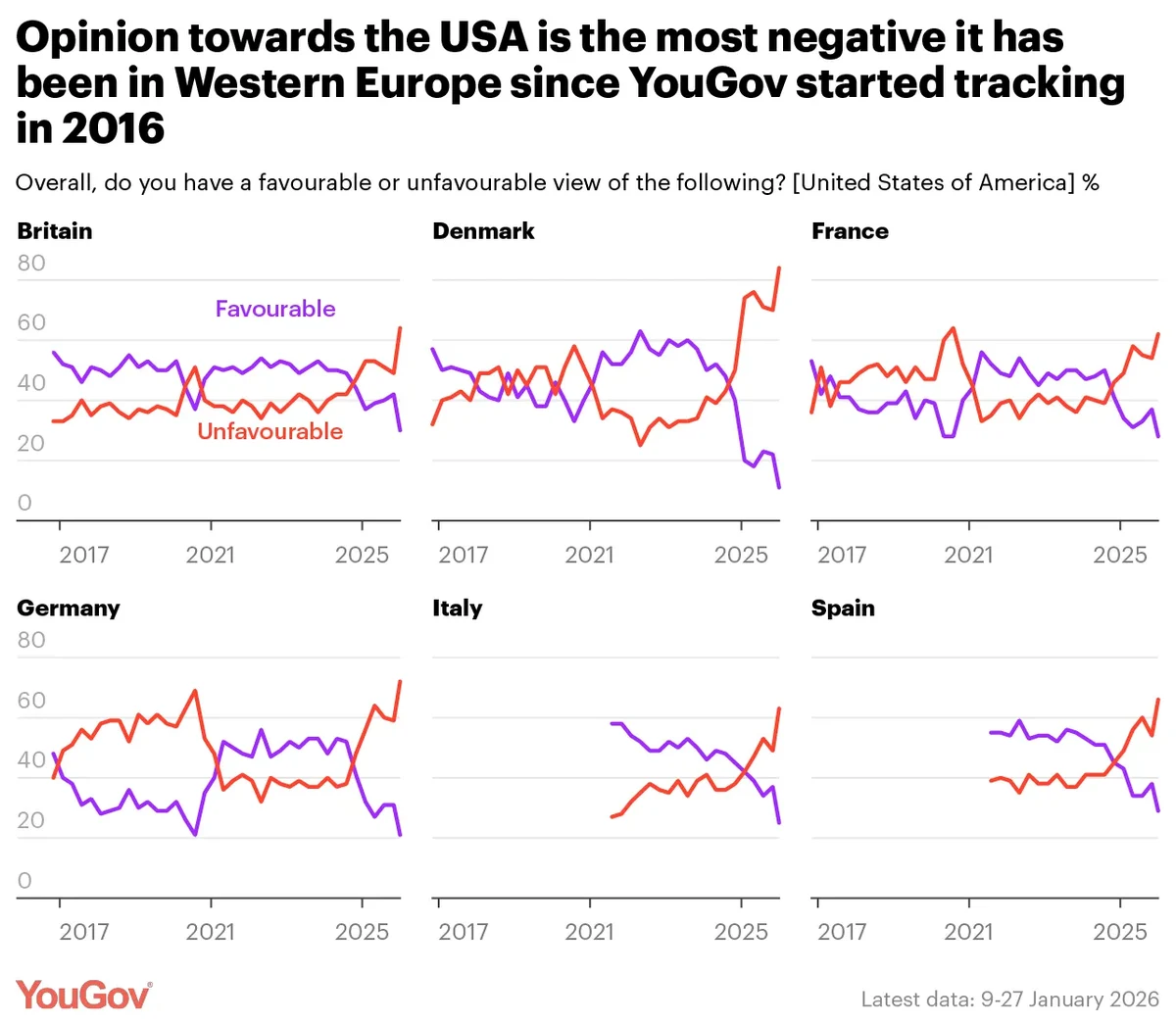
Europe's attitude towards the United States has shifted dramatically, moving from a, post-pandemic, uneasy partnership towards a more cautious, distant, and transactional relationship, particularly following the reelection of Donald Trump. Recent polling in early 2025 indicates a significant decline in favorability, with many Europeans no longer viewing the US as a reliable ally, but rather as a necessary, yet unpredictable and sometimes hostile, partner
Key aspects of this changing attitude include:
- Plummeting Trust and Favorability: European favorability toward the US has dropped by roughly 8 percentage points in key countries like Germany, France, and Denmark since November 2024. Surveys in early 2025 indicated that only about 16% to 26% of people in some European nations viewed the US as a trusted ally or "friend".
- Perception as a Security Threat: A significant portion of Europeans (roughly 73% in some surveys) now view the Trump administration as a threat to peace and security in Europe. This is driven by fears of US withdrawal from NATO and a shift in policy toward the Russia-Ukraine war, which many Europeans believe favors Russia.
- Rise of "Strategic Autonomy": Due to decreasing confidence in US security guarantees, there is growing momentum for Europe to increase its own defense capabilities and reduce reliance on American military infrastructure. A large majority of Europeans (around 70%) agree that the EU must rely on its own forces for defense.
- Economic Tension and Trade War: The imposition of universal and targeted tariffs by the US in early 2025 has created significant economic friction. While the EU initially proposed retaliatory tariffs, many European countries are now bracing for long-term negative economic impacts, with a majority supporting a more protective, independent economic stance.
- Ideological Divergence: Many Europeans feel that US foreign policy no longer aligns with their shared democratic values, seeing the US as moving away from a model of democracy towards a more authoritarian, "America First" stance
Pew Research Center:
U.S. President Donald Trump receives mostly negative ratings in a new Pew Research Center survey of 24 nations. More than half in 19 of these countries say they lack confidence in Trump’s leadership of world affairs.
Majorities in most countries also express little or no confidence in Trump’s ability to handle specific issues, including immigration, the Russia-Ukraine war, U.S.-China relations, global economic problems, conflicts between Israel and its neighbors, and climate change.
Among the United States’ East Asian allies, there is little confidence in Trump’s ability to handle U.S. relations with China. Six-in-ten adults or more in Japan and South Korea express little or no confidence in him on this issue. And about three-quarters of Australians (77%) lack confidence in Trump to handle relations between the U.S. and China.
**https://www.pewresearch.org/global/2025/06/11/us-image-declines-in-many-nations-amid-low-confidence-in-trump/**
At the Olympics:
On The Daily Podcast from the New York Times, Feb. 15, reporters at the Winter Olympics discuss events in Milan, including U.A. athletes being cheered at the opening ceremonies while J.D. Vance was booed.
They also discuss major negative feeling between the U.S. and Canada. Canada is hurt and angry over recent events and speeches, so hopes to show strength against the U.S.
**https://www.csmonitor.com/World/Olympics/2026/0209/winter-olympics-athletes-politics**
Recently, Marco Rubio had strong words for Europe at the Munich Security Conference. The United States is prepared to “rebuild” but only according to its values, Rubio said, while relentlessly evoking America’s historical links to the continent. Those values include embracing Christianity and a shared cultural heritage, closing borders, and dropping climate crisis policies. The US needs to see a reformed Europe, he told decades-long allies – not just details of defense budgets, but a sea change in the continent’s value system.
**https://www.cnn.com/2026/02/15/europe/rubio-speech-us-europe-relations-latam-intl?iid=cnn_buildContentRecirc_end_recirc&recs_exp=up-next-article-end&tenant_id=related.en**
Last year, Trump’s fixation on tariffs and “peace” allowed observers to analyze the situation within the theoretical framework of post-World War II global politics. However, since the U.S. released its National Security Strategy in early December, Trump’s surprise move against Venezuela and threats to annex Greenland have led media outlets to cite the Monroe Doctrine and “resource imperialism” frequently, as if international politics had regressed by two centuries. Europe has unexpectedly been thrust into the eye of the storm: Deep-seated contradictions between the U.S. and Europe are now fully exposed.
• First, a clash of models. Trump wants to reshape the economic and social models of Europe. The strategy explicitly states that Europe should “abandon its failed focus on regulatory suffocation,” which is closely linked to Trump’s effort in his second term to secure allies on Wall Street and in Silicon Valley and to vigorously promote deregulation.
Notably, Trump has made no secret of his intent to unravel the European Union. U.S. media revealed a previously circulating, informal version of the NSS that lists Austria, Hungary, Italy and Poland as countries the U.S. should "pull away” from the EU.
• Second, a tussle for status. The wording of the NSS indicates that while Trump reserves for himself the possibility of co-governance with other major powers, he demands that Europe unconditionally align with him in great power competition, effectively downgrading its international status. Natalia Tocci, director of the Institute of International Affairs, noted that the strategy paints a picture of “imperial collusion” in which the U.S. seeks mutual recognition with other powers—Russia and China, in particular—and regards Europe, or at least most of it, as part of its own colonial sphere.
• Third, a contest over the world order. Europe is deeply concerned that the United States is drifting away from supporting a rules-based international order toward power politics, and from advocating universal values toward carving out spheres of influence. These fears stem not only from ideological convictions but also from a careful weighing of interests.
It will more actively seek to influence U.S. domestic politics, forging alliances with members of Congress, the opposition party and state governments across the country.
At the same time, Europe will be more pragmatic in engaging other major powers as a diplomatic tool to balance U.S. influence. The recent visit of the Canadian prime minister to China set an example for middle-power diplomacy. Within Europe, there are also growing calls for direct dialogue with Russia. On Jan. 27, the EU and India signed a free trade agreement at their summit.
**https://www.chinausfocus.com/foreign-policy/a-qualitative-change-in-the-us-europe-game**
What will world politics look like in 3 years?
How will the changes impact the U.S.?
https://yougov.co.uk/international/articles/54045-where-do-western-europeans-stand-on-europes-relationship-with-the-usa