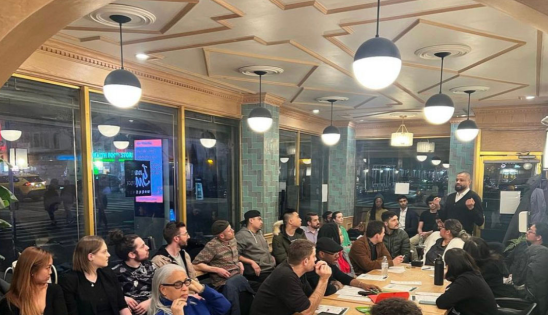

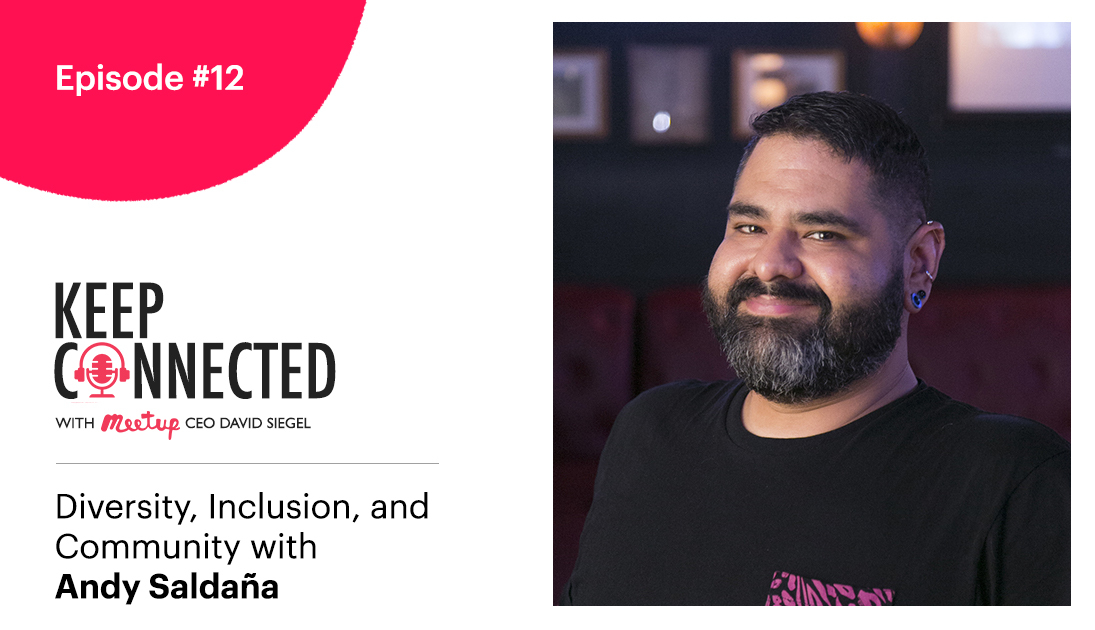
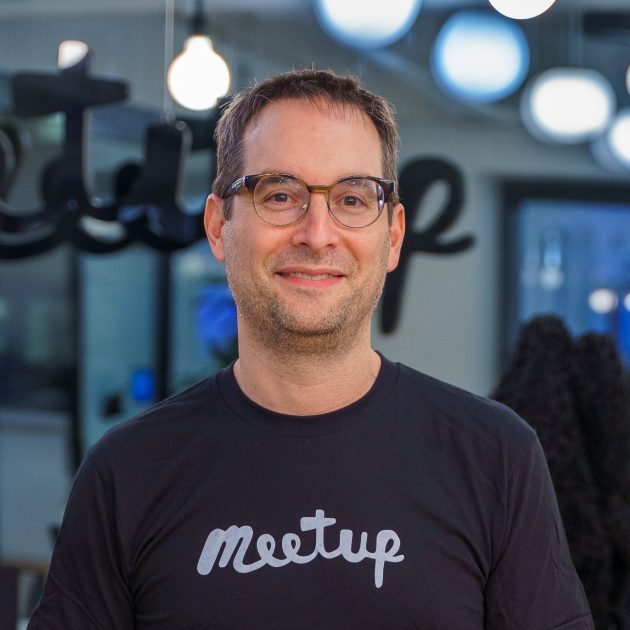


As the leader of the largest tech group on Meetup and an experienced LGBTQ+ organizer, Eustacio Andy Saldaña (he/him) knows his way around community building. Hear Andy’s advice for promoting equity in the workplace, finding a mentor, and growing a healthy Meetup group in this episode of Keep Connected.
Ranked as one of the top 25 CEO podcasts on Feedspot, Keep Connected with Meetup CEO David Siegel is a podcast about the power of community. For more details on other episodes, visit Keep Connected on the Meetup Community Matters blog.
We hope you’ll keep connected with us. Drop us a line at podcast@meetup.com. If you like the podcast, be sure to subscribe and leave us a rating on Apple Podcasts!
Learn more about Keep Connected host David Siegel’s experience as a leader and decision maker in his book, Decide & Conquer. Pre-order your copy today!
Diversity, Inclusion, And Community With Andy Saldaña
In this episode, we’re talking to Andy Saldaña. Executive Director of the New York Tech Alliance, a nonprofit organization that runs the NY Tech Meetup with over 60,000 members. He’s also the Cofounder of QueerTech. We are going to talk about mentoring, relationships and what we could do to foster more diversity and inclusion. I hope you enjoy this episode.
—
Welcome, Andy Saldaña.
How are you?
I’m great. Life is good. You are the leader in New York Tech. You were listed by Crain as one of the top LGBTQ leaders. You’re a leader in the Black and Brown community, help founders and a major leader in driving diversity access inclusion within tech and there’s so much I want to talk about with you. Let’s get first started with talking about you a little bit. I’m always intrigued to understand the background of leaders and how they become the leaders that they are. When do you think you first realized that inclusion, diversity, community would be your life’s mission?
I’m still realizing that. It’s an ongoing process that you happen into. It’s not something that I aim to be my profession. I did not graduate high school and say, “I’m going to be a DEI advocate and specialists,” it’s just as my career evolved as I’ve lived experience through different types of careers. That piece continued to be very important. It was something that I was seeing neglected in some of the companies that I was working in. It was pivotal in creating a community for myself as I navigated some of my early careers and continued to be important to me. Every job that I would take, I ended up being part of some committee, conversation or thinking differently in some aspects of the business because of my own lived experiences.
It wasn’t until I started at NY Tech Meetup that I was shown this world of what is it to become an advocate and an organizer. I credit a lot of that to Meetup as a platform to helping me understand what that looked like. I was new to New York City and to the startup ecosystem to entrepreneurship and I was hungry for finding a community that resembled my experiences where I felt comfortable and I could be in without having to worry about what I look like, what my parents were like or what my effect was in some ways. Navigating that space taught me a lot about the work that needed to be done in the ecosystem around diversity, equity and inclusion. It amped me up to continue forward in that mission.
Had you had any very specific experiences where you didn’t necessarily feel as welcome? Without naming the name of the place, if you have anything you could share about that maybe some of our readers can empathize with would be helpful to know.
I’ve always felt as a human being in this world that I was always out of place. From early childhood, you can see that my name is Eustacio Andy Saldaña, that’s what I have listed. Even that was a cause of conflict when I was going to school for the first time. When I went to kindergarten, I did not know my name was Eustacio. I had always gone by Andy. I learned that first day of school. It sent me home crying. Now that I’m older and have done some reading and research around institutional racism and generational trauma, I’m starting to fit the pieces together to understand why that was even an issue, to begin with.
If you don’t ask for what you need, you won’t get it.
Like my parents, I’m a fifth-generation American. Our family has been in Texas before it was Texas. That also lends itself to this whole conversation around like, “What is culture? What is your culture? How do you fit into that culture? How do you navigate that culture?” All of that has played into who I am as a person and I’m still unpacking a lot of what that implication is. When I was in school, my parents didn’t teach me Spanish. They wanted me to be as American as possible. They gave us Latino-sounding names, Spanish-sounding names but they didn’t use them.
I always went by Andy. When I went to school for the first time, the teacher called me Eustacio and I went home crying again. That was something traumatic for me at that moment. As I went through school, I started taking Spanish. I’m very horrible. My Spanish is bad. I would get so angry at my parents. I was like, “Why didn’t you teach me Spanish?” There’s this whole history of trauma that I wasn’t ready to hear at that moment that I’m starting to unpack now. It’s generational trauma that is carried over through families over time.
What caused you to start having that awareness around trauma? Was it your teen years, college years, post-college years, a person in particular that helped to guide you or was it specific life experiences?
There are so many people that have been in my life that spoon-fed me these little pieces and pushed me in that direction. One of the early people in my understanding of race politics, culture, her name is Alyssa Huerta. She’s a friend I met at school, University of Texas. She would always tease me like, “You’re going to be an advocate of some sort. You’re going to do these things.” She was already that times ten. She was this Chicana warrior that I was a friend with that I did not understand, I had no idea what she was meant to the world. She’s light years beyond any under the city that I have on race, culture and the impacts that have.
We met our last year in college and I’m so grateful for that friendship because she helped me start to explore some of these issues around the queerness specifically in my college years to being Chicano, to being the injustice that existed, how to explore some of that injustice and how to talk about it. She would very kindly lead me through some of these early conversations. She laughs now because she’s like, “It’s amazing to see where you were versus where you are now and where you still have to go.” It’s crazy. It boggles my mind that I’m even asking these questions or that I’m a person having these conversations because I honestly don’t feel equipped to do that.
Mentoring so many others. Let’s fast forward past those college years when you were in the work setting. What role did community play in helping you to evolve from a growth perspective and to become the advocate that you are?
My coworkers are the community that helped push me forward in whatever job I had. I would always find 2 to 3 amazing people that I resonated with whether it was on the queer, Black and Brown spectrum or being friends with. They were awesome people. I’ve had a lot of jobs in my career. I’ve done a lot of things but every time, there were always these 2 to 3 people that I connected with and help to push me forward in what it was I was trying to accomplish. It’s funny because when I graduated college, it was 2001, the economy was crap. Very similar to where we are. I was struggling hard to find something that I liked and that would pay some of the bills that I had accumulated in college. I started as a bank teller at JPMorgan Chase. Even there, my assistant manager at the branch was this awesome woman who took me under her wing and showed me this whole world that existed in banking. She was like, “You’re too smart to be a teller. We’re going to figure out what your next steps are and how to push you forward.” I always had that drive. I’ve always wanted to be good at what I do no matter what it is.
At that age, you don’t quite understand when people are trying to hold you back and push you forward. You are still trying to find your place. Where do you belong and how do you navigate certain situations? I would always inter this thing where it’s like, “I have all these ideas, energy and I want to do all the things.” People are constantly telling me, “You’re not ready for that.” The world has changed in a lot of ways to allow for people who are ambitious and excited to have that determination to explore different options. It wasn’t quite the world that we were living in 2001 and it was not the world that I was living in so there were a lot of stops and starts in my career of trying to figure out where I belonged. These coworkers helped create that community for me and opportunities to vent which was a big help as well as provide some encouragement along the way.
You have gained clearly tremendously from mentorship. You are also someone who mentors so many people both religious, diversity and also not having anything to do with diversity and outside of tech. I love to know what advice do you have for our readers who don’t know how to approach a mentor?

Step number one is to write an email and make the ask. If you don’t ask for what you need, you won’t get it. That’s lesson number one. It’s not innate. For some people, that doesn’t even make sense. Step number two is being persistent. If there’s somebody that you admire, want to have a coffee time with or schedule fifteen minutes conversation with, be persistent in the ask. Don’t be a pest. Number three is to understand that people’s time is extremely valuable. Even 10 or 15 minutes is a huge ask to take somebody’s time away from what they’re focused on.
Be cognizant of that. You see somebody that you admire, you want to connect with them, you start off with an email, write a nice email and send it once every month because you’re not getting a response, be persistent. Eventually, they’re going to see your name and go, “I should answer this email.” When they answer, understand that their time is super valuable. You are asking for their time. They don’t owe you a thing. Understand that. I get approached by a lot of people and they expect me to give them my time. I’m like, “I don’t know you. Why is your time worth valuing my time?” That is an important question that people need to ask themselves and understand that time is a valuable thing.
All three of those pieces of advice which are sagacious are very relevant for entrepreneurs as well. You have to be persistent and ask if you’re an entrepreneur. You have to understand why it’s worth people’s time. What’s interesting is that all three of them are relevant in the tech world that you live in and also completely relevant in the inclusion and diversity world that you’re focused on. Do you have any other specific advice in terms of mentorship as it relates to people of color or the LGBTQ community? All three of those are clearly relevant in all cases but is there anything specific you would call out for more diverse communities?
It’s about your personal comfort and ability to navigate spaces and understanding that not every space is for you. Sometimes you need to be a spectator or a participant but nobody is going to give you things. That’s the biggest thing that anybody needs to understand and sometimes learned that the world does not just hand you opportunities. It may seem like that to some people.
They were like, “You got lucky. This person got lucky.” You create your luck however. It’s what happens because you’re doing a lot of things to put yourself in a situation to end up becoming lucky.
There’s that amazing quote, “Luck is not a thing. It’s being ready to act on the opportunity.” It’s about being prepared. I have a wonderful relationship with my father. I roll my eyes as I say that because we have this tug of war type of relationship sometimes. He’s an 80-year-old man and sometimes I’m like, “I don’t understand where you’re coming from.” It’s been that way our entire life but there’s a lot of love and understanding there. When I was younger, he would give me advice and I’d be like, “Whatever.” Now as an adult man, I’m looking back at that advice and I’m like, “You bestowed on me all of this amazing information.”
Many years later and I’m just now starting to absorb it and understand what all that advice meant and how it’s unfolding in my life moving forward. One of those pieces of advice was, “You always have to be prepared.” He was a boy scout leader. I never resonated with that so much but he would always tell me that. Two things, “Don’t trust anybody and be prepared.” The, “Don’t trust anybody,” is a little frustrating sometimes but the, “Be prepared,” part I took to heart and it does make a difference. If you’re not prepared for the opportunities that come your way, you’re going to miss them.
You’ve been with your parents. Have you told your father this?
I jokingly said, “I’m going to let you know this dad.”
Not every space is for you. Sometimes, you just need to be a spectator.
Make sure he knows. Sometimes I certainly can be better at telling family members how much they’ve helped me and sometimes it’s easy to tell other people and not one’s parents. Hopefully, before you head out, you’ll do that. I have to tell a very quick story around, “Always being prepared for opportunities.” There’s a great story that I love about a person who was on an island and he couldn’t get off the island. He was terrified that he was going to die and scared. Suddenly, a boat comes by and he says, “God will provide.” A helicopter comes by and he says, “God will provide.” Each time he says that. Unfortunately, he dies. He goes to God and says, “God, how could you let me die? What happened? How come you didn’t save me? I thought you were going to provide?” He said, “I sent you the boat, helicopter, you didn’t take advantage of the opportunity. Be prepared for the opportunity.” We got to seize on opportunities when we see them. That person didn’t have very good consequences as the story goes.
There’s a lot of truth to that. There’s a fear that comes with seizing the opportunity as well that a lot of people don’t talk about and it’s the unknown. How do you recognize an opportunity? What is an opportunity? How do you make sure that you’re prepared to take advantage of that opportunity? Those are all things that you learn over time through experience and mentorship is a big help in that. What is an opportunity for one person may not be the opportunity for the next person? Being able to distinguish between what’s good for you isn’t always good for everyone else.
When it comes to community, my perception may be incorrect. If so, I love for you to tell me I’m wrong. For groups that are more marginalized and for individuals that at times didn’t feel like they could be their authentic selves and they could have safe places, the community is even more important. Talk about that a little bit. First of all, do you agree and why do you think it is maybe the case?
It’s true. Safe spaces are pivotal to building community when you’re cultivating organizational community and bringing people together for a purpose. You want those people to bring their authentic selves and come with all of themselves to the table. For a lot of us, it’s not that easy. We don’t know all the spaces that we’re navigating and who’s going to be in those spaces. Our default is hiding a bunch of those pieces from the world because through lived experiences, we’ve been taught that the world is not accepting you because of your skin color, effect, disability or physical feature. At an early age, you start pocketing those pieces of yourself away.
When you enter the safe space for the first time or you enter a safe space where you’re able to unlock and unhide a lot of those pieces of your personality, you feel this freedom and ability to navigate the world in a real way. When you allow people to bring their authentic self, be the complete person, you get a completely different person at the table. It does come with some trauma and pieces that might not be comfortable for other people but it also comes with that passion, power and knowledge that they have lived through and acquired. That’s what you’re tapping into. As an organizer, that’s what you’re trying to get out of them. This feeling that they can produce for the world the best thing possible because they’re being themselves.
Thinking of community, I think about what you built with QueerTech, the process of continuing to expand and to grow. You started in 2014, walk us through that journey. It’s amazing how much it has grown in multiple different cities and how much it’s going to grow. I’d love to know the evolution and what your vision is around QueerTech as the Cofounder.
QueerTech started in 2014. It was rebranded and taken over. There was a Meetup group called GayTech NYC. It went dormant. I got asked to help restart it. At the time, I was truly looking for my community in the ecosystem. I was new to the New York tech Meetup and to the tech ecosystem. I was longing for my place of belonging. When the opportunity arose, I was like, “Sure.” I’m doing this work in my day job. This is awesome. I like the community. We renamed it QueerTech and started as a Meetup group trying with a goal of meeting monthly. That never happens when you’re scrappy. A little Meetup group trying to make things happen.
We ended up doing it once a quarter. For the first couple of years, I was facilitating these Meetups once a quarter, bringing people together and starting to have these conversations. They were awesome. Those numbers in New York were growing. I went to a conference in 2016 in Montreal for the first time called Startupfest which is an amazing conference. When it comes back to in-person, I recommend any entrepreneurs in the ecosystem to go to Montreal and check out Startupfest. It’s fantastic. It’s an outdoor three-day tech conference. It blows my mind every time I’m there. It’s great. I was at the conference and I ran into somebody I knew. He was like, “This is my friend, Fel. He’s great. You should know him.” Fel immediately said, “You’re the only other gay guy here. We’re going to be best friends.”
It was an instant point of connection. From that, he started picking my brain. He was like, “I want to do what you do. I’ve seen the success that you’ve had with the QueerTech group in New York. I want to do that here in Montreal. I don’t know how, what to do or what I need to make this happen, to make this up.” I’m like, “It’s not a problem. I can help you easily. I have a toolkit for getting Meetup started. I can send that over to you.” He was like, “How do you get?” I’m like, “We’ll get you started.”

The toolkit was a Word doc of, “How to set up your Meetup group? What things to say to get people excited about your group? How to open registration?” He did that in Montreal. I came back to New York and checked in with him regularly. I was like, “How’s your Meetup group going?” He’s like, “I have 150 people signed up.” I’m like, “That’s amazing. That’s fantastic.” He was like, “What do I do now?” I was like, “You run an event. You try it out, run a Meetup and see how it goes.” Sure enough, within that first month, he had an event with over a hundred people in Montreal and he was like, “What am I doing?” I’m like, “You’re going to keep doing it and see who keeps coming. From there, you’re going to identify who your co-organizers are going to be because you can’t do this alone. It’s too much work.” He found his co-conspirators as we call them and started organizing on a monthly basis.
That first year was a lot of fun for him. I had put QueerTech in New York City to the side because of my own work and what I was trying to focus on. My own co-conspirators had dissipated. They moved to LA and Seattle. I was like, “I can’t do this on my own. I don’t have the time to find new.” I was doing very random events at that point. He was picking up the speed and he’s like, “Do you mind if I call it QueerTech?” I’m like, “No. I don’t own that name. It’s not work hard for you. I don’t have any plans to organize in that name. If you want to take it and build it, that’s fantastic.” Within the year, he produced a hackathon monthly events. I could see that there was an appetite for this kind of community in Montreal.
Where is QueerTech now? Is it a number of different groups and where is it ideally going to evolve into?
We have big plans. In 2018 we incorporated as a nonprofit in Montreal. That was a big milestone and decision for me because I was like, “I don’t know if I want to be a Cofounder for something when I’m not there.” He was like, “No worries. We’ll make it happen.” Sure enough, we incorporated and it allowed us to help put some infrastructure in place and we’re still building that infrastructure. We’re completely a volunteer organization so nobody’s getting paid to do the work that we’re doing but it’s a lot of fun. I can tell you that much. In my copious amounts of spare time, I’m spending that on QueerTech. Fel and I have been working hard on building the brand with building the community within Canada and making sure that we’re staying true to the core of why we started which was three things. Getting more LGBTQ people into tech, advancing LGBTQ individuals within tech and helping queer founders with a longer journey.
What we do every day is provide the stories and the inspiration to the community to show that there’s this amazing ecosystem that exists, these awesome companies that want to be inclusive, create culture, and that if you want a career in tech it’s possible even if you’re not a technologist. If you’re a business analyst, accountant or customer service. There are these fantastic opportunities. COVID accelerated that conversation for us because you can go to all your service industry friends and say, “Have you thought about tech?” Now they’re thinking about tech.
I could see there being a QueerTech in hundreds of cities and around the world. It’s clearly only the 1st, 2nd or 3rd inning of a big opportunity. Amazingly, not only the Cofounder QueerTech but you also run NY Tech Meetup which has over 62,000 members. You don’t have much free time. You clearly know a lot about growing the community on Meetup or elsewhere. You’ve written articles about it, around our blog, community matters about it. I love to know some tips around the growing community. You’ve gone from small to bigger and you’ve gone from big to enormous. What tips do you get for us?
I’ve mentioned many of them already in the conversation about getting things started, finding people to help you along the way. As you grow and as organizations or Meetup ages, sustainability is a big piece and COVID was a big factor in that and a scary time to be running a nonprofit organization in both cases and to be running a Meetup group where the majority of your activity needs to happen in person. Understanding how to adapt, be nimble, agile and come to your community where they’re at. One of the big lessons I learned from COVID is that it isn’t about the numbers or connecting hundreds of people. It’s about connecting people. If you’re able to make a connection with five people, it’s as important as making a connection with 150 or 1,000 people. Some of the most valuable conversations that I’ve helped facilitate in 2021 have been twenty people in the room having a conversation with the founder and unpacking these tips and tricks, asking questions, understanding and making sure that you’re recording that content, that you’re able to republish and push it out.
The greater the intimacy, the greater the potential connections that people can have between the greater the potential learning. I love your call-out of recording it because then it can have a life of its own. Twenty people could be in the room but hundreds of people can listen and gain from that conversation later on as well. Great call-out.
Being able to leverage the technology that’s available. There are so many free tools out there to make this easiest, StreamYard being one of them. For NY Tech Meetup, we did 36 events in 2019. In 2020, I facilitated 56 events and 4 of those were in person, the rest of them were virtual and that was almost an event a week for me, sometimes two weeks. I am loving this virtual environment. As an event producer and somebody who’s live events, I know that we’re going to have to go back into in-person but the introduction of virtual tools to create these connections has been phenomenal. I’m a little bit worried about what will happen in the future as we look at hybrid.
An opportunity for one person may not be the opportunity for the next. What’s good for you isn’t always good for everyone.
It’s going to be both. There’s going to be some in-person and some many that are virtual because you have NY Tech Meetup and you’re having people come from dozens of different countries. They’re attending NY Tech Meetup groups and that’s something you haven’t done before.
There’s a company from Gambia and Maldives. That’s not possible prior to that. It’s been fantastic. Honestly, as an event producer, the time that I’ve reclaimed in traveling to and from events, events set up and tear down an event, catering alone has been phenomenal. Selfishly I’m like, “I love these virtual events. I’m done at 7:00. I’m not done at midnight.”
You’re such a leader when it comes to DEI and you have a perspective that very few people have. Both because of the different communities that you help to serve and your leadership within tech. Are you seeing change within and outside of tech? If so, what’s been encouraging or frustrating? You have a very different vantage point than I have and many have.
The conversations that are happening now are accelerating quicker and more persistent than they have in the past. I will say that is encouraging. I tend to be an optimist and those things will change for the better but honestly, we’re still waiting to see how much of that is lip service versus actual fundamental change within the community. We’re going to continue to be working towards this goal of change inequality and equity for the ecosystem to evolve. We’re many years away from accomplishing that. We’ve been doing this work for a very long time. We’re just starting.
Are there certain areas you’re seeing more progress and perhaps areas where you’re seeing less progress? For example, more progress in recruiting but less in inclusion or more progress in A but less in B. Where are you seeing more versus less progress?
I wouldn’t say more or less progress. I think more tactics, more things being done versus less things being done. Companies are throwing everything into the wall and are trying to figure out what is working. They’re trying to put metrics on it that exist from a business perspective and that thinking does not necessarily translate well to fundamental change. You can’t look at DEI work as ROI. It doesn’t materialize that. We are human beings. We are not numbers. We are not profit loss. A lot of businesses are struggling to understand that.
They’re like, “We’re going to spend a ton of money here but I want to see the return on that exponentially. I want this number of diverse recruits. I want this number to change dramatically.” It doesn’t work like that. You can spend all that money, recruit all those people but if you haven’t created the culture to be inclusive and equitable, that’s the most important part. Equitable is the piece that people don’t talk about. They talk about inclusivity and diversity but don’t talk about equity. That means that every person that’s coming to the table has to feel like they are empowered enough to have a voice at that table.
Equitable culture creation, you see us fundamental towards success. Is there anyone example of either a company, a program that you think has helped to get towards that more directly around equitable culture creation?
Companies are on the pathway to that. I won’t say that there’s one company that is doing amazingly well but the companies that we’re working with specifically around QueerTech and even NY Tech Alliance, we’re having these conversations more and more. I will tell you the types of conversations that are happening that are promising. They’re asking about what are the things that I need to support to start these relationships. When they come to me and talk about relationships versus ROI, I’m like, “I like where this is going. I like the way that you’re understanding this. This is a relationship that you’re building with the community. You can’t just plug into the community, expect them to give you everything and not give them anything in return. There’s trust that needs to be built.”

thousand.
It is all about relationship building. It’s about who these people are, why should they care about your company and your product? What is it that they’re receiving in return? I hear this a lot, “Our ROI is not matching.” As a nonprofit, you get told that a lot. You’re like, “I understand that you have a marketing budget and that you’re using this budget for this thing but we’re not in the business of lead gen. We’re in the business of relationship building and creating community, of you need to be a part of that community.” When a company is doing something well, they are sending people to these events. They are being part of the conversations. They are holding and listening events where they’re listening to the community, their needs and what they’re looking for versus just talking at them.
Thank you for telling us and painting us a very specific picture of what well and less well look like. ROI less well, relationships, communication, attending events, that’s what well looks like. Let’s jump right to some rapid-fire questions. Are you ready?
Let’s go.
First job.
Warehouse worker.
If you could access a time machine, where would you go, and at what time period would you go?
The ‘60s to see Cesar Chavez organize.
Favorite quote.
One that has been resonated with me is from Theodore Roosevelt, “Do what you can with what you have, where you are.”
Safe spaces are pivotal to building community.
What’s one thing on the bucket list? It could be anything.
Make money. No, I’m kidding.
I knew you were going to say that. What’s the real thing?
I still want to skydive.
That’s on my bucket list too. Maybe you and I together one day. The first time you saw yourself as a leader?
I’m still reconciling seeing myself as a leader.
Why are you still reconciling yourself as a leader when you’ve been one for so long?
It’s that whole in-between place. It’s that self-doubt, trauma, self-knowledge and belief. I’ve done a lot of work on myself over the last couple of years. I appreciate that I can lead people and two organizations. I understand that but I still look at myself in the mirror and I’m like, “How is this even possible? Am I doing it or am I pretending to do it?” People talk about imposter syndrome. It’s thrown around left and right. It is a real thing. We all need to figure out how to move past it and grow from what that is but I don’t think it ever goes away. No matter what heights I reach, I will always look in the mirror and say, “Is this me doing this?”
The first step is recognizing it, which what you have. It’s a culture we have and the next steps are how does one take action based on that. Last question. You have accomplished so much, going to accomplish so much, what do you most want to be remembered by?

Community. Bringing people together. I spent time with my family in Texas and it’s recharged the reason that I do everything that I do. My family is pivotal to my existence and to who I am. The amount of community organizing within my own family that has to happen makes me realize how much I’ve learned from them and gained from that experience. It drives a lot of my work forward. Community and bringing people together is what I want to be remembered for.
I love that you ended with family. People sometimes think of community and don’t realize that their family can be the most powerful community out there. It takes work to build a community and also a community within the family. I hope you do follow up with your dad and continue to tell them how helpful him, your mother and your family have been. This has been an educational and delightful conversation. Thank you so much on behalf of the show and Meetup.
Thank you so much for having me. It’s been a pleasure having this conversation. I love everything that Meetup is doing. I’m such a fan.
—
Thank you for reading. Airing our episode in honor of pride month is something that is incredibly important to me and to Meetup more broadly. This episode was important to share our thoughts around DEI, Diversity, Equity and Inclusion. There are so many great takeaways, relationships, not ROI, creating a culture of equity and a safe space and the advice that Andy gave for reaching out to mentors. If you liked this episode and leave a review. Positive negative, we want to hear it. Let’s keep connected because life is better together.
Important Links:
About Andy Saldaña
 As Director of Operations at NY Tech Alliance (formerly NY Tech Meetup) , Andy has the privilege of meeting, vetting and selecting the companies that are selected to demo on the monthly stage to a crowd of over 800 attendees. He sees tech from all verticals, and is always on the lookout for amazing technology that is being developed in NYC and around the world. Making community connections is at the heart of his day-to-day role.
Manage the creation and implementation of a revenue-generating website for NY Tech Scout, interview and evaluate companies/ projects for the stage at each of the NY Tech Meetup Monthly Meetup events.
Coach and connect young entrepreneurs through the process of pitching, building and growing their business acquire new sponsor and partner relationships that provide the majority revenue stream for the organization speak at partner events about building community, the state of the industry in NYC and developing future work force with a strong emphasis on inclusion advocate for inclusion for all New York citizens in the local tech ecosystem

Last modified on December 13, 2021