

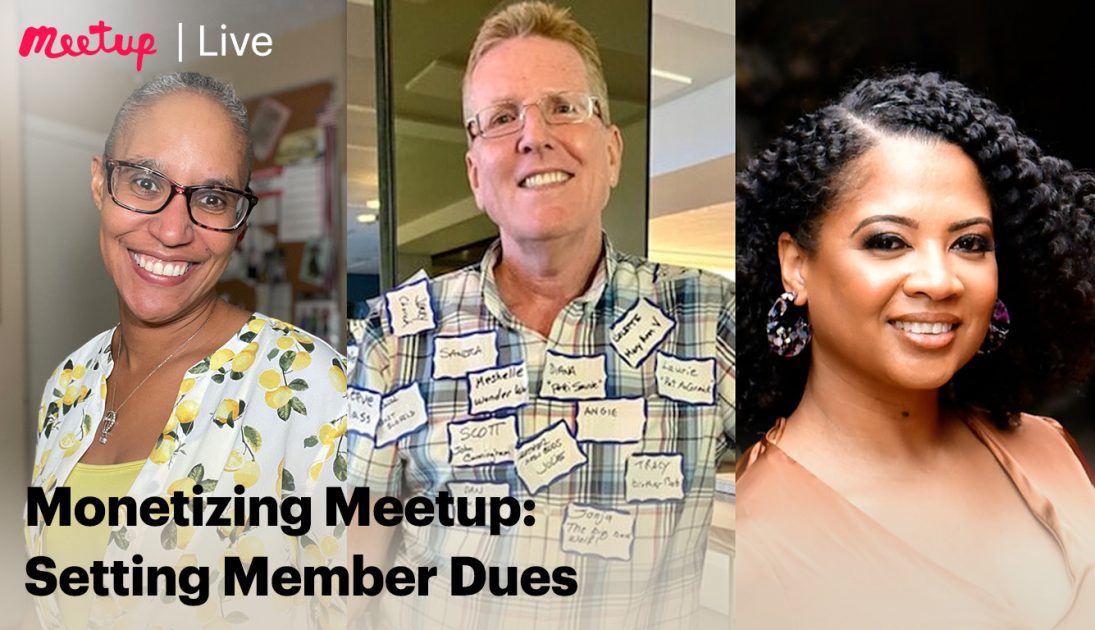



Meetup organizers, we hear you and we’re here to help. We know that subscriptions and event-related costs have an impact on your ability to organize a group. That’s why we’ve rolled out platform tools to help offset your investment in community. In this installment of Meetup Live’s Monetizing Meetup series, we’re discussing member dues.
Watch this recording of Meetup organizers Tonia Tyler, Scott Gore, and Brenda Bea for a discussion on how they have been using member dues to offset costs. They’ll talk about their reasons for setting member dues and share best practices for getting started. Learn about different pricing structures and how to use member dues to increase member engagement.
Main Takeaways:
How to collect member dues:
- Brenda: We collect dues directly through Meetup and we do not accept cash payments. On Meetup, there’s a function to manage money where you can set up your membership dues, you can do it either monthly or annually. The minimum amount you can charge is $1.50 and I don’t believe there is a maximum amount so it’s a wide range. Once you put in the amount that you want to charge, Meetup will tell you how much you’ll receive after the processing fee. You can also set a free trial period before a new member has to pay the dues. The minimum is 14 days, and it goes up to 180 days. Once the trial period starts, they have full access to your group during that period but once it ends they need to pay in order to continue. They can’t leave the group and then come back and start a trial over again. Meetup uses Stripe to collect the dues so I don’t have access to anybody’s credit card information. Collecting the dues directly through Meetup is a really smooth process.
- Tonia: To add to what Brenda said about the trial period, the members who didn’t pay after the trial is over aren’t gone, they’re in a waiting area until they pay their dues. You can still reach out to them and encourage them to pay.
How much to charge:
- Tonia: I sat down and actually ran my numbers, I considered how much it costs me to run the events. My costs came out to roughly $35/month and then I divided that up per group, which gave me the number I should charge my members per year. I knew if I asked $5, that would not cover everything especially if I lose members. If I have no problem paying $35 a month for my fees as the organizer then my members should be willing to pay $35 a year.
- Brenda: We started by charging $5 a year but when I became a partner in 2019. I realized that $5 was not enough to cover our expenses. We decided on increasing it to $12 a year because it was an easy sell to our members: only $1 per month.
How charging has helped organizers and their groups:
- Scott: We have a very engaged group, during some events we’ve had 55 people going and 25 on the waitlist, which is about 80 out of our 200 members. People tell me all the time that our group is the best group they’re a member of. I think having that membership fee gives them a sense of ownership in the group. They’re paying to be a part of it and they want to be there.
- Brenda: Once you start charging dues, you will see your number of members decrease drastically. Our total group size is smaller than the other groups that don’t charge, but I’m okay with that because it cuts down the no-shows. People tend to be quick to RSVP and not show up since there’s no accountability. So we do believe that charging dues helps with this and helps with member engagement.
Top Q&A Questions and Resources:
- Is it best to charge monthly or annual dues?
- Tonia: I’m hearing a lot that people prefer to pay annually so that it’s all taken care of at once. I give them a monthly breakdown of the price per month so they can pay monthly if they want but if they want the discounted rate they pay for the whole year. We leverage the cost a little bit to incentivize members to pay for the whole year.
- How do you prevent non-paying members from coming to events since they are usually held at public venues?
- Scott: Our events occur at public venues all the time, so people are always observing us. The paid members of the group have name tags, so you aren’t a member of the group unless you have a name tag. When doing events in the public, people are going to ask many questions and we’ve had a lot of people end up joining the group this way. They observe us, they become interested, and then they start paying to be a member.
Resources:
- Tonia Tyler
- Confident Strides Meetup groups
- Check out Link-tree for information on podcast streaming platforms and more
- Brenda Bea
- Introverted Girlfriends’ Meetup groups
- Introverted Girlfriends’ Website
- Facebook Group
- Scott Gore
- The Wineopotamus Bloat Meetup group
- Phoenix Screenwriters Association Inc. Meetup group
- Website

Last modified on January 31, 2023