


There’s no question that the pandemic has presented new and difficult challenges for parents and families. The impacts of these changes on parents and children will be the subject of studies for years to come. In this Meetup Live event, you’ll learn about the coping strategies you need to get yourself and your family through this pandemic.
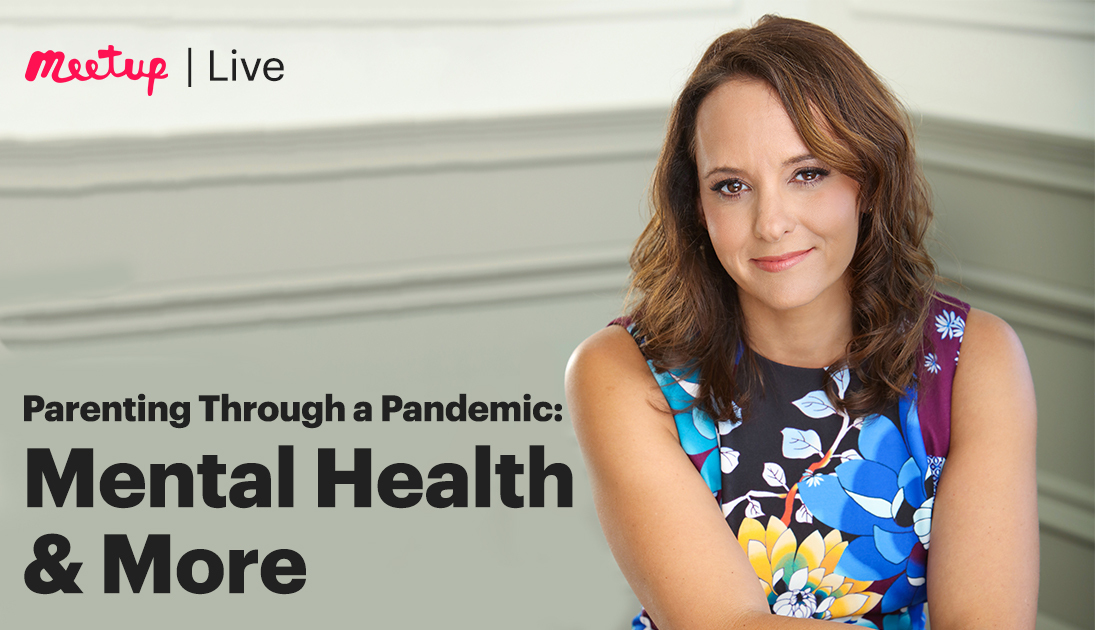
Check out this discussion with Dr. G (Deborah Gilboa, MD), board-certified family physician and parenting expert for The Doctors TV show and The TODAY Show. Dr. G will share strategies for parents to protect their kids and take care of themselves. Learn what mental health behaviors to look for, when you should take action, and how to make time for yourself while keeping up life’s responsibilities.
Main Takeaways:
- There’s a lot of pressure on parents to look at our kids and if they are happy, that means we’re doing a good job and if they’re not, we’re doing a bad job. And I say to that – nonsense. That’s ridiculous. If I’m doing my job as a parent, then often I’m causing my child’s unhappiness because I’m putting limits on their behaviors and limits on what they can have and what they can do.
- Respectful communication from adults:
- Empathy: Empathy is saying, “I see that you’re feeling a hard feeling and it’s hard for you and I care. Because I care about you.”
- Honesty (but not transparency): Don’t lie to your child but not everything is their business.
If you’re upset about something and your child says, “what’s wrong?” don’t say “nothing, I’m not upset.” They can see that you’re upset and it can be really confusing to watch an adult lie. You don’t have to tell them what you’re upset about. You can say “I was having a hard time, thank you for asking.” - Make clear boundaries
- Model healthy behavior
- Respectful communication from kids/teens:
- Modeling for our kids and teaching them polite words, kind language and tone, and good timing will help them get an adult to listen to them.
- Personal accountability
- Household tasks (chores), Video of Dr. G’s child: 8 year old Teaches College Students How to Do Laundry
- Praise effort, not results
- Boundaries
- Empathy for frustration/ but limiting blame
- Responsible tech use
- I want you to think about your kids technology use, the same way you think about nutrition:
- Content
- Quantity
- Behavior – does it negatively impact their behavior?
- Personal accountability
- I want you to think about your kids technology use, the same way you think about nutrition:
- Resilience:
- I cannot overstate the value of treating and caring for your own mental health even if you’re somebody with no diagnosed mental illness. Dealing with your own mental health will make your kids safer, more comfortable, less at-risk.
- When your child comes to you with a problem:
- Ask yourself: Is my child in danger?
- If yes, fix it! If no…
- Ask your child: Are you looking for…
- Empathy?
- Advice?
- Intervention?
- Ask yourself: Is my child in danger?
- If you feel like they always want you to fix it for them, you may have to ease them towards saying “okay, you know what, I hear that you want me to fix it for you but I want you to learn how to fix it when this happens when I’m not around. So instead, I’m going to give you a suggestion of something you can try and we’ll see if this works and if not, you can come back and tell me.”
- As hard as it is to watch our kids go through this (the pandemic), there will be other times in their lives when they go through major upheaval and disruption. Teach them strategies to manage upheaval and disruption so the next time it happens, they’ll handle it better than if they hadn’t been through this with us. So it’s hard and many people have experienced great loss, but there is a silver lining.
Top Q&A Questions/Resources:
- What are some suggestions for split families where both parents have approximately 50/50 custody?
- There’s a lot of research that shows that kids understand that different homes have different rules.
Our kids can absolutely adapt to different schedules, structures, and routines in different settings. (It’s a little harder for the preschool set, no question.)
- There’s a lot of research that shows that kids understand that different homes have different rules.
- I don’t seem to be getting to my nearly adult kids to adopt a wholesome lifestyle of mindfulness. What can I do?
- If you have young adult kids that are outside your purview. The relationship just changes.
You have to be invited to give advice to your adult kids. If they live with you and there are certain behaviors you need from them, then you can require that as the cost of living with you.
- If you have young adult kids that are outside your purview. The relationship just changes.
- What if kids don’t share?
- Sharing is really hard. At any age.
Teaching people to share is a long process. Kids have to see the advantage.
The best way to teach people to share is to catch them doing it, even a little bit.
- Sharing is really hard. At any age.
- What are some ways we can teach teens the value of unplugging from devices?
- I would sit down with teens and ask to tell you, “what’s excellent about being online”. Then ask, “Is there anything you don’t like about it?” As you open up their mind to “pros and cons” thinking, they see that you believe that the issue has positive and negative aspects, then you can have a much more open conversation about what boundaries can be put.
- If you’re interested in Dr. G’s courses, use the code HALFOFF for 50% off (until April 14, 2021):
- Sign up for Dr G’s newsletter here
- Check out part I of Dr. G’s Meetup live: Resilience Skills You Need Right Now

Last modified on June 23, 2021